

Can Beauty Save the World?
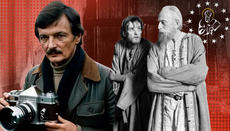
As the world is torn apart by war, Tarkovsky’s film Andrei Rublev foretells the triumph of divine Beauty over suffering, hatred, anger, and despair.
Looking at any headline in the news today, it’s easy to give into feelings of despair. During Great Lent, these burdens can feel all the heavier. In this ascetical period of the Church calendar we’re called to fasting, prayer, and repentance, but with the bombs going off in Tel Aviv, Tehran, and across Ukraine, the groans of the world bring many of us de profundis—to the depths—where God is calling us. Amid this confusion, we look to the cycle of the Church, to the gospel, and of course to the lives of the saints.
This time last year, towards the end of Great Lent, I watched Soviet-era filmmaker Andrei Tarkovsky’s film Andrei Rublev for the first time. The film is a dramatization of the life and work of the fifteenth century Russian iconographer and saint Andrei Rublev. Tarkovsky’s masterful portrait of beauty and sorrow offers viewers—especially in these troubled times—an invitation to contemplate our own humanity, God’s grace, and the suffering of our fellow men and women.
The film is a sprawling epic in black and white told across eight chapters and an epilogue. Through the drama of the film we’re treated to human stories of love, hatred, forgiveness, cruelty, and kindness from characters across the spectrum: from monks and boyars to holy fools and jesters. There is one sequence in particular towards which I would like to direct my fellow Orthodox Christians.
The film is a (largely imaginative) reconstruction of the life of St. Andrei Rublev over several decades. At one point it shows a young Andrei in dialogue with an older monk, Theophanes the Greek. Theophanes, as his name suggests, is an iconographer from the declining years of Byzantium, come north to ply his trade. He functions as a cynical voice of old age and pessimism.
As an older man of the world, Theophanes has clearly seen much of the worst that it has to offer. He’s seen war, destruction, famine, and plague. It’s made him cynical about his trade as well as the fleeting nature of fame, echoing the book of Ecclesiastes he cries out that all is “vanities,” and that if Christ were to return today “they [the people] would kill him again.”
Today, with shrapnel raining on the Church of the Holy Sepulchre, and thousands displaced in the Holy Land, it’s hard not to feel the same way.
And yet—Andrei objects to his master, with the cockeyed optimism of youth, that love will overcome these hatreds. That people must be reminded of their humanity and Christ’s endless love for them, and that this will bring them back. This is the young Andrei’s goal, with his art. This battle in the human heart represented by the two iconographers echoes the words of Solzhenitsyn that the battle between good and evil exists not only in the world but in the heart of every human being.
However, Tarkovsky doesn’t leave us with this back and forth as the final answer to the conflict between these two men, one young and one old.
After Theophanes’ death, Andrei continues his work as an iconographer. He’s asked to paint a Church in Vladimir. There he is confronted by his own inability to paint the Last Judgment. This image of pain, fire, and torment is not part of his own vision of what his art should do—inspire men and women to love, not fear. He agonizes for a long time, refusing to begin work on the icon, because, as he says in the film, “I can't paint all that; it disgusts me. I don’t want to terrify people.”
I think many of us as Christians have struggled with this. We shy away from the ugliness of the world. Especially in the relative comfort of the West, it’s simple for us to close our eyes and forget the hunger, death, and privation going on all around us.
These last few weeks of world events have felt to me like a visceral reminder of the world’s ugliness.
In the film, that moment comes for Andrei in one of the film’s most memorable scenes. Vladimir, where he has been working, comes under attack by a roving Tartar war band—an attack partially instigated by the treachery of a rival brother of the Russian prince. The operatic violence of the scenes that follow are a shock to the system. Men, women, children and animals are engulfed in an inferno of cruelty.
Despite his aesthetic objections, the Last Judgment has come for Andrei.
Amid the burning ruins of the temple Andrei was working on, he has another confrontation with Theophanes. But this time, the person of Theophanes appears to Andrei from beyond the grave, and they relitigate their earlier conversation. This time, however—amid all the wreckage—it is Theophanes who comforts Andrei. In this moment of confusion and despair Andrei admits to the ghost that it was he, Theophanes, who was right about man and the world, and Andrei who was wrong. Looking at him quizzically, Theophanes responds: “I was wrong then, and you are wrong now.”
In this moment, I think a lot of us feel how Andrei felt amid those ruins. Lost, dejected, and at times bereft of faith. It can be difficult to find forgiveness in the face of worldly events—in the face of death and violence and war. Theophanes tells Andrei that God will forgive us, but we mustn’t forgive ourselves. Instead, in his words, we have to learn how to live in between that forgiveness and our torment.
Andrei’s faith isn’t fully restored. He takes a vow of silence that lasts over a decade, and he returns to his monastery. It is only through encountering a young bell maker, whose faith in his craft and God inspires Andrei, that he takes up his path of iconography again.
The end of the film is a truly paschal vision. It is a close up of St. Andrei Rublev’s iconography over slow motion over the course of many minutes. Abruptly the viewer is transitioned from the three hours of black and white cinematography to the intricate colors and geometrical patterns of St. Andrei Rublev’s icons, among which is perhaps his most famous: the Hospitality of Abraham, also known as the Holy Trinity.
This paschal moment in the film should function as a reminder—a reminder that in these dark days, life is not merely a vale of tears and a gnashing of teeth and spleen, but that, through the cracks in this darkness, Christ’s uncreated light still shines through and has from ages to ages.
Perhaps through our own journey of life and Lent, we come through and, like Andrei, boldly say to Christ, “I was wrong then, and You are right now.”
Alex Habighorst is an Orthodox Christian writer from New Orleans. He holds a Master’s Degree in the Great Books and never tires of reading them. He and his family reside in the American South. He writes at Quixote Shrugged on Substack.