



Hieromartyr Gregory V of Constantinople and the Paschal Mystery
In the Orthodox Church, death and resurrection have always been understood as two parts of the same divine mystery. For one saint, martyrdom came on the Feast of Great and Holy Pascha itself.
Tonight, we come to the point of Holy Week where we will see our Lord Jesus Christ on the cross.
Our bodies will ache while standing through the twelve Gospel readings. We will hold our own vigil at the instrument of torture which became the instrument of our salvation 2,000 years ago. We will come forward to venerate His feet. “Most assuredly, I say to you that you will weep and lament, but the world will rejoice; and you will be sorrowful, but your sorrow will be turned into joy” (John 16:20).
We begin anticipating this joy in a more apparent way in the services that follow, but even tonight, we hear the antiphon after the fifth Gospel reading conclude with, “We worship Your passion, O Christ. Show us also Your glorious Resurrection.”
And in many parishes this evening, the Synaxarion will read:
“On this day we commemorate our father among the saints Gregory V, the new hieromartyr, Archbishop of Constantinople and Ecumenical Patriarch, who witnessed by hanging in that city in the year 1821.”
While the commemoration of St. Gregory falls on Holy Friday this year, the day of his martyrdom was April 10, 1821 – the date of Pascha.
And as Greeks recently celebrated their Independence Day on March 25 – also the Feast of the Annunciation – it should be noted that the martyrdom of Gregory V came within weeks of the beginning of the revolution in 1821.
The Patriarch had suffered much before this, as well. An ascetic who dedicated himself to the prayer of the heart, he was slandered and exiled to Mount Athos from 1798-1806. The second time he ascended the Patriarchal throne, he began building churches and schools but was soon wrapped up in geopolitical turmoil once more. He was forced by the Sultan to issue an encyclical against the Russians – who were active in the Balkans, prompting a declaration of war from Turkey – to discourage the Greeks from cooperating with them. He was also forced to quell a Greek revolution three different times. Despite his best efforts to keep the peace, he was once again exiled to Mount Athos.
The third and final time he ascended the throne, a familiar pattern took place. He tried to do good by establishing a fund for the poor and a printing press that published spiritual books. But with failed insurrection attempts stacking up and an eventual Greek Revolution on the horizon, Gregory V had a premonition.
Some sources share that, after hearing suggestions that he flee from Constantinople, Patriarch Gregory was adamant that his death “will be of more use than my life, because through it the Greeks will fight with the energy of despair, which often produces victory.”
As the Orthodox Church in America (OCA) page for the saint states:
During that Lent, jailings and executions were common. One of the Patriarch's friends advised him to flee from Constantinople to the Morea. Saint Gregory replied: "I have a premonition that the fish of the Bosphorus will eat my body, but I will die calmly, for the sake of saving my nation."
And so, he did.
On April 10 – the Great and Holy Feast of Pascha – the Liturgy was celebrated by the Patriarch while fighting tears. Making peace with his coming death after hearing the news of the revolution, he exclaimed: “May the Lord’s will, now as always, be done!”
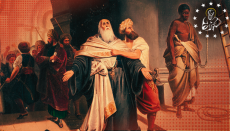
Soon, the Ottoman authorities came and took him to prison by order of Sultan Mahmud II. He was interrogated and tortured, only breaking his silence when asked to renounce his faith.
“The Patriarch of the Christians must die a Christian,” Gregory V said.
He was then hanged from the gate to the Patriarchal Church – a gate that remains closed to this day. Much like our Lord did on the cross while addressing the Father, Patriarch Gregory addressed Christ, asking Him to receive his spirit before breathing his last.
The saint’s dead body – still dressed in liturgical vestments – was stoned and left hanging for three days before a group of Jews bought his corpse for a sum, dragged it through the streets, and eventually dumped it into the sea – just as Gregory V had prophesied. The Patriarch’s body was later recovered and enshrined in Athens, and he was canonized as a saint of the Church in 1921.
Therein lies the Paschal Mystery. How can it be that a bishop is martyred on the day in which we celebrate our Lord’s Resurrection? Why do we say “Christ is Risen” while suffering persecution?
“Because the foolishness of God is wiser than men, and the weakness of God is stronger than men,” St. Paul writes in 1 Corinthians 1:25. Separately in 2 Timothy 2:11-13, he writes:
This is a faithful saying:
For if we died with Him,
We shall also live with Him.If we endure,
We shall also reign with Him.
If we deny Him,
He also will deny us.
If we are faithless,
He remains faithful;
He cannot deny Himself.
There is no resurrection without the crucifixion. The hymnography of Holy Monday gives us one more beautiful reminder of this:
As the Lord was going to His voluntary Passion, He said to the Apostles on the way, “Behold, we go up to Jerusalem, and the Son of Man shall be delivered up, as it is written of Him.” Come, therefore, let us also go with Him, Purified in mind. Let us be crucified with Him and die through Him To the pleasures of this life. Then we shall live with Him and hear Him say: “I go no more to the earthly Jerusalem to suffer, but to My Father and your Father, to My God and your God, I shall raise You up into the Jerusalem on high in the Kingdom of Heaven.”
This Paschal Mystery is both cosmic and historical – it happened once and for all, but it takes place again and again. A mob will arrest Christ, and He will be delivered up to the earthly authorities who wish to torture Him and end his life. Many of the saints of our Church have suffered this same fate. Gregory V is one of them, and just as Isaiah said of our Lord:
He was oppressed and He was afflicted,
Yet He opened not His mouth;
He was led as a lamb to the slaughter,
And as a sheep before its shearers is silent,
So He opened not His mouth.
We are here. We have arrived at the foot of the Cross – that great mystery through which joy came into the world. Let us be crucified with Christ, as Hieromartyr Gregory V of Constantinople was. Let us die to the pleasures of this life, so that we may live with Christ forever.
“I will conclude my word with a sincere wish for you,” St. Theophan the Recluse writes in one of his Lenten homilies. “May the Lord bless you not only to march with Him but also to be crucified with Him, for there is no other way to salvation. Amen.”