



A Good Soldier of Christ
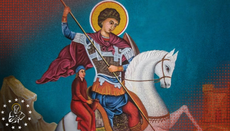
St. George’s greatest victories were won in the realm of “unseen warfare.”
Today, the Orthodox Church commemorates the St. George the Great Martyr.
St. George stands as one of the most beloved saints in the Orthodox Church. Born in the late third century in Cappadocia to a pious Christian family, his father was martyred when he was still a child. His mother raised him on her family’s lands in Palestine, instilling George with his father’s zeal.
As a young man George entered the Roman army, where his bravery, strength, and leadership earned him rapid promotion to the rank of tribune in the imperial guard under Emperor Diocletian. Handsome and valiant, he seemed destined for worldly glory. Yet when Diocletian unleashed his fierce persecution against Christians in A.D. 303, George chose the path of confession. He publicly denounced the idols, distributed his wealth to the poor, and voluntarily presented himself before the ungodly assembly.
Enduring horrific tortures—including the wheel of blades, imprisonment, and poison—his faith remained unshaken. On April 23 of that same year, he received the crown of martyrdom by beheading in Nicomedia. His steadfast witness converted others, including the empress Alexandra.
St. George is venerated across the Orthodox world as a wonderworker, healer, and defender of the faith. He is the patron of Georgia (his namesake), protector of countless churches and monasteries, and intercessor for farmers, the sick, and those in captivity. Orthodox Christians especially invoke him as a champion against visible and invisible enemies.
Of course, his patronage extends far beyond the East: he is the patron saint of England, whose flag bears the red cross of St. George. Crusaders carried his devotion westward, and he became a symbol of chivalry and knighthood. He is also patron of soldiers, archers, and horsemen, as well as many cities and nations, including Moscow. In icons and hymns, he is called the “Great Martyr,” “Trophy-Bearer,” and “Victory-Bearer,” titles that point not merely to earthly conquest but to spiritual triumph.
The beloved legend of St. George slaying the dragon captures the imagination of believers everywhere. According to the story, a fearsome dragon terrorized a city, demanding human sacrifices—including the king’s daughter. George confronted the beast, wounded it, and led it captive into the city. He promised to slay it completely if the people would turn from idols and embrace Christ. The miracle led to mass conversions and the dragon’s defeat.
In Orthodox understanding, this iconographic image is deeply symbolic. That is not to say the battle didn't happen—only that it has layers of meaning, each more powerful than the last. The dragon represents Satan, paganism, or the chaotic forces of evil that oppress humanity. George’s victory recapitulates Christ’s triumph over death and the devil. Most of all, however, “the dragon” is our own sins and passions.
This, in fact, is why St. George is the patron of soldiers. It has to do mainly with his great heroism in the realm of unseen warfare. His martial valor shone brightest not on the battlefield of empires, but in the arena of ascetic struggle and martyrdom. As we sing in his Akathist:
Rejoice, for by thy voluntary suffering for Christ and the Church thou didst crucify the old Adam in thyself!
Rejoice, for through thy courageous suffering thou didst receive a crown of righteousness from the Lord!
Rejoice, rule of pious zeal!
Rejoice, model of spiritual poverty!
Rejoice, for thou didst well please not thyself, but Christ alone!
Rejoice, for thou wast prepared for any form of death for the sake of Christ!
Rejoice, Saint George, great trophy-bearer!
George is called a “good soldier of Christ” because he warred first and foremost against the passions. He slew the dragon in the desert of renunciation. His true martial virtues appeared in fasting, unceasing prayer, and radical almsgiving. As the akathist goes on to say:
Beholding the wicked persecuting the Christians, he did not fear their wiles and tortures, O divinely wise one, but as a good soldier of Christ, he distributed all his possessions to the poor, and voluntarily ran to that ungodly assembly, singing unto Christ, his Commander and God: Alleluia!
These virtues—self-denial, detachment from riches, courageous confession, and total obedience to Christ our Commander—are what we are all called to emulate, whether we wear the uniform of a earthly army or fight the unseen battle of the Christian life. In an age of comfort, distraction, and compromise, St. George summons us to spiritual poverty and zealous faith. He teaches that the greatest victories are won not with swords of steel, but with the sword of the Spirit, through repentance, prayer, and willingness to suffer for the truth.
On this holy feast, let us beseech the Great Martyr George to intercede for us before the throne of Christ. May he strengthen soldiers who defend justice, protect the Church in times of trial, and arm every Orthodox Christian with the courage to slay the dragons within.
Through the prayers of the Holy Great Martyr George, O Christ our God, have mercy on us. Amen.