Man and Church
St. Euphrosynos: Possession vs. Ownership
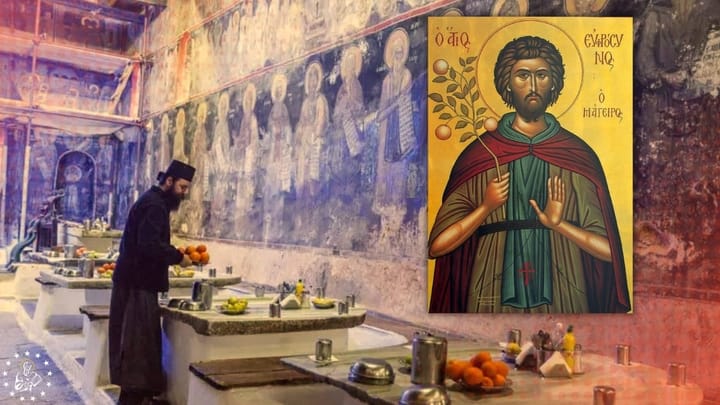
St. Euphrosynos shows that true stewardship means receiving creation as gift, faithfully tending it, and discovering that earthly pleasures point toward their divine source.
“We must work through givens, upon givens, within givens."
— Marion Montgomery
"I’m a sinner. I’m selfish. I’m broken. And only thanks to Jesus’s perfect sacrifice, coming and living a perfect life, that I get something I do not earn but has been given to me, this free gift of eternal life.”
— Charlie Kirk, assassinated on September 10, 2025
September 11 is the feast day of our holy father Euphrosynos the Cook of Alexandria, a saint whose life presents a striking paradox: the man who possessed almost nothing in this world became, by God's grace, one of the inheritors of infinite bounty and an inhabitant, even in this life, of Paradise.
St. Euphrosynos was born into a peasant family and received little formal education, but he was devout and faithful. As a young man he became a cook, a profession that gave him access to the finest foods he prepared for others. Yet Euphrosynos deliberately lived simply. Although he could have eaten the best meats and fish, he contented himself with greens and olives, saving what he could in order to give alms. Eventually he entered a monastery, where his obedience was again to work as a cook.
There he prepared plain food for the brethren. Some monks complained about his cooking and mocked him because of his rustic background, but Euphrosynos bore their contempt quietly. “Good cooking is not useful for attaining the Kingdom of Heaven,” he told them. “The more the body craves pleasure, the more the soul will lose that which it truly needs.” His virtue was largely hidden from the eyes of men, but God would soon reveal what kind of treasure had been entrusted to this apparently insignificant cook.