Man and Church
The Wisdom of Foolishness
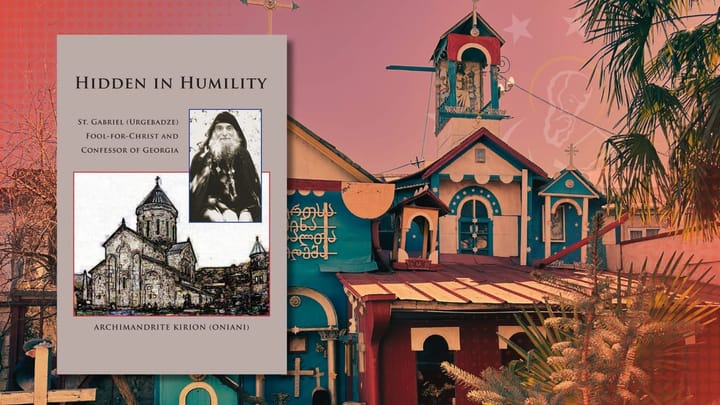
A review of "Hidden in Humility: St. Gabriel (Urgebadze), Fool-for-Christ and Confessor of Georgia" from Pokrov Publications.
Editor's note: The photo used alongside the book cover for this review's graphic was graciously provided by Trisagion Films. To watch their short documentary on St. Gabriel's hermitage, visit here.
It is a lamentable fact that, while an extensive body of literature has been published on the life of St. Gabriel in Georgia and Russia, only a few substantial books have been published for English speakers. The recent release of "Hidden in Humility" from Pokrov Publications — translated by Jesse Michael Dominick — is a welcome and heroic attempt to correct that imbalance. And despite its shortness, it does so impressively. Written mostly in a chronologically linear, anecdotal fashion, the book gives us not merely an impressive quantity of the events of St. Gabriel's life, but abundantly describes the quality of his life.
In anecdote after anecdote, we are shown how St. Gabriel first acquired and then maintained a growing universe of holiness, nearly always through crushing and heartbreaking adversity. The same man who could publicly defy the state in one moment is seen enduring the personal confusion and heartbreak of his loving mother the next. He lived in very large and very small worlds.
Little of the book is given to interpretation or explanation: the facts of St. Gabriel’s astonishing life — the relentless pouring forth of one holy action after another — are presented as frankly and unadorned as an open and outstretched palm. The narratives flow over the reader like a waterfall, until one is submerged in the realization that, for all the stories about him, St. Gabriel must have been something infinitely more than what any number of stories can portray. One finishes the book both abundantly satisfied and deeply hungering to learn more.
At only 214 pages, the book is divided into seven parts: Foreward; Part One: Adolescence, Monasticism, Confession (which makes up 75% of the book); Part Two: Stories; Part Three: Healings; Part Four: Sayings and Recollections; a very short Epilogue; and a Glossary, which seems to have been done very helpfully for the many recent converts to Orthodoxy who may not be familiar yet with basic Orthodox terminology. The book is dedicated to the memory of Patr. Ilia II of Georgia, of recent beloved memory, whom one is delighted to discover played a large role in St. Gabriel’s spiritual life.
The book is also replete with many photos of St. Gabriel refreshingly interspersed throughout the text instead of compiled into one area. Many of these photos show his closeness to others who still have considerable impact on Orthodoxy and on the secular world today. There is one beautiful photo of St. Gabriel with Patr. Ilia: St. Gabriel looks off camera with evident joy and happiness on his face, and Patr. Ilia looks serene and unguarded, as only one who has a clear conscience can look.
Someone once said of the poet Yeats, “Mad Ireland hurt you into poetry.” Something similar can be said of St. Gabriel. The foolishness and madness of this world — its communism, modernism, godlessness, and cult of personality — seems to have hurt St. Gabriel into further and further holiness. The analogy breaks down very quickly, though: whereas Yeats was reacting against some of the evils of this world when he turned to poetry, St. Gabriel started off his extraordinary life rather acting for Christ, even before he truly knew who Christ was or what Christ was trying to save him from. St. Gabriel did not find Christ after turning away from “mad Georgia” and the communism that had infected its every farm and urban alleyway with fear. St. Gabriel sought after Christ even before he knew there was any fear to turn from.
For the first third of the book, very little argument or explanation is given for St. Gabriel’s gifts or behaviors as a saint. From his earliest childhood on, it is clear that, for reasons and in ways to which we are not privy, St. Gabriel was in love with God before he knew who He was. These initial facts of St. Gabriel’s life are axiomatic and defy any cause-and-effect explanation.
That narrative changes abruptly on page 57 when St. Gabriel begins to manifest his talent as a Fool-for-Christ. Then the book not only provides a kind of justification for St. Gabriel’s behaviors, but does so in a lovingly concerned way, lest the reader misunderstand St. Gabriel’s Foolishness and the seemingly impossible feats of asceticism and Godliness required even to contemplate the labor of such a life. This explanation and description of who and what the Fool for Christ is, is worth the price of the book alone. The author is clear that Foolishness is not merely the inevitable result of the accumulation of huge spiritual feats: “It is not a question of our achievements” (pg. 64). The author goes on to say that we can understand this Foolishness in itself only if God, who created this form of asceticism, grants us understanding of it. But we may come to know it in some of its innumerable effects, both on the audience and on the Fool himself. This much is clear: the Fool-for-Christ is not merely a trickery or sleight of hand. He is not merely a façade hiding holiness. The Fool-for-Christ gives up a great deal for his holiness. And St. Gabriel’s Foolishness was convincing: even some of those who knew him would visit him and, seeing him in one of his modes, would come away thinking, “Maybe he really is stupid and not just pretending” (pg. 89).
Foolishness-for-Christ — presenting oneself as crazy for the sake of Christ — is, according to Church teaching, the most difficult and highest labor of Orthodox asceticism. Foolishness is an asceticism in which the ascetic presents himself as crazy and a sinner before the whole world, outwardly hides his rationality, that Divine gift of the Creator, and, for the sake of Christ and out of love for Him, refuses to live according to the rules of the virtuous life commanded him on earth. The deeds that the fool intentionally commits, and his visible breaking of the rules, discredit him before men and cut him off from the world, Because the foolishness of God is wiser than men; and the weakness of God is stronger than men (1 Cor. 1:25) (pg. 63).
We see in this explanation that there is one thing that the Fool gives up that, for me at any rate, comes as a great surprise. Generally, saints are often described as giving up the evils of this life in order to obtain a better life, a deeper connection with God. But it would appear that much of what the Fool gives up is good. Not merely the good of a comfortable life, but inherent goods. Things that would normally please God. As the book states, the Fool is able to exchange “the rules of the virtuous life commanded him on earth” (pg. 63) for true Communion with God. That is an astonishing trade. If you or I give up any part of “the virtuous life” (assuming we ever had such a life to give up), we give it up for evil and selfish desires. But the Fool-for-Christ gives up the virtuous life for something far more valuable than the virtuous life itself. We non-saints always trade down. The Fool-for-Christ trades up: the difficult to attain (virtuous life) for the nearly unattainable (sainthood).
The book also gets across the incredible paradoxes of St. Gabriel’s life. Whereas St. Gabriel’s faith never once wavered, even as a child who did not fully understand Whom he had fallen in love with, literally everything else in his life was defined by instability, sometimes even interminable chaos. He lived in cemeteries, bell towers, sheds, corn storages, chicken coops, cells, and one would sometimes find him in trees. He lived in country and city. He scoured garbage dumps for abandoned icons and holy objects. He sometimes slept in a grave he had dug for himself. Sometimes he was available to everybody and anybody for any reason. Other times he would deliberately lock himself away in one of his many temporary shelters and receive no visitors for two or three months at a time. And yet order and cleanliness were the rule of his life. He spent much time cleaning the many icons he rescued from abandoned churches and even from trash heaps, and some visitors would notice that even the eating utensils of this poverty-stricken man would be polished clean. It was intolerable to him that any part of Orthodoxy would fall into disuse, and so he would often visit abandoned or dilapidated churches in order to say a prayer service there and, hopefully, reinvigorate that church's life. He lit every garbage pile and every derelict building he prayed in on fire with prayer and holiness, putting everything that he could in order until it was clean and shiny. Let the hoarder know that there is a kind of imbalanced selfishness that is pleasing to God!
The unstable circumstances of St. Gabriel's life thankfully put him into contact with a large variety of Georgians. Of particular value to this book are the number of witnesses who, knowing little or nothing about each other, are brought to bear witness, from several corners of Georgian life, to the universal character of St. Gabriel's holiness. As mentioned above, from 1972 to 1990 St. Gabriel visited as many dilapidated or abandoned churches and monasteries as he could. He and those who traveled with him were in considerable danger given the anti-Orthodox spirit of the time. Besides that, they would sometimes have to wrap themselves in plastic to protect themselves from the rain and cold, as the churches they hoped to revive sometimes offered little protection. But during these travels — as with all the other phases of his life — people encountered St. Gabriel either completely on his own or with only a few in attendance. What comes through so many independent narratives is that, whether he was being a Fool-for-Christ or a completely sober citizen of Georgia, he was the same at all times and to every person: to monastics, laymen, atheists, policemen, politicians, hierarchs, shopkeepers, informants, spies. This book is able to portray what sounds on paper like an inherently insurmountable paradox: here is a man whose life, and even his seemingly divergent personalities, were all built on instability and unpredictability. His only homes were either passing rooms he found as a visitor in innumerable monasteries, or cells built by his own hands (and sometimes dismantled by his enemies). And yet he reveals himself perhaps as the most constant man whom the modern world has ever known. He became all things to all men that he might win some (1 Cor. 9:22).
It is part of the superabundance of Orthodoxy that we find in all the saints' lives such things as miracles and holiness and love. We all desire, each in our limited and sinful way, such things as holiness and love. We would like to perform miracles. We would like to know and be known as we were created to be. This book reminds us of yet another aspect of the spiritual life that perhaps we have forgotten to desire: to be one in whom there is no change, no falling away, no turning from the task. To be consistent. To have integrity. St. Gabriel followed the Lord across the shifting quicksand of this world and even sometimes challenged it to drown him if it could. The demons and the world tried. Not once did they turn him from his path. One thing I think that this book will impress upon the reader is that, whereas St. Gabriel's miracles are stupendous and many, none of them outshone the consistency of the man himself, whose integrity was perhaps the greatest miracle of his life.
This book urges us to consider the different manifestations of this one man — drunkard, fool, carpenter, priest, prisoner, confessor, healer, builder, preacher, clairvoyant, prophet, rebel, janitor. The lightning quick switches between all these different personalities. The itinerant lifestyle that brought him to innumerable dilapidated and abandoned churches solely to plant a single seed in the midst of so much communist rot and the howling winds of atheism. The cold world that did not love him or the things he did. There are almost no moments where at least two or three major aspects of his life were not shifting simultaneously, many times for the worst. The stability of his soul revealed this world as little more than pure fault line; a world of tectonic failures. But for all that change and instability, we find in the end that these were the many, many colors that were necessary to paint so great a man as St. Gabriel. What else could have revealed St. Gabriel’s wisdom other than the astonishing variety of holy Foolishness?
I will share one of the most delightful ironies of the book, which was revealed when he was being tortured regularly. (In retaliation for the famous public burning of Lenin's portrait, the Soviet's broke seventeen of St. Gabriel's bones, including his jaw.) On pg. 52, we are shown the original psychological assessment, written by a Soviet psychiatrist in November 1965, that had designated St. Gabriel a “schizophrenic.” The psychiatrist says:
The inspection established that the patient’s orientation in space and time and his surroundings has been destroyed. . . . He believes in the existence of Heavenly beings, God, angels, etc. In conversations, the major axis of his psychopathy is that everything happens by the will of God, etc. . . . If someone starts talking with him, he will certainly mention God, angels, etc.
What an assessment of clairvoyance and holiness! Truer to say that all orientations of space and time were only too happy to be reoriented in the person of St. Gabriel. His world was not destroyed; it was being remade anew. All was being redirected, realigned, with the true Axis. The tectonic plates found their place. Imagine if you lived your life in such a way that, at your grave, your friends remarked to each other, "Every time I saw him coming, I knew it was all going to be about God."
One miracle in particular will illustrate this mastery of “orientation”: on page 39, a Mrs. Valentina relates to us how she happened upon St. Gabriel diligently working (as was his wont) on his famous “church-cell,” the little church he built with his own hands and lived in from time to time. She came into the church’s yard and witnessed the following: "I entered the yard without warning and was shocked by what I saw: buckets full of cement gliding through the air and emptying themselves into ready-made frames by themselves. Fr. Gabriel was standing below in the yard, mixing cement and filling the bucket.”
Later, St. Gabriel was expecting to receive a special icon specifically for this church built with human and not-human hands. He got everything ready and when the large icon (Christ the Savior) was installed in its rightful place, “the air was saturated with a pleasant fragrance.” One of the witnesses there asked, “It seems there really is a pleasant smell in the air?” St. Gabriel responded, “It does not seem so, it truly is so. This was a sign that the Lord was pleased to come to my church.” Witnesses then say, “He was kneeling, and wept and rejoiced, praising Christ.”
St. Gabriel: we, too, desire to be ones in whom there is no turning, no falling away, "disoriented” by every worldly metric, rescued from the foolish wisdom of this world into the wise foolishness of God, a place for Christ the Savior, the Axis of life, prepared in our hearts. Pray unto God for us!