News
‘I Was in a State of Unspeakable Anxiety’
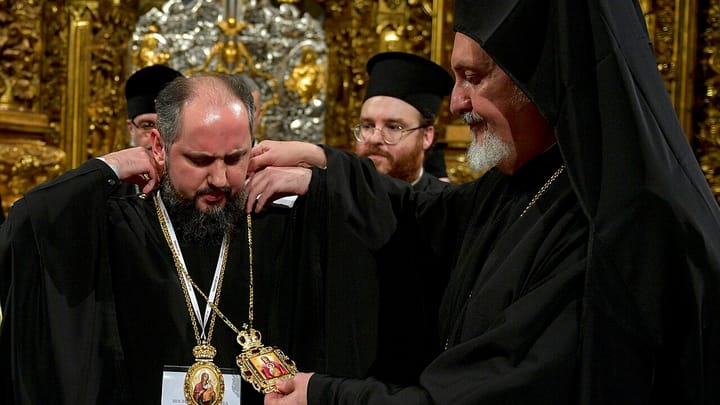
A leaked document addressed to Ecumenical Patriarch Bartholomew reveals the alleged detaining of a Constantinopolitan delegation by former Ukrainian President Petro Poroshenko the day before the unification council which created the OCU.
While in Kyiv for the Unification Council of the Eastern Orthodox Churches of Ukraine, a delegation of the Ecumenical Patriarchate was allegedly subjected to round-the-clock surveillance, day-long negotiations, and impromptu meetings with government and intelligence officials.
According to a document leaked to the Union of Orthodox Journalists of America, the situation reached its climax the day before the December 15, 2018, council, when former Ukrainian President Petro Poroshenko detained members of the delegation and barred them from leaving the country.
The chronicle’s author, Metropolitan Gregorios of Ankara (who was a deacon at the time of these events), says this was due to the insistence of the self-proclaimed Patriarch Filaret Denysenko for certain powers within the new structure which would become the Orthodox Church of Ukraine (OCU). When Metropolitan Emmanuel of France (now of Chalcedon) rejected Filaret’s proposal, the relationship between the EP delegation and those seeking autocephaly became much more strained. Due to this, Poroshenko invited Emmanuel to a consultation at the presidential palace at 11 p.m. on December 13, 2018.
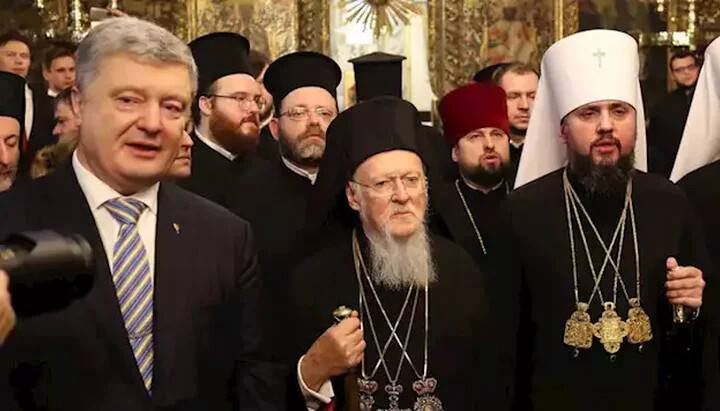
Metropolitan Gregorios writes that he waited in the reception hall of the building “in unspeakable anxiety and amid the cold” along with Metropolitan Amphilochios of Adrianople and Archbishop Daniel of the Ukrainian Orthodox Church of the USA. Metropolitan Emmanuel returned around 2 a.m. the next morning, “downcast and deeply saddened.”
“Unfortunately, we shall fail,” Gregorios records Emmanuel saying. “They even asked me to remove my wristwatch, which I kept only by threatening to leave. Entering the office, I saw, besides the President, His Eminence Filaret and the head of the secret services. During the discussion, the elder Filaret was unyielding and inflexible, refusing any reduction of his demands. He also had the President’s silent support. We arrived nowhere.”
Gregorios notes that Filaret did not leave the Presidential Palace until 3 a.m.
Resolving that any conversation they had to plan a solution “would be frustrated by the constant surveillance of everything in the building,” the delegation chose to continue their dialogue in silence by handwritten messages on paper. The decision was made to call Ecumenical Patriarch Bartholomew in the morning and propose that they depart Ukraine, which they hoped would persuade the Ukrainians of the “firmness on the part of the Mother Church.” Metropolitan Emmanuel even purchased a plane ticket at his own expense.
“In the morning we submitted a draft announcement to Your Most Divine All-Holiness solely because we knew that everything said in telephone conversations was being heard, grieving, of course, that at that hour we had no way to disclose the truth at least to You,” Metropolitan Gregorios writes.
When Rostyslav Pavlenko, a government official and representative of Poroshenko in some of the deliberations around the OCU’s charter, heard of the group’s intentions to depart Kyiv, he notified the president “in terror.”
At noon on December 14, 2018, Metropolitan Emmanuel had packed his luggage and summoned vehicles for the airport. Poroshenko asked him to stop briefly at the Presidential Palace on his way past it. But after about an hour, Metropolitan Gregorios writes that they still had no word from their elder hierarch. Then, news came that the police were coming to take the remaining members of the delegation there, as well.
“After our initial reactions of perplexity, we all put on cassock and kalimavkion and, having resolved that above all we would prefer the all-sacred interests of the Mother Church, we were led there under escort by a strong police force. On the way, His Excellency Archbishop Daniel of Pamphilon, who protested to his compatriots about the forcible conveyance, informed the American Embassy, while His Eminence Metropolitan Amphilochios of Adrianople informed the Greek Ministry of Foreign Affairs. We received reassuring replies from all.”
Upon entering the palace, Gregorios continued, the group sans-Metropolitan Emmanuel was led to an office to wait. They then descended to the operations room, “passing through corridors where pictures of armed soldiers were displayed, which created strange impressions.”
Before entering the room in which Poroshenko and Emmanuel were, the delegation’s mobile telephones were taken and they were subjected to bodily searches. Upon entering, the situation was immediately recognized as grave.
“The expression of His Eminence of France betrayed the tragic nature of the moments. Beside him were the President, Mr. Pavlenko, and an official of the secret services. The President informed us that an attempt was being made to establish telephone contact with Your Venerable Headship, and that the conversation would be heard by everyone so that we might receive Your instructions. In response to a question from His Eminence of Adrianople, His Eminence of France answered that we were being detained and had been forbidden to leave the country.”
Praying to remain firm and immovable in the face of the Ukrainian’s desires, Metropolitan Gregorios writes in the document his understanding of Luke 12:11-12 in those moments:
“And when they bring you unto the synagogues, and unto magistrates, and powers, take ye no thought how or what thing ye shall answer, or what ye shall say: for the Holy Ghost shall teach you in the same hour what ye ought to say.”
“I confess that at that hour I did not have the strength to record on paper what was said, for I was in a state of unspeakable anxiety lest the interests [of the Church] be endangered by false promises of the President and so forth, and unconsciously I repeatedly wrote upon the paper the prayer, ‘O Theotokos and Virgin,’” Gregorios continues.
He does, however, recall the words of Ecumenical Patriarch Bartholomew once connection was established between His All-Holiness and Poroshenko on the phone.
Bartholomew: “Your Excellency, I have learned from His Eminence of France about the difficulties, and I am sorry that the problematic behavior of one person alone proves that you are not ready for autocephaly. I am the Ecumenical Patriarch, and I have no right — before the history of the Patriarchate, before God, and before my predecessors — to make a mockery of the privileges of the Throne and its position in the Orthodox Church. I have a responsibility, Mr. President. I honor you and respect you, but I am not going to sell the dignity of the Patriarchate to any Filaret. And if you are not in a position to impose order upon him, I am sorry, but my people must depart. At the Phanar we learned to fear no one and nothing where its rights from the ages are concerned. Act accordingly.”
Poroshenko: “I am not Filaret, Your All-Holiness; I am Petro Poroshenko.”
Bartholomew: “I am telling you these things so that you will convey them, Mr. President.”
Poroshenko: “Your All-Holiness, the situation in Ukraine is such that, if we do not hold the Council tomorrow, there is a possibility of military intervention by Russia, which will see our weakness.”
Bartholomew: “Then correct the situation immediately.”
Metropolitan Gregorios shares that Poroshenko then read a draft which he himself would give Filaret to sign.
“In it Filaret would address Your Venerable Headship and say, in brief, that he desired no further position in the new Church and resigned from every such position except that of permanent member of the annual Holy Synod, which we had accepted as a necessary solution during the study of the Statutory Charter,” he recounts.
Poroshenko: “If I obtain Filaret’s signature on that document, then do we proceed, Your All-Holiness?”
Bartholomew: “We shall proceed only if my Exarchs assure me that none of the privileges of the Mother Church [are] placed at risk.”
“Indeed, by an exchange of glances it was judged that such a development would be the sufficient and necessary condition for what followed,” Gregorios records. “At the end of the conversation, when His Eminence of France asked on behalf of everyone for the prayers of His All-Holiness for the work, Your Venerable Headship added: ‘Your Eminence of France, I call your attention to your steps. I do not permit you to play with the interests of our Patriarchate. Let us stand aright. You have my blessing.’ It was so powerful a moment that recording it on paper a month later once again brought tears to the eyes. ‘Such a high priest was fitting for us…[a minister] of the true tabernacle, the Great Church, which the Lord pitched, and not man.’”
These events came after Poroshenko had already violated the terms under which the council would be held, as he initially promised the Ecumenical Patriarch that many more hierarchs of the canonical Ukrainian Orthodox Church (UOC) would be present. Instead, only two (who would later be deposed and excommunicated) showed up. Allegedly, Poroshenko had others pressured by the Security Services of Ukraine (SBU) to sign documents promising their participation, which he used to reach a threshold that would convince the Ecumenical Patriarch.
For his part, Bartholomew did not accept the signatures once he learned they had been made under duress, but nevertheless chose to move forward with the council and the OCU’s creation. While Filaret was not elected as primate, his secretary, Epiphany (secular name Serhii Dumenko) was.
In closing of this particular chapter in the 20-page chronicle, Poroshenko bade everyone farewell and hurried to Filaret, so that “by his own authority he may obtain his signature.” Within an hour it was signed, and the EP delegation departed from the Presidential Palace in relief, “but bearing within us the psychological burden of the forcible conveyance and the great and unbearable pressure.”
And the pressure did not end there. When the group arrived at the guesthouse, Metropolitan Emmanuel proposed they go to a restaurant to discuss what comes next.
“The noteworthy fact is that, throughout the ‘meal,’ more than ten secret agents moved around us, making little effort to conceal their secret character,” Metropolitan Gregorios writes. “After an hour we returned.”
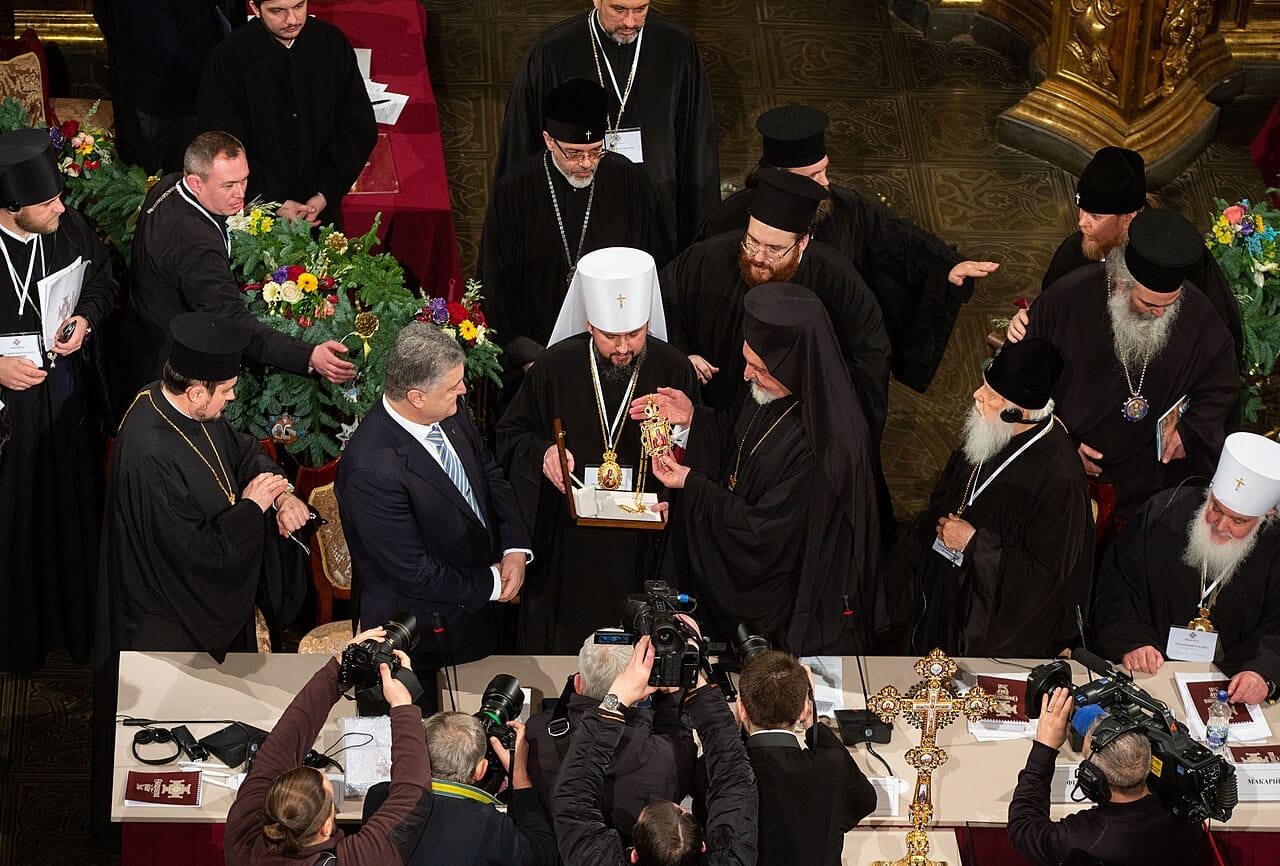
The following day, the relevant parties gathered at St. Sophia Cathedral in Kyiv for the council, whereafter Poroshenko gave a triumphal introduction of the newly elected Metropolitan Epiphany to the masses.
To read the full document and UOJ-America's previous reporting on it, visit here.
Read also