



The Redemption of Frank Atwood

On June 8, 2022, a Great-Schema monk named Ephraim was put to death by the State of Arizona.
In the world, Ephraim was known as Frank Atwood. In 1987, he was convicted of kidnapping and murder of eight-year-old Vicki Lynne Hoskinson in Tucson. He insisted he was innocent until his dying day. To be sure, there were some irregularities about his conviction.
For instance, the evidence used to convict him was entirely circumstantial. There was no physical evidence linking Atwood or his car to the crime. There was, however, considerable reason to believe that law enforcement “contaminated” the evidence (likely on purpose) to secure a conviction. Most importantly, multiple witnesses reported seeing Vicki alive with an unidentified woman at a local shopping mall in the evening of September 17, 1984—hours after the alleged abduction by Atwood.
The exculpatory evidence pointing to a female suspect was withheld from court. Meanwhile, jury reports of coercion and the prejudicial introduction of Atwood’s prior California convictions for unrelated crimes likely tainted the proceedings in a high-profile child murder case. Crucially, despite Atwood’s many appeals, the State of Arizona never allowed this evidence to be presented in open court.
Nevertheless, Frank Atwood was far from innocent. He had been in trouble with the law for most of his life. In the years he spent waiting for his execution, he also began to suffer from severe spinal deterioration that confined him to a wheelchair and caused him constant pain.
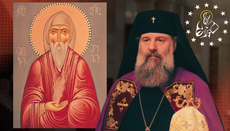
Atwood seemed doomed to live out his final years in misery. Then, by chance, he picked up a copy of Metr. Hierotheos of Nafpaktos’s book Orthodox Psychotherapy, a modern classic on healing the soul through the therapeutic tradition of the Church Fathers. Atwood then began reaching out to modern Orthodox elders, beginning with Metr. Athanasios of Limassol, then abbot of Machairas Monastery in Cyprus. He soon made contact with St. Anthony the Great Monastery in Florence, AZ. In 2000, with the blessing of Elder Ephaim, Atwood was baptized by Elder Paisios. He was given the name Anthony.
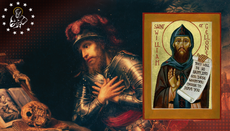
From that point onward, Atwood immersed himself in the life of the Church, right there on death row. He fasted, kept vigils, and studied the Scriptures and Church Fathers. He practiced the Jesus Prayer faithfully, eventually achieving prayer of the heart. Before his spinal condition rendered him wheelchair-bound, he would make 300 prostrations every day to Christ and 200 to the Theotokos. He produced hand-drawn icons and poetry reflecting his growing love for Christ. Elder Paisios, Metr. Hierotheos, and others noted the sincerity of his repentance—not merely for any specific crime, but for the totality of a life lived apart from Go
Atwood’s story echoes the lives of the great repentant saints: the Apostle Paul, once a persecutor; St. Moses the Black, a violent brigand; or St. Dismas, the thief on the cross. His prison cell became a desert where he was able to work out his salvation with fear and trembling. His correspondence reveals a soul grappling earnestly with sin, bravely confronting his mortality, and seeking union with God. His sponsors and monastic community, including monks and nuns who witnessed his transfiguration, affirmed the authenticity of this change and swore to his innocence in the murder of poo Vicki Lynne.
Yet, even amid appeals and public scrutiny, his focus remained on Christ, not self-justification. In a final email to Metr. Hierotheos, he wrote (among other, deeply moving things):
After my deliberation hearing on May 24, the victim’s family passed by my cage and the girl’s uncle smiled and said, “Now you will finally get the needle in your arm.” I bent down and smiled. For 40 years this man despised me, and now he has the opportunity to curse me to my face. How good it must have felt! I was happy! I do not agree with his hatred, but I think I understand it, and I’m sorry that he needs to do this to feel better.
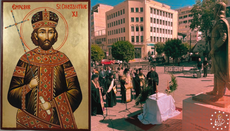
On the eve of his execution, June 7, 2022, Atwood was tonsured a monk, receiving the Great Schema. He was given a new name, Ephraim.
The following morning, June 8, he underwent lethal injection at the Arizona State Prison in Florence. A Greek Orthodox priest accompanied him into the chamber—the first such instance in state history—laying hands upon him in prayer. Witnesses described Atwood as calm and composed. He was so calm, in fact, that he helped the executioner to locate the vein where the fatal cocktail of drugs would be injected. Then he uttered his final words, “May God forgive us all.”