



Who Was St. Shio?
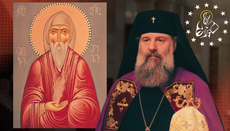
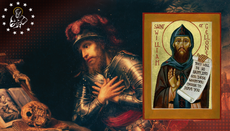
The Orthodox Church commemorates St. Shio the New—along with his companions Davit, Gabriel, and Pavle—today, on June 1.
Last month, Shio III (Mujiri) was elected Patriarch of Georgia. This was probably the first time most Orthodox Christians in the United States heard the name Shio. Yet its significance to the Georgian people is ancient and venerable.
Shio is simply the Georgian version of the Hebrew Shimon, or Simeon.
The first Georgian saint to bear this name is Shio of Mgvime, also known as Simeon of Mgvime or Shio the Anchorite. Born in Byzantine Antioch in the 6th century, he was the sole heir to a wealthy father. As such, he received the best education available at the time. Yet Shio was drawn to the ascetic life, he joined the disciples of St. John of Zedazeni, one of Georgia’s greatest missionaries. Around the mid-6th century, this group traveled to the Kingdom of Iberia (eastern Georgia) at the invitation of Catholicos Eulabius to strengthen the faith introduced earlier by St. Nino.
Shio settled in a cave in a limestone gorge west of Mtskheta, along the Kura River. “Mgvime” means “cave” in Georgian, earning him the title Shio of the Cave. His life exemplified extreme asceticism: solitary prayer, rigorous fasting, and spiritual warfare. Tradition holds that he received miraculous visions and performed great wonders.
His example attracted followers, leading to the establishment of the Shio-Mgvime Monastery complex, one of Georgia's largest and most enduring monastic centers. At its peak, it housed over 2,000 monks in its rock-hewn cells. The monastery remains active today, and is both a center of pilgrimage and a UNESCO World Heritage Site.
St. Shio the New (or Shio of Gareji), a 17th-century monk-martyr, shares the name. He was born in Vedzisi, in the Kartli region, to wealthy parents. When his parents died, his brothers fought over their inheritance; eventually, his oldest brother killed his youngest. Disturbed by worldly vanity, he entered the David-Gareji Monastery in the wilderness east of Tbilisi. There he was tonsured, and distinguished himself for his humility, tireless labor, and love for the brethren. He was also a capable steward of the monastery’s business and finances.
Around 1696–1700, Dagestani raiders attacked the monastery. They captured Shio along with monks Davit, Gabriel, and Pavle, killing them. The raiders desecrated the site, destroying icons and property. The martyrs’ relics were buried near St. David of Gareji's grave.
The Orthodox Church commemorates St. Shio the New—along with his companions Davit, Gabriel, and Pavle—today, on June 1.