



Must Wives Submit to Their Husbands?
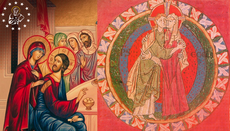
St. Paul’s vision for marriage reveals, not a power struggle, but a mutual call to total self-gift: wives submitting as to the Lord, and husbands dying for their wives as Christ died for the Church.
Ephesians 5 is, without a doubt, one of the most controversial chapters in the Bible. It is also one of the most widely misunderstood.
Most people hear the words, “Wives, submit to your own husbands” (Eph. 5:22)—and then immediately tune out. This is enough for them. The very idea of submission is, for us moderns, not a very comfortable one. It’s illiberal, undemocratic. It may even strike us as un-Christian. Doesn’t Christ Himself say, “No longer do I call you servants… but I have called you friends” (John 15:15)?
And you know what? If that’s all St. Paul had to say about marriage—that wives should submit to their husbands—then we would be in trouble, as we need the admonishment. Lucky for us, that’s only the beginning of the Apostle’s message.
Here are all the relevant passages taken together:
Wives, submit to your own husbands, as to the Lord. For the husband is head of the wife, as also Christ is head of the church; and He is the Savior of the body. Therefore, just as the church is subject to Christ, so let the wives be to their own husbands in everything. Husbands, love your wives, just as Christ also loved the church and gave Himself for her, that He might sanctify and cleanse her with the washing of water by the word, that He might present her to Himself a glorious church, not having spot or wrinkle or any such thing, but that she should be holy and without blemish. (Eph. 5:22-27)
Wives must live for their husbands; husbands must die for their wives. St. Paul isn’t trying to say which spouse should have more power within a Christian marriage. Power is the last thing he’s concerned about. No: he’s saying that husbands and wives must make a complete gift of themselves to each other.
To understand this, we must also have the traditional (Orthodox) understanding of the Church as the Body of Christ—and of Christ laying down His life for the Church. For many Christians today, this simply means “Jesus loves everyone” in some vague way. Of course, Jesus does love everyone! But He does so specifically by kenosis.
As St. Paul says elsewhere, Christ “made Himself of no reputation, taking the form of a bondservant, and coming in the likeness of men” (Phil. 2:7). Christians are called to do the same. We must empty ourselves of vanity and willfulness. We must become a “bondservant” to all of humanity, doing what is best for our neighbor and not thinking of ourselves. And if we owe our neighbor all that we have, how could we withhold any part of ourselves from our own God-given bride? Whose bondservant am I, if not my wife’s?
Our Lord is much more than a pop culture figure who makes us “feel good”: He is the Bridegroom of the Church. His sacrifice on the Cross didn’t only wash us and free us from the debt of sin: it revealed to us the true love one must have for their spouse—and so much more.
Again, it’s not a question of how much “power” the husband has, or how much “freedom” the wife. St. Paul is calling both spouses to live eucharistically, to make a gift of themselves to the other, and to thanksgiving for what has been accomplished. He calls each to be mindful, not of their privilege, but of their responsibility.
Lest there be any doubt, the Church Fathers have never understood St. Paul to be speaking of an inflexible hierarchy within marriage. Indeed, St. John Chrysostom says that, at times, wives must lead their husbands! For “nothing is more powerful than a pious and sensible women to bring a man into proper order, and to mould his soul as she will.”
And here we come to the heart of the matter. The “point” of marriage is not for women to be dominated by men, or for men to provide for women. The point of marriage is for two souls to help each other get to Heaven.
“Marriage is a school for virtue, where patience, forgiveness, and love are learned and practiced daily,” St. Theodore the Studite teaches. “It is a divine workshop where two souls are forged into one, in the image of Christ.” It is this divine image of Christ on the Cross which is at the center of our relationships. This is controversial for those who while seeing do not see, and hearing do not hear, nor do they understand (cf. Matt. 13:13).
And yet, Christ is Risen! This is the eternal truth of the Christian faith. But before the resurrection comes crucifixion. However, we have this expectant faith—the faith that if we die with Him, we shall also live with Him (cf. Rom. 6:8).
Wives, submit to your own husbands, as to the Lord. Husbands, love your wives, just as Christ also loved the church and gave Himself for her. Remember your marriage crowns, which are a foreshadowing of what is to come: “Be faithful until death, and I will give you the crown of life” (Rev. 2:10). There is no other way for those who journey toward the Kingdom through this divine workshop of marriage.