



Must Christians Be Pacifists?
On the one hand, the choice to die rather than kill is noble and Christ-like. On the other hand, the Church has never taught that every use of force is intrinsically evil.
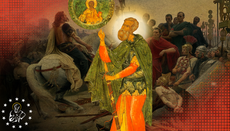
On April 24 the Church honors the memory of the Holy Great Martyr Savva Stratelates (“the General”), a third-century Roman soldier who rose through the ranks of the imperial army while secretly confessing Christ. When his faith was discovered, Savva refused to sacrifice to the gods. He endured unspeakable tortures before finally being drowned in a river. His life offers an especially timely vantage point from which to ask a question that has lately been thrust into the headlines: Must Christians be pacifists?
The question is not merely an academic one. In recent weeks Pope Leo XIV has issued a series of forceful statements to that very effect. On April 10, he declared: “God does not bless any conflict,” adding that “anyone who is a disciple of Christ, the Prince of Peace, is never on the side of those who once wielded the sword and today drop bombs.” In his Palm Sunday homily he went further, insisting that Jesus “rejects war” and “does not listen to the prayers of those who wage war.”
The synaxarion takes a more nuanced view.
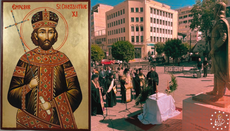
It’s true that some saints embody a radical nonviolence. The Church celebrates this without reservation. The passion-bearers Boris and Gleb, the first canonized saints of Rus’, stand as luminous examples. When their elder brother Sviatopolk seized power and sent assassins against them, the two young princes chose not to raise arms in self-defense. “It is not right for a Christian to repay evil with evil,” Boris told his retainers before laying down his weapons. Their voluntary acceptance of death rather than fratricidal war is honored every July 24 as a triumph of the Gospel over the logic of power. Similarly, the early martyr Boniface—once a servant entangled in worldly passions—repented, embraced martyrdom, and refused any violent resistance when seized by pirates. The Church sings of such men not because they were weak, but because they revealed the power of the Cross.
At the same time, the Church doesn’t treat martial saints as embarrassing anomalies. It praises St. George, St. Demetrios, St. Theodore Stratelates, and St. Savva himself. Yet the praise is rarely for martial prowess. The texts linger instead on their chastity, their mercy toward the poor, their fearless confession before emperors, and their patient endurance of suffering. The sword they once carried is mentioned only in passing; the holiness they attained is what the Church lifts up. Violence, even when historically necessary, is never glorified for its own sake.
Crucially, renunciation of military service is not a recurring theme among these soldiers-turned-saints. St. Savva Stratelates did not resign his commission upon baptism. He remained in the legions until the moment his faith forced a choice between Christ and Caesar. The same pattern appears in the lives of many other military martyrs: they served faithfully until obedience to the state contradicted obedience to God. The Church has never demanded that every Christian in uniform lay down his arms upon conversion.
Nor has the Church hesitated to invoke divine aid for soldiers defending the innocent and the faith itself. When the Russian principalities faced annihilation by the Tatar hordes in 1380, St. Sergius of Radonezh blessed Prince Dmitry Donskoy and his army before the Battle of Kulikovo. The great abbot sent two monks—former soldiers themselves—into the ranks, prayed over the banners, and assured the prince that God would grant victory. The subsequent triumph is still commemorated as a turning point in the liberation of the Russian land. St. Sergius did not preach pacifism; he prayed for justice.
The tradition, therefore, holds two truths in tension. On the one hand, the choice to die rather than kill is noble and Christ-like. On the other hand, the Church has never taught that every use of force is intrinsically evil.
St. Savva Stratelates embodies this balance. He was no pacifist in the modern ideological sense; he was a general who loved Christ more than empire or career. His feast day calls us to reject both naïve bellicosity and sentimental pacifism. Christians are not required to be pacifists, but they are required to be holy. Sometimes holiness means laying down the sword. Sometimes—by God’s mysterious providence—it means taking it up for the protection of the weak and the preservation of justice, always with the prayer that one day swords will be beaten into plowshares and the Prince of Peace will reign without end.
In the end, the question is not whether Christians may ever fight, but whether they will fight as Christians: without hatred, without cruelty, without forgetting that every enemy is also a soul for whom Christ died. On this feast of the holy general, may we have the courage both to embrace the peace of the Gospel and, when conscience and charity demand it, to defend it with clean hands and a pure heart.