



Who Was St. Elpidophorus?
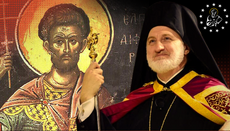
You've probably asked yourself: who was St. Elpidophorus? And why was the Archbishop of America given this striking name?
On April 3, Orthodox churches of the Slavic tradition commemorate St. Elpidophorus of Persia—along with his fellow martyrs Dius, Bithonius, and Galycus.
Most Orthodox Christians in America probably hadn’t heard the name “Elpidophorus” until 2019, when the Holy and Sacred Synod of Constantinople elected His Eminence Elpidophoros (Lambriniadis) to serve as Archbishop of America.
So, who was St. Elpidophorus? And why was the His Eminence given this striking name?
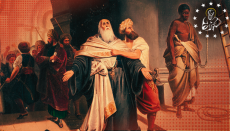
The original Elpidophorus was a 4th-century Christian martyr and high-ranking dignitary at the court of King Shapur II of the Sasanian Empire, who reigned from A.D. 310 to 379. He lived during a period of intense persecution against Christians in Persia, which peaked around A.D. 330.
Along with fellow courtiers Acindynus, Pegasius, Anempodistus, and Aphthonius, Elpidophorus was secretly a Christian. When pagan officials denounced the group for instructing fellow believers to remain steadfast amid the growing crackdown, the five were summoned before Shapur. They fearlessly confessed their faith in the Holy Trinity.
The king ordered them beaten with whips; exhausted executioners were replaced twice, yet the martyrs uttered no cry or groan. Even Shapur briefly lost consciousness from the strain before recovering. The king then accused them of sorcery and had them laid on iron beds over flames. By their prayers, the fire was extinguished and their bonds fell away. Their endurance converted many, including an executioner named Aphthonius and the emperor’s own mother. Elpidophorus openly declared his Christianity and condemned the slaughter of innocents.
Enraged, Shapur decreed that Elpidophorus and the others be beheaded outside the city walls and their bodies left unburied. As the condemned were led forth, a vast crowd of some 7,000 Christians followed, glorifying Christ. On the king’s orders, soldiers attacked the procession and massacred the faithful. Elpidophorus was among those killed. The precise site of their martyrdom is unknown.
The death of St. Elpidophorus, like that of his companions, stands as a testament to the courage of Persian Christians who refused to renounce their faith under imperial pressure.
Abp. Elpidophoros, meanwhile, was born Ioannis Lambriniadis on November 28, 1967. He is a native of Istanbul, Turkey. He completed his early education in Istanbul and Athens before enrolling at the Aristotle University of Thessaloniki, where he graduated with highest honors in 1991 from the School of Pastoral and Social Theology.
In 1993, he earned a Master of Arts in Philosophy from the University of Bonn, Germany, with a dissertation on the brothers Nicholas and John Mesarites. He later studied Arabic at the University of Balamand in Lebanon and received his Doctorate of Theology from Thessaloniki in 2001, focusing on Severus of Antioch’s stance against the Synod of Chalcedon. In 2018, he was awarded the title of Professor of Theology at Thessaloniki.
Ordained to the diaconate in 1994 at the Patriarchal Cathedral, he served as scribe and later Chief Secretary of the Holy and Sacred Synod. Elevated to archimandrite in 2005, he was elected Metropolitan of Bursa in 2011 and appointed Abbot of the Holy Trinity Monastery on Halki. Elpidophoros was elected Archbishop of America on May 11, 2019, and enthroned on June 22, 2019, at the Archdiocesan Cathedral of the Holy Trinity in New York City.
Elpidophoros was given his name by the Ecumenical Patriarch, His All-Holiness Bartholomew. As Theodore Kalmoukos wrote in The National Herald:
The Patriarch had already noticed early on—from the time Ioannis Lambriniadis was a student of Theology—the gifts that God had bestowed upon him and he had foreseen that Elpidophoros could bring hope to the martyred and wounded Mother Church of Constantinople.
The Patriarch’s instinct was correct because whichever position Elpidophoros was assigned, from the Diaconate, Chief Secretariat of the Holy Synod, Head of the Holy Trinity Monastery in Halki, and Metropolitan of Bursa Elpidophoros brought hope and progress.
A 2025 editorial in the Herald noted that the etymology of the name was also important:
The name—Elpidophoros, meaning “bearer of hope”—was chosen not only because the feast day of the Holy Martyr Elpidophoros coincided with the anniversary of his enthronement, but also because the young clergyman exhibited qualities and gifts that would come to serve the Church. “Archbishop Elpidophoros is truly the bearer of hope,” the Patriarch affirmed. “We elected him unanimously, and he has never disappointed us. Indeed, you are fortunate to have such a Chief Shepherd.”
So, there you have it.
We at the Union of Orthodox Journalists would like to wish His Eminence the Archbishop of America a happy and blessed name-day.
Is polla eti, Despota! Many years, Master!