



The Silent Evangelists: Icons as Visual Beacons of Salvation
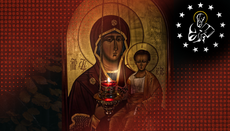
The holy icons reflect not just who we are, but what we are made to become.
In a world increasingly saturated by glowing screens, endless distractions, noetic noise, and fuel for the blazing inferno of the passions within the human person, the Orthodox Church offers the ancient, steadfast, and luminous alternative: the Holy Icons. Understand, these are not merely “religious art” or some form of artifact from a bygone era to be gawked at in a museum. No, the icons are part of the living tradition of the Church, our life in the Holy Spirit, and a tool for the evangelical mission of the Church: to draw all men into the Body of Christ and see them transfigured.
Long has man been lured into the dominion of darkness and urged to wear the egocentric mask which obscures the image and likeness of God they were created to bear and to grow into. Christ came to change this by opening up the possibility to again enter into genuine relationship with God the Father and to become the living icons we were meant to be, reflecting His love to the world around us.
Visual Witness to the Incarnation
The theological bedrock of iconography rests entirely on the Incarnation of the Logos. For centuries before, the invisible God could not be depicted in any fitting way. Then, the immaterial God became flesh, the "uncircumscribed" became circumscribed, taking on skin, bone, and breath. He walked among us as the Light showed forth into the darkness.
Iconography grew to become the visual witness to the fact that God truly became man. Christ truly God and man, dwelt among men. He could be seen, heard, and touched. Thus to remember Him through the iconography is fitting and right. As St. John of Damascus famously wrote:
Of old, God the incorporeal and uncircumscribed was never depicted. But now that God has appeared in the flesh and lived among humans, I make an image of the God who can be seen.
Likewise, he spoke of their evangelical quality: “What the book is to those who can read, the icon is to the illiterate; and what the word is to the ear, the icon is to the sight.”
From St. Theodore the Studite, we read: “The icon is like a mirror, reflecting the divine glory and making it accessible to our human eyes.”
Within iconography, we see not only Christ, but also His Holy Virgin Mother and all the Saints, these ones who followed the Way and became beacons of Divine Life lived out in varied and unique lives. It is of great importance for us to see such things: lives and persons depicted before us, for that on which we set our focus has the power to affect both the way we live and what we become.
Teaching without Words
It has been said that icons are "Holy Scripture for the illiterate," but their pedagogical value is far greater than this. They hold a special role for the teaching of genuine Orthodox theology. Whereas homilies and hymns educate the faithful through the written word with beginnings and ends, icons reach the story of human salvation through images silently but continuously. They reflect not just who we are, but what we are made to become.
Amidst this confused world, we see the fragmentation of the souls of mankind; in the icon, however, we see the restoration and transfiguration of the human person with singularity of purpose: namely, to love God with all our being and our neighbor as our very own self. To those unaccustomed to icons, their elongated features, large, calm eyes, and radiant halos may seem like stylistic oddities, but in truth they are theologically charged visual statements about the deified human state, or theosis. (We will explore the specifics of these features more at length in a future article.)
Icons in the Land of the Free?
We often call the United States a free nation. While this may be true in one way, in a completely different context, we are the land of the captive. Our culture projects "icons" of vanity, consumerism, and ego—imagery curated by the enemy of mankind to disfigure us into an animalistic and even demonic likeness. Our modern idols urge us to put on the masks of self-will, pretense, and distortion, focusing either on the past with nostalgia and longing, or some imaginary future with delusions of grandeur. The programming of these images to the viewer is the inversion of how Christ taught us to pray. “Thy will be done” instead becomes “Do as thou wilt”—this is nothing less than slavery to sin.
In contrast, true Orthodox Iconography urges us to cast off these masks. It reveals the human person as a radiant, prism-like beacon, reflecting and refracting the divine light of God. There is a profound truth captured in the phrase, "We are what we behold." If we focus our eyes and attention on the perverse or shallow things of this world, our bodies and souls follow suit. But as the Proverbs remind us, "As a man thinketh in his heart, so shall he be." By surrounding ourselves with icons, we provide an anchor for our mind and heart. We choose to contemplate what is “true, noble, right, pure, lovely, admirable and praiseworthy” (Phil. 4:8).
Intentional imagery changes the world around it. Holy Icons written in a true canonical fashion are clear windows into the Heavenly Kingdom. They are beacons that proclaim the good news of salvation in Christ, as well as what is possible and necessary for every human being who seeks to be saved. It is essential that we spread the truth by both word and image, so that both what is heard and seen transforms the listener and the viewer. This message, paired with the action of the indwelling Spirit and the Energies of God synergistically working with human cooperation, is part of the totality of Union with God.
Saint Sophrony of Essex rightly stated: “In the icon, we see the face of the New Man, transfigured by the grace of God”
As we look upon Christ and the Saints within the icons, we see our goal and true potential. We see what it looks like to be a son or daughter of God. In beholding the Glory of the Lord in the faces of the icons, we are being transformed from glory to glory with God’s help.
George Weis is cofounder of Theophany Works, a maker and provider of Orthodox icons and handiworks.
Kyriakos Kosova is a master iconographer and founder of Otrigrammatos Byzantine Icon Studio.