

What Is the ‘Uncut Mountain’?
On March 24, the Orthodox Church commemorates the Icon of the Mother of God “the Uncut Mountain.” It’s a name familiar to many through businesses like Uncut Mountain Supply and Press. But what does it actually mean, and why is it so popular?
On March 24, the Orthodox Church commemorates the Icon of the Mother of God “the Uncut Mountain.” It’s a name many readers have heard before, thanks to companies like Uncut Mountain Supply and Uncut Mountain Press. And you’ve probably asked to yourself, what is the “uncut mountain” and why is everything named after it?
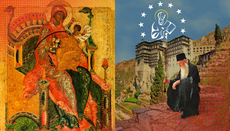
The icon itself shows the Theotokos standing upon a semicircular elevation. In her right hand she holds a small mountain—often surmounted by a domed church—representing the “stone cut out of a mountain without hands” (Daniel 2:34-35). That stone, untouched by human tools, is Christ Himself, born of the Virgin without violation of her purity. The mountain itself is Mary, who conceived a Child without the help of any man and remained unaffected, physically, by the birth of her Son.
The image draws directly from the prophet Daniel’s vision of a rock that shatters earthly kingdoms and grows into a mountain filling the earth. Orthodox hymnography echoes the same theme: “Rejoice, O mountain whole and uncut by man!” sings the Akathist Hymn (Ode 5). Patriarch Germanos of Constantinople, the eighth-century saint, praised her as “the uncut mountain” alongside other Old Testament prefigurations—the jar, the rod, the ark, the ladder, the throne of the King.
The icon, which emerged in Russian monastic circles some three centuries ago and spread from a Tver monastery, visually proclaims what the Church has always believed: the Virgin Birth is the foundation of our salvation.
Luke Hartung, founder of Uncut Mountain Supply, recalls the name’s origins in the late 1990s and early 2000s when he and Peter Heers (now Fr. Peter Heers) were theology students together at Aristotle University in Thessaloniki. While translating and publishing books, they needed a U.S. distribution point for their press. Hartung was also beginning an icon workshop.
“My small mission parish was dedicated to the Dormition of the Most Holy Theotokos,” he tells the UOJ, “so naming the newly founded business after the Theotokos seemed providential and most blessed!” The partners chose Uncut Mountain to honor the Mother of God, for whom they have “always had a deep reverence and maternal affection. Of course we were very aware of the many references to her as the ‘Uncut Mountain’ in Holy Scripture, the writings of the holy fathers and also our church hymnography.”
Fr. Peter Heers, who remained in Greece and founded Uncut Mountain Press, offers a complementary vision. “We chose the name for the scriptural reference in Daniel, the vision of the stone cut from the mountain without injuring or changing the mountain,” he tells the UOJ. “We chose it to honor the Mother of God. We chose it because it points us to the Incarnation.
“But we chose it also because it connects us to the Holy Mountain of Athos,” Fr. Peter continues. “And we very much see the Holy Mountain as an ‘uncut mountain,’ with regard to the fullness of Revelation and Holy Tradition and the Orthodox Faith.” In the name, therefore, three realities converge: the Theotokos, the miracle of the Incarnation, and the steadfast witness of Athos, which refuses to “make changes or deductions or innovations with regard to the faith and life and the ethos of the Church.”
So, what is the Uncut Mountain? It is Mary. It is Athos. It is every faithful labor offered in her name.