History and Culture
The Pochaev Icon of the Mother of God: A Bridge Between Orthodox Ukraine and America
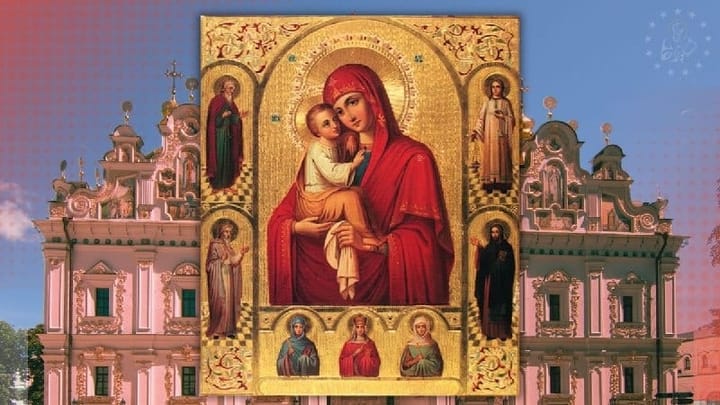
“After the deliverance of thy Lavra from infidels, O Mistress, the Orthodox people joyfully received thine icon...”
Those following Church news in Ukraine have likely heard of the ongoing conflict surrounding the Holy Dormition Pochaev Lavra. As with many other historic Orthodox Church sites, the Ukrainian government has its eyes set on seizing this beautiful monastery, whose significance to the history of Orthodoxy both in Ukraine and around the world cannot be overstated.
What many people may not know about is the wonderworking Pochaev Icon of the Mother of God, which today unites many Orthodox faithful in America with the monks in Western Ukraine. August 5 (July 23 O.S.) is the primary feast of this miraculous icon, established after the salvation of the monastery from Turkish siege in 1675.
According to one tradition, the first skete in the area was founded in the 1220s by an Athonite monk, St. Methodius of Pochaev. Although the exact date is unknown, what is known is that the Mongol raids on Kiev led to many monks fleeing the Caves Lavra and seeking safety further west, in the lands of Volhynia. The Pochaev Lavra website writes:
[Seeking refuge,] they found it on a craggy, forest-covered mountain, where they would settle. They brought with them the strict ascetical spirit of Venerable Anthony and Theodosius of the Kiev Caves, and named the place of their seclusion in honor of the Pochaino River, a tributary of the Dnieper, on the banks of which their monastery once stood.
In 1340, two hermits from the monastery, seeking greater seclusion, settled on another part of the mountain. One, after prayer, they beheld a vision of the Mother of God enveloped in flame (“calling to men’s minds the bush which burnt yet was not consumed” – we read in the service to the Pochaev Icon); she touched her right foot to the ground and left an imprint in the rock, and a spring of water gushed forth. The Lavra’s main cathedral was built over the “footstep” of the Mother of God, which can still be seen and is venerated to this day.
Perhaps the most renowned figure associated with the Lavra is Venerable Job of Pochaev (October 28), who served as its abbot until his repose in 1651. St. Job introduced a cenobitic order at the monastery and built it up significantly. But his greatest contribution to Orthodoxy was the printshop that he established, which printed many spiritual texts, including the Ostrog Bible – the first Slavonic Bible.
The icon itself was a gift from the future Patriarch Neophytus II of Constantinople to the local landowner, Anna Hojska, in the latter half of the 16th century. Soon the icon began working miracles, healing Anna’s brother of his blindness, and in 1597 it was brought to the monastery.
In 1675, Turkish forces laid siege to the monastery. Knowing that the monastery walls would not withstand the attackers, the abbot ordered the brethren to sing the Akathist to the Most Holy Theotokos and pray to St. Job. As they began the words “To thee, the Champion Leader,” the Mother of God appeared above the monastery; arrows fired by the Turks turned back on them, terrifying them and causing them to flee.
The service to the Pochaev Icon, sung on August 5 (July 23 O.S.), commemorates this event: “Chant a new hymn unto the Queen, the Mother of God, who hath wrought a miracle newer than all the miracles of old, on the Mountain of Pochaev: For she struck down the mighty Hagarene bolts of the Tartars [sic] launched thereat, turning them back upon the heads of those who loosed them…” (Litia). “After the deliverance of thy Lavra from infidels, O Mistress, the Orthodox people joyfully received thine icon, as of old the life-creating Cross of thy Son was received after its Persian captivity” (Aposticha).
During the First World War, the Lavra was occupied by Austro-Hungarian forces, who sent the monks to a concentration camp and desecrated many of the monastery’s holy sites (the refectory church was converted into a movie theater). Though briefly restored by advancing Russian forces, the Lavra suffered further after the Revolution, enduring the Ukrainian and Russian Civil Wars and Polish-Soviet War, during which it was briefly occupied by the Soviets and sacked. Finally, the territory of the monastery wound up within the newly formed Polish Republic and was turned over to the jurisdiction of the Polish Autocephalous Church.
Though the Lavra was not closed, many of its brethren fled, establishing the Monastery of St. Job of Pochaev in Ladomirová, Czechoslovakia. It was here that the bridge between Pochaev and America began. Perhaps most significant for Orthodoxy in America was the presence of the dynamic Archimandrite Vitaly (Maximenko; +1960), who founded the monastery. In 1934, he was consecrated Bishop of Detroit and sent to the United States to serve the ROCOR parishes there and lead the new Holy Trinity Monastery in Jordanville, N.Y. Later, Archbishop Vitaly would say:
Who among our people has not heard, does not know of Pochaev? From the most ancient times, it has been a holy site for all of Western Rus’… even until our days, hundreds of thousands of worshippers head there annually… Who among us from our childhood and youth did not go many times to Pochaev to worship?
The Ladomirová brethren continued their prayers and the publishing work of St. Job. Toward the end of the Second World War, as the Red Army advanced, they fled once more, and this time would end up in the United States, joining the brotherhood in Jordanville. Among their number were the future Metropolitans and First Hierarchs of ROCOR: Vitaly (Ustinov; +2006) and Laurus (Škurla; +2008) other ROCOR bishops, and the future Archimandrite Cyprian (Pyzhov; +2001), founder of the “Jordanville School” of Orthodox iconography.
A copy of the Pochaev Icon in Jordanville would soon come to be known as wonderworking, as well. Today, this miraculous icon is occasionally taken from the monastery to parishes for veneration, including, traditionally, taking part in the annual St. Vladimir’s Day Celebrations in Jackson, N.J. Copies of the Pochaev Icon with its iconic sunburst kiot can also be found in many churches.
The only Orthodox parish in America dedicated to the Pochaev Icon is, perhaps unsurprisingly, in the jurisdiction of ROCOR in North Port, Florida. (There is another mission in Canada, as well.) Its dedication was decided by Metropolitan Hilarion (Kapral; +2022), himself ethnically Ukrainian. Its clergy are almost all monks, recent transplants from the Volhynia region with deep connections to the Pochaev Lavra, including its rector, Archimandrite Stefan (Khilchuk). I spoke with Fr. Stefan, who said this of the significance of a church of Our Lady of Pochaev for Orthodoxy in America:
Ukrainian refugees come here to experience comfort and a piece of home. At a time when the world is trying to divide us, the Pochaev Icon unites us. Everyone – Russian, Ukrainian, American – prays together here and experiences the grace of the Mother of God. By her prayers, may Orthodoxy flourish in this land!
We will conclude with the kontakion for the Feast of the Pochaev Icon:
Thine icon of Pochaev hath been shown to be a wellspring of healings and the confirmation of the Orthodox Faith, O Theotokos. Wherefore, from misfortunes and temptations free us who have recourse to it; preserve thy Lavra unharmed; establish Orthodoxy in the surrounding lands; and remit the sins of those who pray to thee, for whatsoever thou desirest, thou canst do.