Man and Church
As Far as They Could Bear It
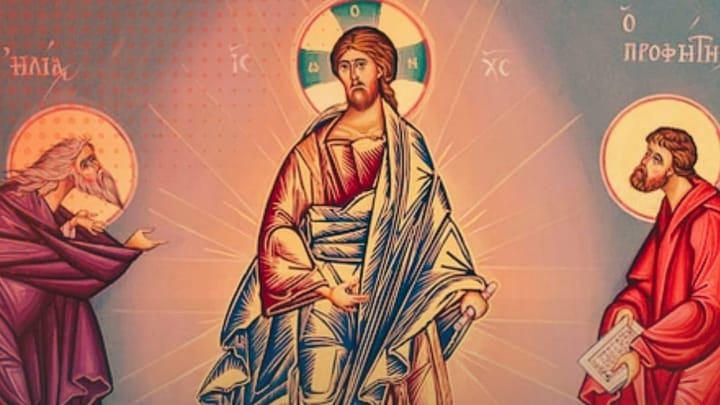
If the Transfiguration ended on Mount Tabor, it would remain a beautiful event to admire from a distance. Instead, the Church presents it as a mystery that speaks to every Christian life.
You were transfigured on the mountain, O Christ God, revealing Your glory to Your disciples as far as they could bear it. Let Your everlasting Light also shine upon us sinners. Through the prayers of the Theotokos, O Giver of Light, glory to You.
For most of us, those words immediately call to mind one of the most majestic scenes in the Gospels. Christ ascends Mount Tabor with Peter, James, and John. His face shines like the sun, His garments become dazzling white, and Moses and Elijah, representing the Law and the Prophets, appear beside Him bearing witness to the One in whom both find their fulfilment. From the bright cloud the Father’s voice proclaims, “This is My beloved Son, in whom I am well pleased. Hear Him.”
Yet the Troparion contains a phrase we can easily overlook: “…revealing Your glory to Your disciples as far as they could bear it.” Why does the Church chant those words? Why not simply say that Christ revealed His glory?
At first glance, the phrase almost suggests restraint, as though Christ withheld something from His disciples. Yet the Fathers invite us to see the feast in precisely the opposite way. The limitation was never in Christ, but in the disciples’ capacity to receive Him. The Transfiguration reveals not only the splendor of the incarnate Son of God, but also the tenderness with which He discloses Himself to those who follow Him.
St. Gregory Palamas reminds us that the Transfiguration was not a moment in which Christ somehow became more glorious than He had been before. The Son of God did not acquire a new splendour on the mountain, nor did He set aside His humanity to reveal His divinity. Christ remained exactly who He had always been. Rather, the grace of the Holy Spirit strengthened the disciples to behold, according to their capacity, the uncreated light that had always belonged to Him. Prayer, St. Gregory explains, was not for Christ’s sake, but for ours. Christ did not pray because He needed to receive glory, but because He wished to reveal how human beings are illumined by communion with God.
The path to Tabor is not spectacle, but prayer.
Seen in this light, the words of the Troparion take on an entirely new depth. Christ did not withhold His glory, for the eternal Light of Tabor cannot be diminished. Rather, finite human beings had to be gradually prepared to receive what He desired to reveal. The Transfiguration is therefore not only a revelation of Christ’s identity, but also of His compassion, as He patiently prepares His disciples for the fullness of divine life.
If the Transfiguration ended on Mount Tabor, it would remain a beautiful event to admire from a distance. Instead, the Church presents it as a mystery that speaks to every Christian life. Many of us quietly assume that holiness belongs to someone else. We read the lives of the saints and wonder why our own lives seem so ordinary. We wish our prayers were more fervent, our faith more unwavering, or that we knew God’s presence as clearly as the saints who came before us. The Troparion gently redirects our attention. Rather than chasing extraordinary experiences, we are called to become capable of receiving the One who is already present.
This is why the Church places such emphasis on prayer, repentance, fasting, the Divine Liturgy, and the Holy Mysteries. These are not techniques for producing spiritual feelings, nor are they steps toward earning God’s favour. They are the means by which God gradually heals and enlarges the human heart. This transformation is ordinarily slow, often imperceptible, but never without purpose. The question is not whether Christ desires to reveal Himself more fully to us. In the mystery of the Incarnation, He has already drawn nearer than we could ever have imagined. The real question is whether we are allowing Him to transform us, little by little, into people capable of receiving the life He continually offers.
That transformation often unfolds quietly. It may look like returning to prayer after weeks of distraction, asking forgiveness when pride urges us to remain silent, persevering through suffering without surrendering to despair, or standing faithfully at the Divine Liturgy even when our minds wander. None of these moments resembles the dazzling vision of Mount Tabor. Yet each one prepares the heart, by God’s grace, to bear more of the light Christ has never ceased to reveal. In the words of St. Paul, “We all, with unveiled face, beholding as in a mirror the glory of the Lord, are being transformed into the same image from glory to glory” (2 Cor. 3:18).
It is no accident that the Feast of the Transfiguration is celebrated forty days before the Elevation of the Precious and Life-giving Cross. As the Kontakion of the Feast declares, Christ revealed His glory to His disciples “so that when they should see You crucified, they would know that Your suffering was voluntary.” The light of Tabor was not given to spare them from the Cross. It was given to strengthen them for it.
The same is true for us. God does not promise a life free from suffering, confusion, or temptation. He promises to remain present with us in the midst of those trials. Like the disciples descending from the mountain, we are called to carry the memory of Christ’s glory into the ordinary struggles of daily life, trusting that the One who shone on Tabor remains with His people in every place and every season.
The Troparion leaves us with a profound consolation. Christ revealed His glory to His disciples “as far as they could bear it,” not because His light was diminished, but because His love is patient. He heals us, strengthens us, and gently enlarges our hearts until we become capable of receiving ever more of His own divine life. By His grace, one day we shall behold Him as He is. Until then, our life in Christ is one of faithful response to the One who continually reveals Himself, rather than a search for new revelations. Little by little, He prepares us to bear the light that has always shone from His face, until faith gives way to sight and we enter, at last, into the everlasting joy of His Kingdom.