News
EXCLUSIVE: Full English Text of Leaked Unification Council Chronicle Published by UOJ
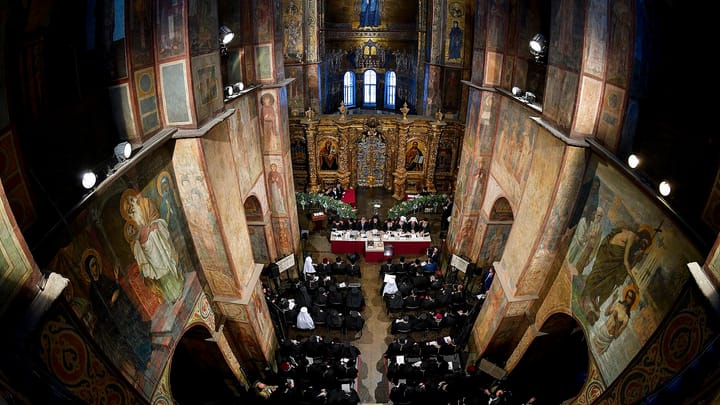
The document - authored by Metr. Gregorios of Ankara - was addressed to Ecumenical Patriarch Bartholomew and written in the time immediately following the December 2018 council.
OCT. 9, 2026 — Published below is the full, unabridged text of the chronicle of the days leading up to and including the Unification Council of the Eastern Orthodox Churches of Ukraine which resulted in the creation of the Orthodox Church of Ukraine (OCU).
This document was submitted to Ecumenical Patriarch Bartholomew of Constantinople by Metropolitan Gregorios of Ankara, who was a hierodeacon of the Ecumenical Throne and part of the Constantinopolitan delegation to Kyiv at the time of the December 15, 2018, council.
Much of the chronicle was written in Katharevousa and follows the structure, style, and formal tone expected of a communication that is ecclesiastical in nature and directed to a patriarch. The original Greek version of the text will be included at the bottom of this article.
Last week’s report on the chronicle can be read here, and an explanation of its authenticity and authorship as investigated by UOJ-America can be read here.
Chronicle of the Week of the Clergy Laity Council in Kyiv for the Election of the First Primate of the Autocephalous Church of Ukraine Kenotically Created by the Mother Church
Your All-Holiness, Master,
Filially submitting to Your venerable command, I went on the morning of Monday, December 10, to Kyiv, so that, with my meager powers, I might assist in secretarial work under Your Exarch, His Eminence Metropolitan Emmanuel of France, during the preparation of the Unification Council for the election of a Primate of the [Church created] by the Holy Great Church of Christ. The purpose of the Council in question was certainly not the election of a Primate by any and every means, but the establishment of the new Church upon strong ecclesiological and canonical foundations, according to the exhortation of the Mother Church, so that no one and nothing might diminish, on the one hand, her all-sacred privileges from the ages and, on the other, the authority of the actions and subsequent life of the Church of Ukraine as a daughter of that of Constantinople.
I therefore arrived in Kyiv at nine in the morning and, as one of Your clerics, was received by officials of the Presidency accompanied by the police, for reasons of security. I went to the lodging of the Presidency of the Republic, where Your Exarchs were staying. At noon His Eminence of France arrived. After speaking with His Grace Bishop Ilarion of Edmonton, who was already there, we both ascertained that the road to holding the Unification Council was long, since the necessary preparation had not been made and the Church had not been properly informed. Thus, in accordance with what the president of the Exarchate had wisely decided, we organized a plan of meetings with all the parties involved, in search of the best conditions for holding the Council.
Late that evening, I accompanied His Eminence of France to a private audience with His Excellency Mr. Petro Poroshenko, President of the Republic of Ukraine, at his palace. The meeting between the two men took place face to face, and when His Eminence came out he had the President’s assurances that “we are moving full speed straight ahead” toward the Council, having as an unshakable basis the ecclesiological and canonical lines of the Mother Church. His Eminence delivered to the President the draft Statutory Charter of the new Church, so that he might forward it to all the parties for their separate study, that they might be ready for the joint committee that would examine it. It is regrettable that this draft was circulating on the internet immediately after the session of the Holy and Sacred Synod of November 29, and indeed not merely as information, but as the complete text itself, even before its correction in Synod. Let him who understands, understand.
On the following day, December 11, we received the Very Reverend Archimandrite Cyril Hovorun, who explained in Greek what he had heard about the prevailing atmosphere, placed himself at the disposal of the Exarchate, expressed his intention to strengthen the work of the Council by his personal presence, and declared his fidelity to the Phanar.
Thereafter His Eminence Metropolitan Alexander, of Onuphry’s faction, came and we heard him. During the meeting he warmly expressed his support for the canonical actions of the Mother Church. He reported that many secretly desired to enter the new body, but were afraid, on the one hand, that the Phanar would not ultimately take action to protect them and, on the other, that Moscow’s actions toward possible “defectors” would be merciless. His Eminence assured Metropolitan Alexander that His All-Holiness the Ecumenical Patriarch, exercising his right to render assistance beyond his borders through the right of appeal, would under no circumstances leave without that assistance the clergy of every rank who might come forward. He urged him to convey this in every direction, under sacred secrecy, to encourage those who desired to do so.
That same evening, representatives of the country’s secret services came to brief His Eminence of France and those with him. They gave assurances concerning the security measures, the genuine intention of many from His Eminence Onuphry’s faction to come to the Council, their fears arising from Moscow, and the warm support of public opinion for this undertaking.
Thereafter we were visited by His Eminence Metropolitan Filaret, formerly of Kyiv, together with Metropolitan Epiphanius and Archbishop Eustratius. Earlier, with the consent of His Eminence of France, I had exchanged written messages with Metropolitan Epiphanius, who wrote to me at about noon (attachment 1). From the intense, two-hour dialogue with His Eminence, formerly of Kyiv, and those with him (attachment 2), the conclusion emerged that the advanced-in-age Filaret—most vigorous in spirit and unbending in disposition—was possessed by great anxiety about the future of this local Church if the man chosen from the ballot box did not belong to his selection. He therefore demanded that he not stand as a candidate for the position of Primate, but that the Unification Council appoint him president of the Holy Synod. The wise, prudent, yet unbending resistance and handling of the matter by His Eminence of France led His Eminence Filaret to conclude: “Tomorrow my representatives will come to work with you on the Statutory Charter.” After the meeting with His Eminence Filaret, and with the knowledge of His Eminence of France, I again exchanged messages with His Eminence Epiphanius.
After their departure, we went to the Church of Saint Andrew, which had been given into the possession of the Mother Church and where Your All-Holiness had established a stavropegion. The deputy minister of culture was waiting there, as was the official responsible for religious affairs, Andrii Yurash, with their associates. There we ascertained with surprise that the information which had come to the Church’s attention, to the effect that there had been no progress in renovating the church and resolving the matters surrounding it, was wholly unreliable. We saw with our own eyes that the renovation works were continually advancing; the priest had left the church apartment; and its spaces were being renovated. Visiting them, we were surprised to discover two chapels beneath the main church. The one on the first level is dedicated to the sacred couple Zacharias and Elizabeth, parents of the Honorable Forerunner, while the name of the other was unclear. His Eminence of France immediately proposed that the latter be named in honor of the Holy Apostle Bartholomew, so that the name of Your All-Holiness might be linked with this sacred stavropegion forever. Near the end of the tour, the Minister of Culture of Ukraine came as a mark of honor and assured His Eminence of France that the works would be completed as soon as possible and, at the same time, every accommodation would be provided to the Exarch of His All-Holiness so that he might celebrate the services and carry out his work. The matter of an apartment for the Exarch was discussed, along with other matters concerning the stavropegion which were of lesser, yet decisive, importance and related to the process of its renovation.
That evening we had dinner with Their Eminences Metropolitans Symeon and Alexander of Onuphry’s faction, accompanied by clergy who would follow them into the new Church. The discussion revolved around the approaching Unification Council, the position of the bishops of Onuphry’s group, and the extent to which parishes and clergy were ready to come.
On the morning of the next day, December 12, from nine until nineteen hundred hours, with a break for the midday meal, we worked with representatives of all the factions on the Statutory Charter of the new Church, in the presence of His Excellency Rostyslav Pavlenko, representing the President, and Andrii Yurash, the official responsible for religious affairs. Through this most laborious process, during which we used every means in defense of the age-old privileges of the Holy Great Church of Christ, we were finally brought, in love and unanimity, to the final text which the Unification Council accepted (attachment 3). From this meeting we must reverently note the following. The parties of Makariy and Onuphry openly supported all the positions of the Mother Church. His Eminence Archbishop Eustratius, on Filaret’s side and highly capable in diplomacy, resisted; nevertheless, our “concessions” demonstrated still more clearly the authority of Your Venerable Headship over the Statutory Charter.
For example, the draft stated that the Ecumenical Patriarch is guarantor of the Statutory Charter. We worked for an hour on this phrase. Finally Archbishop Eustratius asked what I had wanted from the beginning: “Can you explain the phrase to us? What does it mean?” With the permission and encouragement of His Eminence the Exarch, Metropolitan of France, I reverently answered as follows: “Today, you who are in the new Church respect and honor the Phanar and the Patriarch, who is your benefactor. Tomorrow, perhaps, ungrateful persons who are indifferent to such things will come and say: Let us establish provisions in the Statutory Charter contrary to the Tomos. In such a case, who is the guarantor that the Charter agrees with the Tomos? Certainly it must be the Patriarch.” To this he replied, “Then let us set it down in detail,” which was done. After everyone had accepted it, toward the end of the session this hierarch admitted: “The explanation has made it more binding than the original. But since I myself asked for, and before everyone accepted, the explanation of the passage, I do not wish it to be changed again. I ought to have been content with the original.” By such practical measures and certain apparent “concessions,” the position of the Holy Great Church of Christ was secured.
This meeting ended at seven in the evening, having begun at nine in the morning. During the discussions I went to the washroom to throw a little water on my face and renew my strength, and there encountered His Eminence Eustratius. He asked, “How do you see matters?” I answered: “Your Eminence, I respectfully perceive a misunderstanding. We did not come here to negotiate or to cast doubt upon the rights of the Mother Church. She teaches and you are taught. In this case we are not negotiating as equals with equals, but we love you greatly. If you defend the rights of your elder, we defend those of our Patriarch and of the Great Church. Do you want irrational demands? You will remain in schism. This is the last opportunity for the elder Filaret to become a hero. If he loses it, he will end his life as a schismatic. We are not in the position of the beneficiary, but of the benefactor, in the name of His All-Holiness the Ecumenical Patriarch, who truly benefits you. Therefore do not put the peaceable character of His Eminence of France to the test, for I marvel at the patience with which he endures hearing these unreasonable demands. You owe the unity of this Church to the All-Holy Spirit. He awaits your return. Do not undo so much labor for one senseless act of obstinacy. Our labors here will be for your benefit. We came for you, not for ourselves. The Patriarch has great love for your persons; do not disappoint it. You personally have great influence with your elder. Change his mind. Do not attribute egotistical tendencies to him while you yourselves remain passive. If you love him, help him.” He replied: “Thank you very much. The voice of your sincerity has been heard. On my part I shall do everything, but I have instructions. Yet I promise it. Do not leave us.”
Thereafter we held a meeting with His Eminence Archbishop Eustratius and Messrs. Pavlenko and Yurash concerning the demands that His Eminence Filaret would make of the Clergy-Laity Council. During this meeting, His Eminence Eustratius read before everyone a draft announcement from the Clergy-Laity Council, by which Filaret’s future position would be announced to the fullness of the Church. Among other things, it stated that the Clergy-Laity Council would elect a Primate, but Filaret would be president of the Holy Synod and Exarch throughout Ukraine, with the rights of a Primate—that is, the convening of a synod, episcopal elections, depositions, and so forth. I humbly confess the composure and prudence of His Eminence the Exarch, who listened without any reaction to the whole draft announcement, which was about a page long. At its end, in a gentle voice, he began to explain to Eustratius that what was requested could not possibly be done, because it would constitute an unprecedented act in the ecclesiology of the Orthodox Church and would make us a laughingstock throughout Orthodoxy.
His Eminence Eustratius insisted strongly and vigorously, threatening that without it no Council would take place. The strange thing is that the state officials, who had assured us many times that they would finally persuade the elder Filaret, at that hour more or less took Eustratius’s position. The Exarch was left alone, saying, “Let us conclude the Council, and after it do as you know how.” At the moment of this discussion, His Eminence Metropolitan Amphilochios of Adrianople arrived at the guesthouse. Having been informed of the discussion then taking place, but not possessing the prior history of the communications with the state officials, he decisively strengthened the Exarch’s position. He declared that acceptance of such a position would constitute an obvious surrender of the rights and principles of the Holy Great Church of Christ, and that those in Ukraine—not we—were the ones in need of a Council. Interpreted, this meant: “We accept threats from no one, especially since we possess the weapon of truth and justice, and also bear our responsibility before History to vindicate the name and person of His All-Holiness the Ecumenical Patriarch, which we are not permitted to stain for the sake of any Filaret, however powerful he may be.” The Exarch agreed completely with the foregoing and, strengthened in the views he had already expressed, answered definitively: “We can do nothing without the opinion and permission of His All-Holiness. We shall hear from you again.”
After this discussion, which lasted two hours, we met under the leadership, as was fitting, of His Eminence of France, concerning what should be done thereafter. His Eminence briefed Your Venerable Headship by telephone and received the instruction to set out the situation to His Excellency Mr. Poroshenko, who was away in Brussels.
On the following day, Thursday, December 13, Their Eminences of France and Adrianople went to Hagia Sophia to arrange the space for the needs of the Council. Thereafter we went to the Patriarchal Stavropegion of Saint Andrew, whose feast was celebrated that day. There His Grace Bishop Ilarion of Edmonton celebrated the Divine Liturgy, assisted by priests of Metropolitans Symeon and Alexander, who had contributed greatly to arranging the church so that it would be ready for the Divine Liturgy, and by my leastness. Before the Divine Liturgy, the hierarch sprinkled holy water throughout the church, which had undergone renovation. It was a moving moment when, before many cameras and journalists and a multitude of Ukrainians, the Greek words “Bless, Master,” as well as the Gospel of the feast, were heard beneath the vaults of the magnificent church. At the end of the Divine Liturgy, the celebrating hierarch spoke, as did His Eminence of France, who then distributed the blessing of the Cross to the congregation. His Eminence Metropolitan Alexander afterward offered a festal meal at a restaurant.
Thereafter Their Eminences of France and Adrianople and my humility visited His Excellency Yönet Can Tezel, Ambassador of the Republic of Turkey to Ukraine, with whom His Eminence of France held an informative discussion. It was noteworthy when the ambassador asked about the status of the autocephalous Churches. When told that all are considered equal in a certain manner, he replied: “The information I have on the question is different. Only the five Churches are the principal ones, while the others, which are much younger—with the exception of Cyprus—come from the jurisdiction of the Patriarchate of Constantinople. How, then, can they be considered equal?” Marveling at the ambassador’s precise ecclesiological knowledge, we acknowledged the truth of his statement. He also asked whether the presence of His Excellency Mr. Poroshenko at the Council diminished the rights of our Patriarchate, because, as he said, a principle of the Republic of Turkey is the unobstructed performance of religious duties without interference by the state. We answered that the presence of the President gave no grounds for a diminution of the rights of the Throne, since his presence was considered a unifying one among the tendencies existing within the ecclesiastical body. He indicated to us that the time had come for the Patriarchate to demonstrate its true position throughout Orthodoxy. Astonished by the ambassador’s views, we departed for the Presidency’s place of hospitality.
At seven in the evening, His Eminence Metropolitan Michael, of Filaret’s faction, arrived accompanied by seven hierarchs. That morning they had held a “synod” to decide upon the candidate whom they would put forward, as well as matters concerning the conduct of the Council. These were among those who had objected. At this important meeting (attachment 4), all the views of the hierarchs were heard, the principal points being as follows:
a. It became apparent that they had no knowledge or information whatsoever about the course of the discussions concerning the Clergy-Laity Council.
b. They were afraid to express their views by vote, since the aged elder Filaret had imposed an open vote upon them.
c. They displayed the inward lack of readiness produced by uncertainty regarding the Council.
His Eminence Metropolitan Anthony, of Greek descent through a grandfather who had been a refugee in Mariupol, moved everyone by his words, saying: “Holy Fathers, for so many years we have lived in schism and in a condition of darkness and shadow, captives of our choices and without freedom to decide correctly. Then the Mother of all the Orthodox, the Church of Constantinople, and His All-Holiness came and gave us a helping hand. But we are in such a condition that we do not know how to take hold of this God-sent helping hand. We do not know how to respond to the help of our Mother. We beg you, do not abandon us, and show patience toward our weaknesses. We had become accustomed to the condition of schism and were, as it were, self-sufficient. Often we have no awareness of our wretched condition. Help us even to understand our problems.” The hierarch’s speech brought a most warm response from His Eminence of France, who emphasized that we had come there to embrace them with the affection and concern of His All-Holiness, who desired to see them walking in newness of life.
After this meeting, from which we understood the tragic point to which the aged Filaret’s insistence had come, and the inability of the many to express opposition, we received word from the Presidency that His Excellency Mr. Poroshenko invited His Eminence of France to a consultation at his palace at eleven that night. In the reception hall of the building, His Eminence Metropolitan Amphilochios of Adrianople, His Excellency Archbishop Daniel of Pamphilon, and my leastness waited patiently, in unspeakable anxiety and amid the cold, for His Eminence of France to return from the Presidential Palace. The hierarch returned at two in the morning, downcast and deeply saddened, saying: “Unfortunately, we shall fail. They even asked me to remove my wristwatch, which I kept only by threatening to leave. Entering the office, I saw, besides the President, His Eminence Filaret and the head of the secret services. During the discussion, the elder Filaret was unyielding and inflexible, refusing any reduction of his demands. He also had the President’s silent support. We arrived nowhere.” It should be noted here that, as we learned the next day, the elder Filaret left the Presidential Palace at three in the morning and, only a few hours later, presided at a concelebration of many bishops for his name day, during which he also ordained a priest.
After a short discussion, knowing that any conversation among ourselves to plan a radical solution would be frustrated by the constant surveillance of everything in the building, and after His Excellency Archbishop Daniel of Pamphilon—who was suffering from ill health and had endured the wait with difficulty—had departed, we decided to continue the dialogue in silence by handwritten messages on paper. We concluded that in the morning we must telephone Your Venerable Headship and submit that we ought to depart. Otherwise they would not be persuaded unless they saw firmness on the part of the Mother Church. His Eminence of France even proceeded, at his own expense, to issue a ticket so that those in authority there would see it. In the morning we submitted a draft announcement to Your Most Divine All-Holiness solely because we knew that everything said in telephone conversations was being heard, grieving, of course, that at that hour we had no way to disclose the truth at least to You.
When Mr. Pavlenko learned of our intentions, he informed the President in terror. His Eminence of France packed his luggage and summoned vehicles for the airport. It was twelve noon. The President asked His Eminence of France to stop briefly at the Palace on his way past. After about an hour, while we had no word whatever of the hierarch’s progress, news came that the police were coming to lead all of us together to the Presidential Palace. After our initial reactions of perplexity, we all put on cassock and kalimavkion and, having resolved that above all we would prefer the all-sacred interests of the Mother Church, we were led there under escort by a strong police force. On the way, His Excellency Archbishop Daniel of Pamphilon, who protested to his compatriots about the forcible conveyance, informed the American Embassy, while His Eminence Metropolitan Amphilochios of Adrianople informed the Greek Ministry of Foreign Affairs. We received reassuring replies from all.
Entering the Palace, we were first led to an office to wait. We then descended to the operations room, passing through corridors where pictures of armed soldiers were displayed, which created strange impressions. Before our final entrance, they took our mobile telephones, we underwent bodily searches, and we entered the room. The expression of His Eminence of France betrayed the tragic nature of the moments. Beside him were the President, Mr. Pavlenko, and an official of the secret services. The President informed us that an attempt was being made to establish telephone contact with Your Venerable Headship, and that the conversation would be heard by everyone so that we might receive Your instructions. In response to a question from His Eminence of Adrianople, His Eminence of France answered that we were being detained and had been forbidden to leave the country. This did not frighten us so much as the prospect that we might yield to their desires, and by exchanging glances we resolved to stand firm and immovable.
When, after some time, the conversation with Your Most Divine and God-moved All-Holiness was achieved, we all understood the Lord’s words: “And when they bring you unto the synagogues, and unto magistrates, and powers, take ye no thought how or what thing ye shall answer, or what ye shall say: for the Holy Ghost shall teach you in the same hour what ye ought to say” (Luke 12:11–12). I confess that at that hour I did not have the strength to record on paper what was said, for I was in a state of unspeakable anxiety lest the interests [of the Church] be endangered by false promises of the President and so forth, and unconsciously I repeatedly wrote upon the paper the prayer, “O Theotokos and Virgin….” Yet all the words of Your Most Divine All-Holiness were engraved indelibly, as a precious deposit, in the place of conscience and heart.
Specifically, You spoke with boldness: “Your Excellency, I have learned from His Eminence of France about the difficulties, and I am sorry that the problematic behavior of one person alone proves that you are not ready for autocephaly. I am the Ecumenical Patriarch, and I have no right—before the history of the Patriarchate, before God, and before my predecessors—to make a mockery of the privileges of the Throne and its position in the Orthodox Church. I have a responsibility, Mr. President. I honor you and respect you, but I am not going to sell the dignity of the Patriarchate to any Filaret. And if you are not in a position to impose order upon him, I am sorry, but my people must depart. At the Phanar we learned to fear no one and nothing where its rights from the ages are concerned. Act accordingly.” The President, hearing the foregoing in perplexity, protested: “I am not Filaret, Your All-Holiness; I am Petro Poroshenko,” only to hear again: “I am telling you these things so that you will convey them, Mr. President.”
He continued: “Your All-Holiness, the situation in Ukraine is such that, if we do not hold the Council tomorrow, there is a possibility of military intervention by Russia, which will see our weakness.” “Then correct the situation immediately.” The President then read a draft which he himself would give Filaret to sign. In it Filaret would address Your Venerable Headship and say, in brief, that he desired no further position in the new Church and resigned from every such position except that of permanent member of the annual Holy Synod, which we had accepted as a necessary solution during the study of the Statutory Charter.
“If I obtain Filaret’s signature on that document, then do we proceed, Your All-Holiness?”
“We shall proceed only if my Exarchs assure me that none of the privileges of the Mother Church is placed at risk.”
Indeed, by an exchange of glances it was judged that such a development would be the sufficient and necessary condition for what followed. At the end of the conversation, when His Eminence of France asked on behalf of everyone for the prayers of His All-Holiness for the work, Your Venerable Headship added: “Your Eminence of France, I call your attention to your steps. I do not permit you to play with the interests of our Patriarchate. Let us stand aright. You have my blessing.” It was so powerful a moment that recording it on paper a month later once again brought tears to the eyes. “Such a high priest was fitting for us…[a minister] of the true tabernacle, the Great Church, which the Lord pitched, and not man.”
The President immediately bade everyone farewell in great joy and hurried to visit the elder Filaret, so that by his own authority he might obtain his signature. Within an hour, Mr. Pavlenko brought the signed document. We departed from the Palace greatly relieved, but bearing within us the psychological burden of the forcible conveyance and the great and unbearable pressure. Arriving at the guesthouse, His Eminence of France proposed that the three of us go to a restaurant to discuss what followed in another place. The noteworthy fact is that, throughout the “meal,” more than ten secret agents moved around us, making little effort to conceal their secret character. After an hour we returned.
We had a titanic task before us, because we had not proceeded to record the changes and corrections to the Statutory Charter, which required many hours of work, nor to determine the committees for the following day’s Council. At the urging of His Eminence of France, I undertook the proper drafting of the Statute with the changes. Mr. Pavlenko would initially be present at the meeting, and afterward Mr. Yurash in his place. With the Exarch’s permission, I undertook the following. I told Mr. Pavlenko that, before the Clergy-Laity Council, the legal organizations of the “Kyiv Patriarchate” and Makariy’s “Autocephalous Church” would have to be dissolved. He assigned the matter to Mr. Yurash. The latter answered me that, as soon as the representatives of the two factions arrived, he would mention it to them privately and not before everyone. I noted: “The Exarch will not go down to the Council unless this is done. I personally guarantee it and assume the responsibility.”
After a brief communication between them, the two came, and Archbishop Eustratius said: “For us to proceed, we need a clergy-laity assembly. Might we do it within the Council? Or after it?” I answered: “Your Eminence, at the Unification Council we cannot dissolve an organization which the Mother Church never recognized. That would be an indirect recognition of it. Nor can we do it afterward. How, then, shall we present one completely united Autocephalous Church?” In my mind I had the following ulterior consideration: if something did not go well at the Council, they would have the option of taking refuge in their former condition. Dissolution would close that road of retreat and bind them. After an exchange of arguments, I told them: “Since a clergy-laity assembly is needed for the dissolution, tomorrow, before the Council, constitute yourselves earlier as separate bodies and sign a text.” They proposed to me: “Will you draft a plan of dissolution for us?” “I shall try….”
With the help of the Greek-speaking Father Ioannis, we drew up a text that dissolved even the smallest parish as a legal entity. They accepted it and informed all the members of their factions by telephone about the plan. It was therefore determined that at nine they would constitute themselves as separate bodies, and at ten they would come to the Exarch, deliver the signed documents to him, and thereafter he would go down to preside at the Council. “Do not doubt that without these documents he will not go down, and you will be humiliated to the ends of the earth,” I added.
Thereafter, for three hours, we proceeded to complete the draft Statutory Charter on the basis of the changes and corrections. During this, Archbishop Eustratius proposed: “Might we remove the term ‘Autocephalous’ from our official title? It is not ecclesiological!” Everyone accepted his proposal. I answered: “Your Eminence, I respectfully submit that I admire the restoration of the discussion to an ecclesiological basis and, since all of you desire it, it shall be done.” The truth is that he did not want this term because it recalled the title of Makariy’s faction. Nevertheless, it was a proposal that benefited the legacy of the Mother Church, since the concept of “Autocephalous Churches” is cacophonous and inadmissible.
After a detailed consideration of the Statutory Charter, we recorded the final text on the basis of the Greek text; that is, I first made the corrections in Greek and then in their language through the English and Ukrainian translations. At the same time, Their Eminences of France and Adrianople held meetings upstairs with hierarchs and candidates, while His Excellency Archbishop Daniel of Pamphilon undertook the organization of the Council’s practical matters.
At eleven that night, His Eminence Michael arrived with nineteen hierarchs, with whom there was a repeated and recapitulating discussion of all that had occurred. They expressed their support for the decisions of the Great Church.
The day’s work ended at about one in the morning.
On the following day, Saturday, December 15, a priestly Divine Liturgy was celebrated in the Little Hagia Sophia. Thereafter the two factions withdrew into separate rooms: Filaret’s faction there, and Makariy’s in a nearby office area. Led by His Eminence of France, we arrived at about a quarter past nine and were taken to the office area opposite the Little Hagia Sophia. Time passed, and no one came out of Filaret’s Clergy-Laity Assembly. We learned that Makariy’s dissolution had been signed. The hour reached ten. We were informed of an impasse regarding Filaret’s signature. He would not sign. Inwardly, we understood such an action. It was entirely natural. For the ninety-year-old hierarch, the matter of the “Kyiv Patriarchate” was a matter of his life and conviction. Moreover, he feared that a man of his own would not be elected and that this man would undo his efforts up to that point. It was understandable.
He also had one further demand: that each faction have one candidate so that the votes would not be divided. We refused it. Everyone had the right to be a candidate. “At a Unification Council, we shall not proceed according to the logic of factions,” said His Eminence of France. With us was also His Excellency Mr. Yushchenko, former President of the country and a leading figure in this matter. Not long afterward the Speaker of Parliament arrived, and finally President Poroshenko. They went to the elder Filaret. There was no result. Everyone waited. Bitter cold. Snow. Protests began among the participants waiting in Hagia Sophia. The security measures were draconian, with army and police cooperating. A multitude of people was gathering in the adjacent square, awaiting the favorable result. Negative news reached us below. The elder hierarch was unpersuaded.
At about one in the afternoon, His Eminence of France came down, majestic and Doric, to see the situation close at hand. President Poroshenko, outside the Little Hagia Sophia, made a gesture of supplication toward His Eminence, saying: “Please do not leave now. Everything is already prepared. He will sign shortly.” And so it happened. Panting and in tears, Archbishop Eustratius placed the text with the signatures into the hands of the Exarch (attachment 5). As he departed, he approached me, embraced me, and said: “Father, I think that you know what this text means for us.” Likewise filled with tears, I answered: “Yes, Your Eminence. I know and understand. It is a matter of life. I also understand the elder. But the Mother Church is a physician. Every operation causes pain, but it heals. Be certain that all these things are for your benefit.”
Thus His Eminence of France and those with him went down for the opening of the proceedings. At the entrance of the church, President Poroshenko honorably awaited the Exarchs. We entered as a body into the packed historic Church of the Wisdom of God. The emotion was great. At the presidium awaited the elder Filaret wearing a monastic cap—a most wise requirement of His Eminence of France—together with Makariy and Symeon, the first-ranking representative of Onuphry’s faction. After the short prayer (attachment 6), His Eminence of France declared the Unification Council open. First he thanked the three participating parties for their vigorous devotion and recourse to the care of the Mother Church, conveyed Your venerable wishes and blessing, delivered an appropriate address (attachment 7), and thereafter gave the floor to the President. He then announced the secretariat of the Council, the composition of the electoral committee, the tellers for votes cast by raised hands, and so forth.
He then called upon those present to express, by raised hands, first their affirmative and then their negative vote concerning the request for autocephalous ecclesiastical status for the Church of Ukraine. Everyone voted in favor, followed by applause. He then said: “Each of the parties that has come has already had a draft of the Statutory Charter for several days. It is yours. We, as a committee, with the participation of your representatives, have made the necessary corrections to it for your benefit and so that it may cover your needs. Do you accept it?” All two hundred except one voted affirmatively, while the aforementioned one voted negatively.
His Eminence of France then noted: “We proceed to the election of a Primate. All the hierarchs may be candidates for the position except the two hierarchs, Filaret and Makariy,” and he explained the procedure precisely.
At that point Metropolitan Filaret took the floor and said: “Is it possible that we are deprived of the right of election? Everyone here has a name and title. I do not. Why? Furthermore, we as a faction have chosen our own candidate. Let us vote by open ballot.” His intervention momentarily disturbed the waters. Indeed, a man dressed in military uniform approached the President and demanded Filaret’s candidacy, but the President restored order. Metropolitan Symeon answered Filaret first, saying that this was what had been decided and that it was just, and Metropolitan Makariy followed. At this point, His Eminence of France read with solemnity—and with thanks for it—Metropolitan Filaret’s letter to Your Venerable Headship, by which he resigned from every position in the new Church (attachment 7).
His Eminence of France then put the choice of a secret or open ballot to another show of hands, with the following result: 121 in favor of a secret ballot, 41 in favor of an open ballot, while others, out of indifference, did not vote. In any event, the 121 affirmative votes plainly constituted an absolute majority out of a total of 200 electors.
Thereafter followed the procedure for selecting a slate of three, in which hierarchs, clergy, and laity voted. First the electors went outside, signed, received the ballots that had meanwhile been prepared and sealed with the Council’s seal by my leastness, and approached the ballot box, where they cast their votes. I required that, for the Exarchs, the list be brought to them, and specifically in the middle of the procedure, so that it would not appear—whether at the end or at the beginning—how each one voted.
During the counting of votes, over which His Excellency Archbishop Daniel of Pamphilon presided and at which I was continuously present, the following emerged: Metropolitan Epiphanius, 81; Metropolitan Symeon, 56; and Metropolitan Michael, 38 votes.
After the results were announced, Metropolitan Michael and Metropolitan Demetrius, who followed him in the voting, successively withdrew from the slate of three, as did all those after them. This reached the point that the elder Filaret was compelled to ask some of those who had received one vote—indeed, without their knowing it—to accept their inclusion on the slate of three, which was done. Thus, with the procedure unfolding in the same manner, and with Metropolitan Filaret approaching and blessing the ballot box after casting his vote in an impressive and symbolic gesture, the final vote, in which only the bishops voted, gave Metropolitan Epiphanius 36 votes and Metropolitan Symeon 28. Metropolitan Epiphanius was therefore elected the first Primate of the Orthodox Church of Ukraine.
The president of the Council, His Eminence Metropolitan Emmanuel of France, announced the result to applause and presented the Primate with an enkolpion as a gift. The service for the close of the Council was sung, together with the Polychronion for Your Venerable Headship (attachment 8). The Primate then signed, upon the Holy Gospel, the record of his election, which had been formulated on the basis of the memorandum of the election of Sylvester of Kyiv, who had been elected at the Phanar in the year 1649 (attachment 9). Thereafter His Beatitude of Kyiv spoke in thanksgiving. At the mention of Filaret’s name, everyone rose and applauded.
As the bells rang joyfully throughout Kyiv, everyone went out to the square, where His Excellency the President presented the Primate, amid acclamations, before the thousands of faithful who had waited patiently in the cold since morning for the results. Before our departure from the church, the elder Filaret, visibly happy, offered his warm thanks to Your Most Divine All-Holiness for Your loving providence toward the Mother Church. To the undersigned in particular he declared: “You are a young cleric, but I would like to confess the following from my long experience. If I had been certain that a hierarch would be elected who would not destroy what I built with much labor and amid adversity, I would not have caused so many reactions. I ask forgiveness for the trouble, but please understand me. I did so much for Ukraine, but now I am finally at peace.”
Thereafter we went to the offices of the Church of Hagia Sophia, waiting for the President to depart so that the roads would open and we could visit His Excellency the Speaker of Parliament, who was awaiting the Exarchs. Meanwhile, His Beatitude of Kyiv came up to the waiting area and, in a warm atmosphere, communicated with Your Most Divine and, to me, most venerable All-Holiness, offering his gratitude and respect.
His Excellency the Speaker of Parliament courteously received the Exarchs and bestowed an honorary distinction upon them.
On the following day, Sunday, December 16, His Eminence Metropolitan Amphilochios of Adrianople celebrated the Divine Liturgy at the Monastery of the Archangel Michael, where His Beatitude Epiphanius had his residence. In a short address at the end of the Mystery, with the Greek-speaking Protopresbyter Vasyl—who had rendered many services, visible and invisible, during the Council process—translating into Ukrainian, he noted that a new day had dawned in Ukraine; that the Mother Church and His All-Holiness the Ecumenical Patriarch, as a duty indeed, but through self-sacrificial actions, had looked upon this vineyard and rebaptized the Ukrainian people; and he urged everyone to stand beside the new Metropolitan of Kyiv and the efforts of the new Church of Ukraine.
Thereafter we went to the Church of Saint Volodymyr, which had been granted to the white-haired elder Filaret for him to celebrate. He was concelebrating with five bishops. Seeing us, he rejoiced so greatly that he came down from the synthronon behind the Holy Table, upon which, according to the Slavonic typikon, the clergy ascend regardless of rank. As he descended, with Father Vasyl translating, he said: “God, Ecumenical Patriarch Bartholomew, and I know what it means to take on Moscow. The magnitude of His All-Holiness’s courage is inconceivable. Please kiss his venerable hand on my behalf. I thank you for everything. You are always welcome.” Having venerated the sacred relics of Saint Barbara there, we departed for the Monastery of the Archangel Michael in the center, where His Beatitude of Kyiv was celebrating, surrounded by a host of bishops in a full church. All embraced us with emotion and joy, first among them His Beatitude, to whom we offered our respects. The visit was symbolic, so that they might know that the Church of Constantinople would be their support. After the end of the Divine Liturgy, we departed for the airport, whence we came to Your See to brief Your Venerable Headship.
Your All-Holiness,
At first sight, the matter of resolving the Ukrainian question was thorny. Yet Constantinople’s canonical fortification is so strong that no one and nothing can harm it when it acts in accordance with the hallowed practice of the Church. It was a titanic work, but one from God. His presence became more manifest after Your telephone conversation with the President. Your unshakable and indisputable insistence upon the rights of the Mother Church once again protected her sacred affairs.
It would be no exaggeration to say that, within a few days, thirty years of work were accomplished, since bases and foundations were laid for a sound course upon correct ecclesiological foundations in the newly established Church. At every moment, the criterion for our actions and movements was the defense of the divine and imprescriptible rights of the Holy Great Church of Christ, particularly as embodied in Your Venerable Headship. According to God, the favorable outcome was manifest; from the human standpoint, however, it concealed labors, anxieties, and efforts both spoken and unspoken; discussions, processes, consultations, and very many human actions directed toward these things, because the circumstances revealed complete unpreparedness for this major event. I learned much from the holy hierarchs, and especially from His Eminence the Metropolitan of France, with whom I lived through all these difficulties from the beginning and in whose person I saw the indefatigable champion of the rights and privileges of Your Throne.
Submitting the foregoing with the deepest respect and boundless filial devotion, I remain Your least servant.
Attached below is the original Greek version of the chronicle.
Read also