News
Proof of Provenance: Metadata and Context of the Leaked Unification Council Document
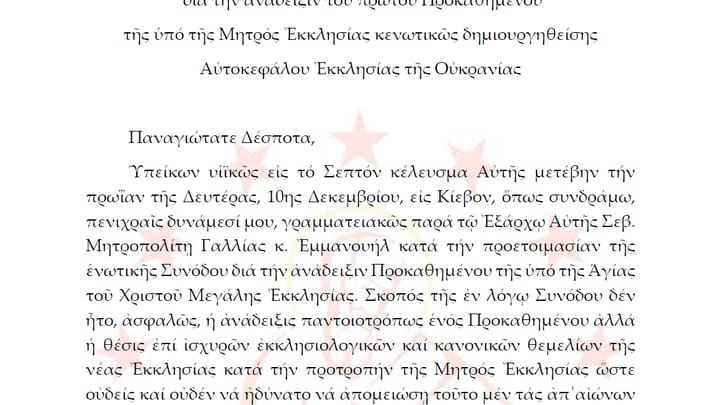
UOJ-America offers information which demonstrates the authenticity of the chronicle, as well as its confidence that Metr. Gregorios of Ankara is its author.
OCT. 8, 2026 — As part of the Union of Orthodox Journalists of America's investigation into the leaked unification council chronicle, which was published by our outlet last week, this article will demonstrate the authenticity of the document by laying out the technical indicators, historical context, and further commentary by Archons and Ecumenical Patriarchate-aligned media since its release.
A look at the metadata
As reported by UOJ-America last week, the chronicle was worked on between December 28, 2018, and January 8, 2019. The application field is listed as "Microsoft Office Word," and the application version is 15.0000 – consistent with Word 2013.
Word writes these dates during document creation and saving using the clock of the computer the file originated on. The values are embedded inside the document and remain unchanged when the file is copied or downloaded.
Furthermore, both the "creator" and "last modified by" fields name "Grigoris" as the document's owner.
The saved statistics report 23 pages, 6,516 words, and 3,239 minutes of accumulated editing time. That duration equals 53 hours and 59 minutes. It can include time the document remained open in Word, suggesting it was left open on a personal desktop computer.
The body text is 14-point Palatino Linotype, an old Windows font that supports polytonic Greek. The font table also contains Calibri, Calibri Light, and Times New Roman. These families were available before the recorded dates, so there is no font anachronism.
It must be noted that a docx file is really a ZIP file containing individual files which make up the contents of the document. These XML files hold the main text, formatting, and metadata like what has been described above.
The chronicle in question contains 14 of these files, and they are all normal and expected for a typical Word document. There is no embedded malware or sections that could be described as "non-standard."
Context clues
The unification council was held in Kyiv on December 15, 2018. The dates included in the metadata lend to the chronicle being recorded in detail by the author after returning to Turkey from Ukraine and getting through Nativity celebrations on December 25.
At the time of the council, Metropolitan Gregorios (Frangakis) of Ankara was a hierodeacon of the Ecumenical Patriarchate serving as deputy secretary of the Holy Synod. His presence in Kyiv is confirmed by media reports surrounding the council, most notably a Divine Liturgy celebrated at the Stavropegial Church of St. Andrew on December 13, 2018. This service is described in the chronicle in this way:
"On the following day, Thursday, December 13, Their Eminences of France and Adrianople went to Hagia Sophia to arrange the space for the needs of the Council. Thereafter we went to the Patriarchal Stavropegion of Saint Andrew, whose feast was celebrated that day. There His Grace Bishop Hilarion of Edmonton celebrated the Divine Liturgy, assisted by priests of Metropolitans Symeon and Alexander, who had contributed greatly to arranging the church so that it would be ready for the Divine Liturgy, and by my leastness. Before the Divine Liturgy, the hierarch sprinkled holy water throughout the church, which had undergone renovation. It was a moving moment when, before many cameras and journalists and a multitude of Ukrainians, the Greek words 'Bless, Master,' as well as the Gospel of the feast, were heard beneath the vaults of the magnificent church. At the end of the Divine Liturgy, the celebrating hierarch spoke, as did His Eminence of France, who then distributed the blessing of the Cross to the congregation. His Eminence Metropolitan Alexander afterward offered a festal meal at a restaurant."
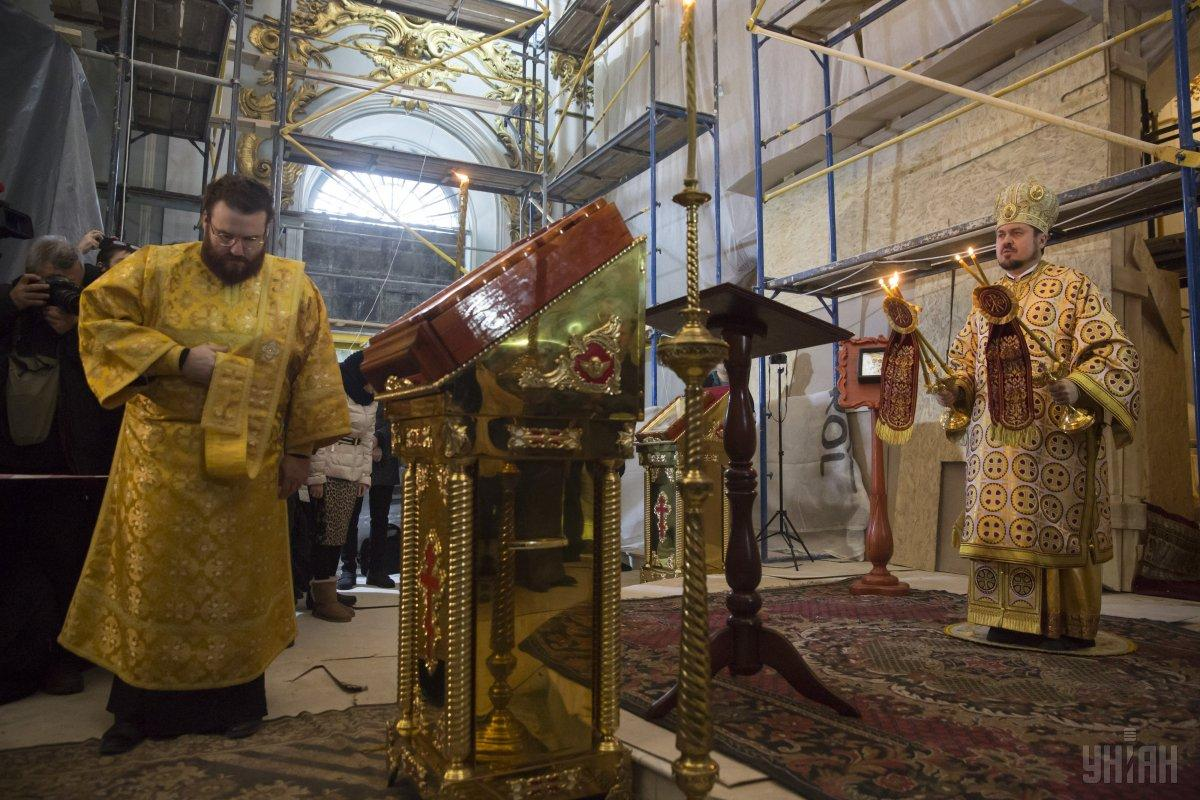
As UOJ-America has already reported, an official roster of the Constantinopolitan delegation to Kyiv has never been made public by the Ecumenical Patriarchate. However, members of the delegation who were visible in photos taken at the council and recorded in the chronicle are Metropolitan Emmanuel of France (now of Chalcedon), Metropolitan Amphilochios of Adrianople, Archbishop Daniel of the Ukrainian Orthodox Church of the USA, and Metropolitan Hilarion of Edmonton. The latter two are of Ukrainian descent.
It should be noted that the UOC-USA, which Archbishop Daniel is part of, was originally made up of the American parishes of the schismatic Ukrainian Autocephalous Orthodox Church (UAOC), one of the two groups united in the “unification council” in question.
Hilarion is explicitly mentioned in the above quotation from the chronicle, and "Their Eminences of France and Adrianople" are Emmanuel and Amphilochios, respectively. Metropolitans Symeon and Alexander were the only two hierarchs of the canonical Ukrainian Orthodox Church (UOC) who disobeyed the decision of their Synod and attended the council.
In media coverage of the event, and when considering the additional context provided by the chronicle, there is only one Greek cleric present who isn't a bishop: Fr. Gregorios Frangakis.
The chronicle begins by addressing Ecumenical Patriarch Bartholomew and stating the following:
"Filially submitting to Your venerable command, I went on the morning of Monday, December 10, to Kyiv, so that, with my meager powers, I might assist in secretarial work under Your Exarch, His Eminence Metropolitan Emmanuel of France, during the preparation of the Unification Council for the election of a Primate of the [Church created] by the Holy Great Church of Christ."
Photos shared by then-Ukrainian President Petro Poroshenko's office show Gregorios in the background doing exactly that.
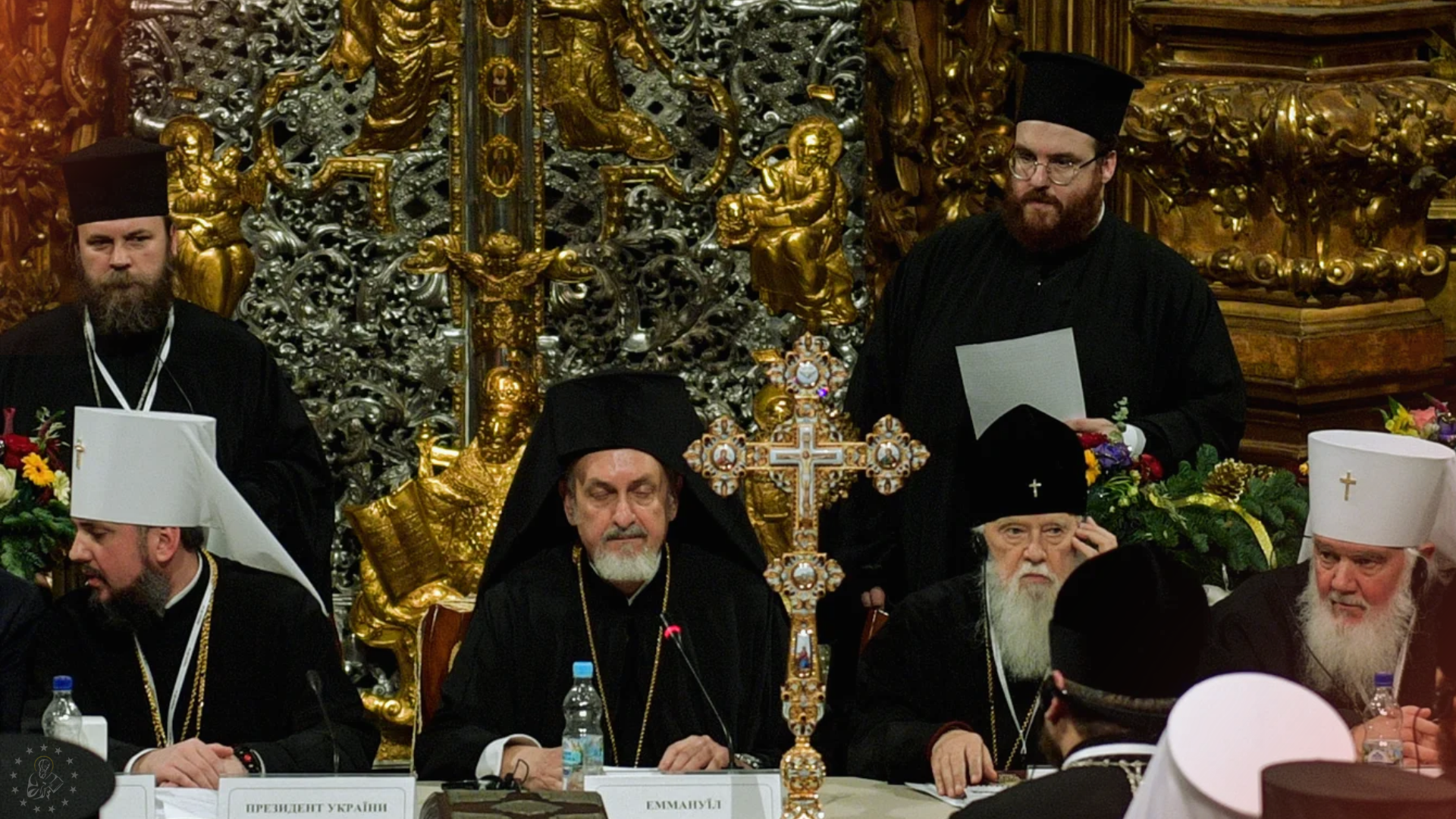
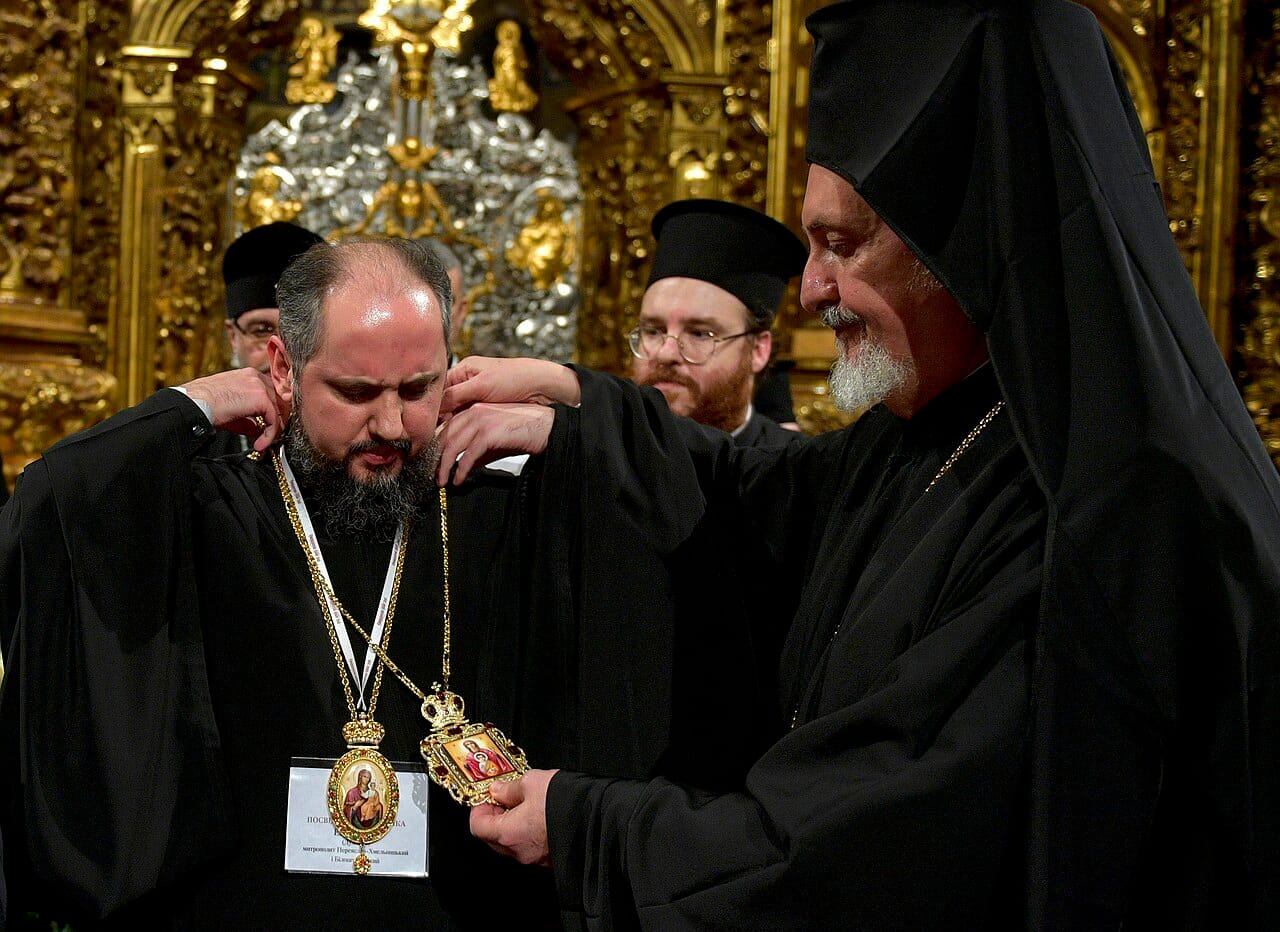
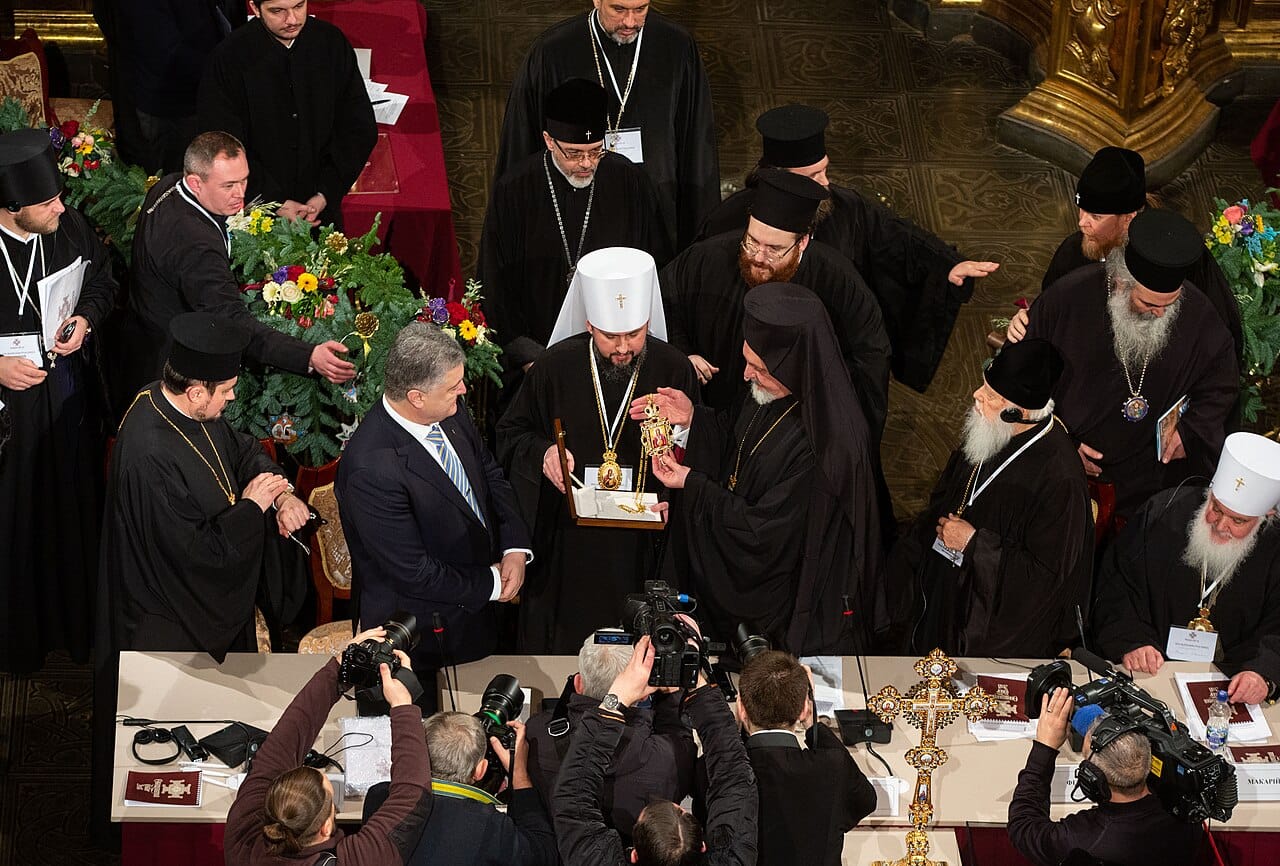
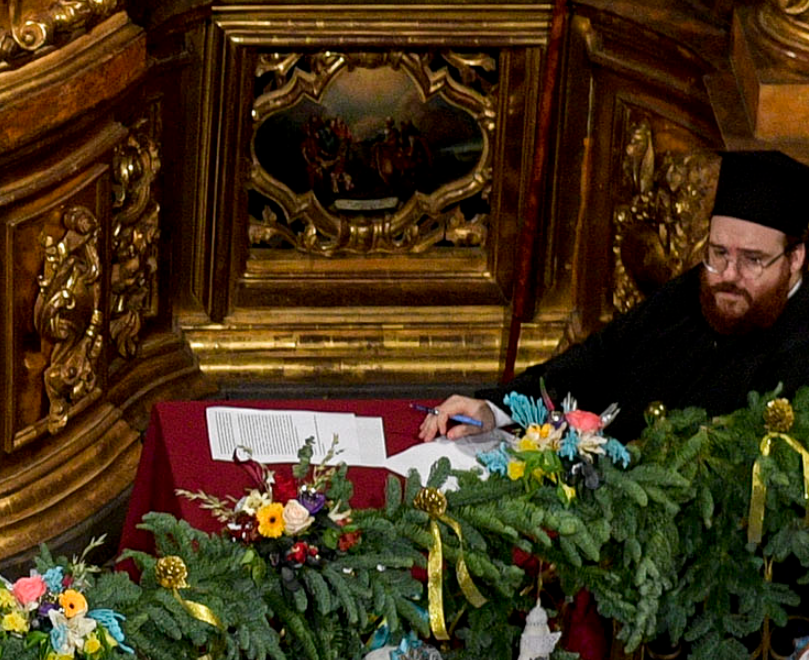
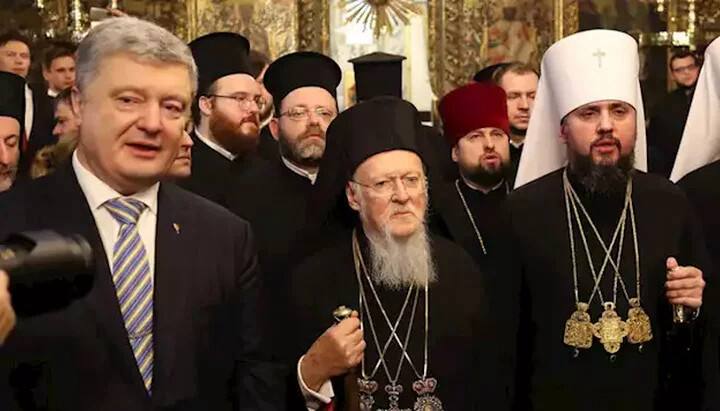
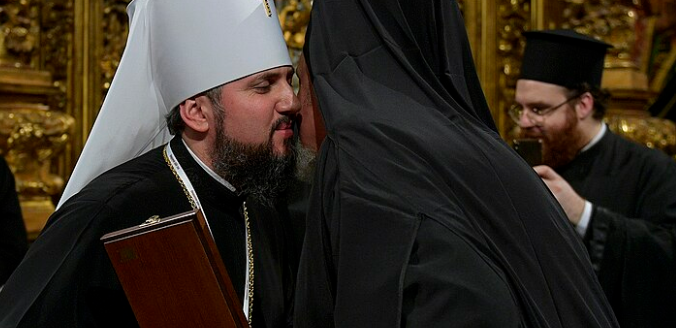
Photos: president.gov.ua
There are also events which have taken place since the 2018 council that lend to Gregorios' involvement in its proceedings, perhaps the most significant being the Holy Synod of the Church of Albania responding directly to a Master's thesis authored by Fr. Gregorios in 2022, titled, "About the Healing of the Ecclesiastical Issue in the Ukraine by the Mother Church of Constantinople (The Issue of Ordinations)."
To justify its issuing of the Tomos to the Orthodox Church of Ukraine (OCU), this scholarly work was officially published by the Ecumenical Patriarchate and distributed to primates and hierarchs of the Autocephalous Churches – thus the response from Albania.
Furthermore, according to UOJ sources, in subsequent negotiations with Churches refusing to recognize the OCU, Fr. Gregorios was regularly brought in as the "expert" on the matter.
At his consecration to the episcopacy late last year, Ecumenical Patriarch Bartholomew congratulated the new Metropolitan Gregorios of Ankara and referred to his "contribution to the issue of Ukrainian Autocephaly."
Interestingly, Ukrainian diplomats attended the consecration – a notable presence for a cleric who was elected to oversee the Turkish capital.
The response
At the time of publication of this article, Metropolitan Gregorios and the Ecumenical Patriarchate still have not responded to the UOJ's request for comment. The offer to correct inaccuracies in our reporting remains open.
The UOJ has also learned that Constantinople still has not responded to requests for comment from secular media sources. This has been described as the first time the Ecumenical Patriarchate has ever remained silent when contacted by the outlets in question.
Since UOJ-America's publication of the chronicle, numerous Greek outlets have picked up the story. Those reporting on it include Elias Damianakis – a vocal iconographer and Archon of the Ecumenical Patriarchate who offers a consistent witness in favor of the prerogatives of Constantinople – and the Orthodox Times, an outlet that is well-sourced at the Phanar and which also supports autocephaly for the OCU and all it entails.
The tone taken by the EP-aligned articles must be taken into account.
Damianakis' piece is a direct response to a column written by Metropolitan Anthony (Pakanich) of the UOC and published by the UOJ. In his response, Damianakis offers the following quote:
The ecclesiological contradiction is stark: Bishop Anthony, a hierarch outside canonical communion, presumes to question the Holy Spirit’s presence at the Kyiv Unification Council. The answer is in the very account he sadly attempts to turn against Gregorios and indirectly Ecumenical Patriarch Bartholomew.
Reports describe the Chronicle as a leaked report attributed to a participant in the Ecumenical Patriarchate’s delegation as if some conspiracy is uncovered, quite to the contrary. It records a delegate’s assistant’s fear and the acknowledged pressure they faced and clearly says that Gregorios connected that moment with Christ’s promise in Luke 12:11–12: the Holy Spirit would teach them what to say. Anthony seizes on the fear, then concludes there was 'much less the Holy Spirit.'
Damianakis goes on to refer to Gregorios as the chronicle's author numerous times in his reflection. He offers his own opinion on the chronicle and what it means, but never does he question the authenticity of the document or the identity of its author. This is significant coming from a high-ranking and highly visible Archon of the Ecumenical Patriarchate.
A column written by Hieromonk Nikitas Pantokratorinos for the Orthodox Times takes a similar approach. He stops short of mentioning Gregorios by name, but lays out his belief that the publication of the chronicle is actually a positive for the Ecumenical Patriarchate.
"The publication of this so-called 'scandalous document of the Phanar' was presented as a supposedly earth-shattering revelation, capable of demolishing the canonical and ecclesiological foundations of the granting of the Tomos of Autocephaly to the Church of Ukraine," Nikitas writes. "Yet it testifies to precisely the opposite of what its authors wish to prove. If one reads the 'Chronicle of the Week of the Clergy-Laity Council of Kyiv' carefully, one will see that it is not a record of an ecclesiastical 'conspiracy' but a testimony to the arduous efforts of the Ecumenical Patriarchate to preserve ecclesiastical order, to heal a decades-long schism, and to safeguard its canonical rights against pressures coming from every side. For the document itself shows the Ecumenical Patriarchate resisting, negotiating, threatening to withdraw, and insisting on its ecclesiological principles."
Hieromonk Nikitas has a long history of defending the Ecumenical Patriarchate and attacking the UOC, with examples here, here, and here.
Other notable Greek outlets that have reported on the chronicle include Romfea and Ekklisia Online. The latter has even called on the Ecumenical Patriarchate to comment on the document, stating:
"A church decision with such profound consequences for Orthodoxy must withstand historical scrutiny. If political pressure was exerted on the patriarchal delegation, it should be clarified. If the accounts are inaccurate, an equally clear denial, supported by evidence, is needed. Silence leaves room for suspicions surrounding the critical days of December 2018."
In the days following UOJ-America's publication of the document, a new Metropolitan of New Jersey was elected in Constantinople. According to a source in the Synod which relayed information to The National Herald, Ecumenical Patriarch Bartholomew "appeared to be hesitant and troubled for reasons known to him better than anyone else and which, reportedly, cause him concern."
The source also stated that His All-Holiness did not invite participating hierarchs to his office before the meeting, as is his custom, but instead told them, “Go ahead and vote.”
UOJ-America will publish the full, unabridged English translation of the chronicle tomorrow.
Read also