News
Funeral of Filaret Denysenko Marred by Dispute Between UOC-KP and OCU
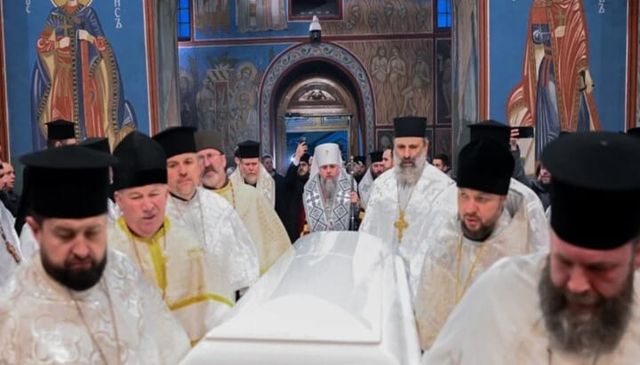
Competing claims over body, burial rites, and church authority highlight deepening divisions following the longtime schismatic leader’s death.
KYIV — The death and burial of Filaret Denysenko have triggered a major escalation in tensions between the Ukrainian Orthodox Church–Kyiv Patriarchate (UOC-KP) – not to be confused with the canonical Ukrainian Orthodox Church (UOC) – and the Orthodox Church of Ukraine (OCU), with both sides accusing each other of violations surrounding the late leader’s funeral and legacy.
Death and Immediate Aftermath
Filaret Denysenko died on March 20, 2026, at the age of 97. A central and controversial figure in Ukrainian Orthodoxy, he broke from the canonical church and had led the so-called “Kyiv Patriarchate” since 1995. Following the creation of the OCU in 2018, he held the title of “Honorary Patriarch.”
After taking offense to the selection of Epifaniy Dumenko as head of the new structure after the unification council called by the Ecumenical Patriarchate of Constantinople, Denysenko revived the UOC-KP soon thereafter.
Shortly after Denysenko’s death, Dumenko announced that funeral events would take place at St. Michael’s Golden-Domed Monastery, the main cathedral of the OCU, despite Denysenko distancing himself from the OCU for the past several years.
Lying in State and Public Farewell
On March 21, Denysenko’s body lay in state at St. Michael’s Monastery, where hundreds gathered to pay their respects. Among them was Ukrainian President Volodymyr Zelensky, who praised Denysenko’s role in the development of what he described as an independent Ukrainian Church.
Without his courage, Zelensky said, "it is impossible to imagine the history of Ukrainian independence, our spiritual independence, and the development of a truly strong state of our own.”
That same day, Sviatoslav Shevchuk – head of the Ukrainian Greek Catholic Church (UGCC) – led a memorial service at the cathedral, expressing solidarity with the OCU and describing Denysenko’s life as “almost a century of service and trials.”
Such an act is seen by critics as further revealing the desire for one state church of Ukraine – not based in either Orthodox or Catholic theology, but in nationalism.
Dispute Over Body and Testament
Tensions escalated on March 20 when the newly elected “primate” Abp. Nikodim of the UOC-KP publicly accused OCU representatives of seizing Denysenko’s body and taking it to the OCU cathedral, describing the act as a “raider” operation in violation of the canons.
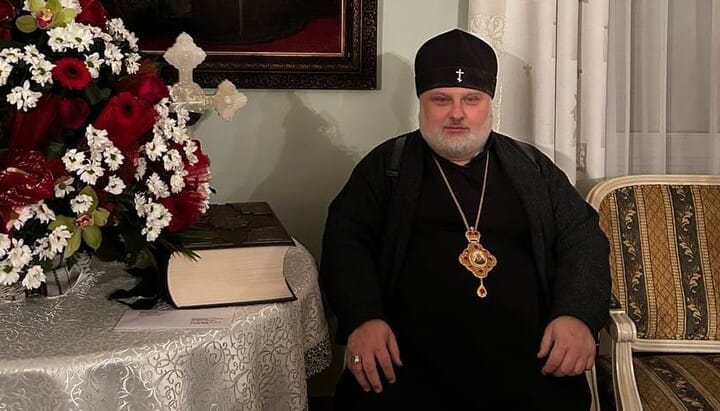
Nikodim also cited a spiritual testament allegedly signed by Denysenko in October of last year, stating that his funeral should be conducted by UOC-KP hierarchs and that he should be buried at St. Volodymyr’s Cathedral.
As previous reporting from UOJ-USA on the letter states:
“I am not the Honorary Patriarch of the Orthodox Church of Ukraine, as its representatives and leadership claim,” the 96-year-old Denysenko stated.
He also forbade the OCU from performing his funeral rites. “I bequeath that the rite of the funeral service and burial be conducted in the Patriarchal Cathedral of St. Volodymyr in Kyiv by the clergy and hierarchs of the UOC-KP, not by the OCU,” Densysenko wrote.
“They, contrary to his will, are now trying to appropriate the body of the patriarch and perform the funeral service themselves. And this, from our point of view, is a direct desecration of the blessed memory of our patriarch,” Nikodim said.
The OCU has previously dismissed the existence of such a testament, calling it a “forgery.”
After a meeting was held between Denysenko and Dumenko in November, members of the UOC-KP said their primate was "coerced" and that the OCU was "exploiting" his health decline.
Funeral and Burial Ceremony
On March 22, the official funeral ceremonies began with a Divine Liturgy at St. Michael’s Monastery, led by Epifaniy Dumenko and concelebrated by OCU hierarchs.
Following the service, a procession carried the body through central Kyiv — including Sophia Square — to St. Volodymyr’s Cathedral of the UOC-KP.
Despite the dispute, Denysenko was ultimately buried in the cathedral crypt, reportedly in accordance with his stated wishes regarding the place of burial. However, the funeral service itself was conducted by OCU clergy rather than representatives of the UOC-KP.
OCU officials emphasized the apparent continuity with Denysenko’s vision. Spokesman Yevstratiy Zoria stated that the cause of an independent Ukrainian Church “has not died and will not die.”
UOC-KP Absence, Police Presence, and Parallel Services
Representatives of the UOC-KP did not participate in the official funeral rites.
Nikodim, who was elected as the new head of the Kyiv Patriarchate under what he described as extraordinary conditions, claimed that UOC-KP clergy were prevented from attending due to threats from representatives of the OCU and the presence of law enforcement.
Reporting from UOJ-Ukraine states:
Nikodim accused representatives of Epifaniy Dumenko’s structure of hypocrisy, noting that they had earlier described Filaret as “a man in senility” and “with dementia.” “And now, suddenly, these same people, having seized the body, are trying to do PR off his blessed memory,” the newly elected head of the UOC-KP said, adding that the purpose of these actions was to take possession of property.
Instead, UOC-KP hierarchs held a separate memorial service at a Kyiv church, where Nikodim described Denysenko’s death as “an irreparable loss” and called for daily prayers for his repose.
“His figure will remain in history forever as a symbol of courage, faithfulness, and spiritual strength,” he said.
According to UOC-KP representatives, attempts to gather at St. Volodymyr’s Cathedral were blocked by police, who allegedly cordoned off the site and denied access to their clergy.
Nikodim further claimed that the election of a new primate had to be conducted outside the cathedral due to the presence of law enforcement and security services, which he described as “accomplices” in what he called a seizure of church property.
He also alleged that access to key church buildings, including the Patriarchate residence, had been restricted, with valuable items remaining inside.
OCU Moves to Consolidate Control
On March 23, Epifaniy Dumenko conducted a memorial service for Denysenko at St. Volodymyr’s Cathedral and formally received the cathedral’s clergy into the OCU.
According to an official statement, clergy led by rector Borys Tabachek were issued decrees confirming their continued ministry under the OCU, citing the decisions of the 2018 unification council.
"Based on their submitted petitions, the Primate presented decrees confirming the continuation of their ministry among the clergy of the cathedral, which is a religious community belonging to the Orthodox Church of Ukraine, in accordance with the decisions of the Local Council of the UOC-KP and the Unification Council held at Saint Sophia's Cathedral on December 15, 2018," the OCU said.
Broader Implications
The dispute reflects a long-running conflict between supporters of Denysenko within the Kyiv Patriarchate and the leadership of the OCU, dating back to the 2018 creation of the latter.
Nikodim argued that recent events demonstrate that the OCU “does not seek genuine unity,” while also expressing willingness for dialogue toward a unified local Church independent of both Moscow and Constantinople.
Reporting from UOJ-Ukraine states:
Despite the conflict, the new leader of the UOC-KP expressed readiness for dialogue in order to create a “single local church with a patriarchal structure,” independent of both Moscow and Constantinople. “If we truly want to have one Church and to have genuine Christian love, then even half an hour would be enough for us to explain ourselves,” Nikodim said, adding that he intended to reach out to Metropolitan Onufriy and OCU head Epifaniy.
At the same time, he sharply criticized the methods used by the OCU, accusing it of hypocrisy in its calls for unity.
“The Orthodox Church of Ukraine declares that it is ready for unification... And on the very next day it violently seizes churches, using tear gas, batons, and angle grinders," he said. "Is that an expression of love? I think not,” Nikodim concluded.
As the dust settles following Denysenko’s burial, the conflict between the two structures appears to have deepened — with disputes now extending beyond ecclesiastical authority to include control over legacy, property, and even the final rites of one of Ukraine’s most influential – and controversial – religious figures.
Read also