



Study: About 6 in 10 Cradle Orthodox in U.S. Remain in Church
Analysis of national surveys finds most who leave Orthodoxy abandon religion entirely, while overall retention appears relatively stable over time.
MARCH 9, 2026 — A new analysis by the Orthodox Studies Institute indicates that roughly 60 percent of Americans who were raised Orthodox remain in the Church as adults.
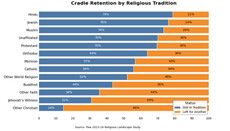
The study, conducted by Matthew Namee, examined major national surveys that ask respondents about both their current religion and the faith in which they were raised. The largest dataset comes from the 2024 Pew Religious Landscape Study, which found that 64 percent of the 260 respondents raised Orthodox still identified as Orthodox in adulthood.
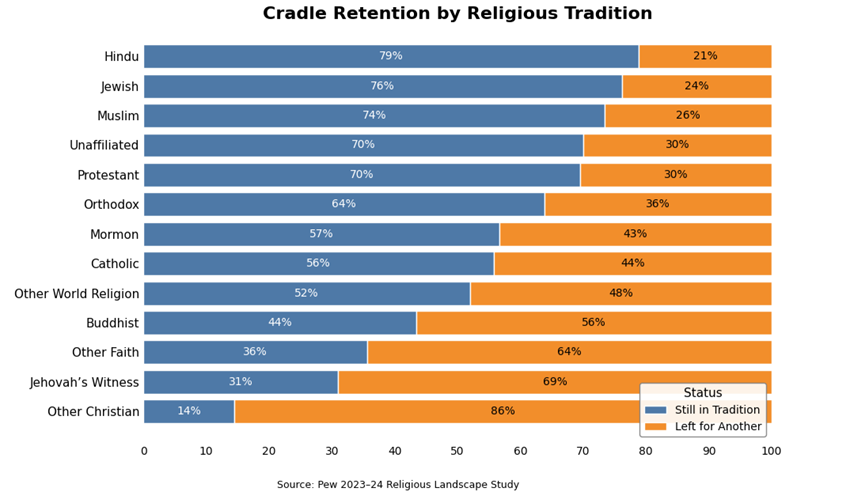
Source: Orthodox Studies Institute (citing Pew 2023-24 Religious Landscape Study)
The previous Pew survey in 2014 reported a similar figure, with 58 percent of cradle Orthodox remaining in the Church. Combined, the findings suggest that about six in ten Americans raised Orthodox continue to identify with the faith later in life.
"That’s a bit better than Catholics but worse than Protestants – with the caveat that Pew doesn’t show, in its publicly-available 2024 dataset, any distinction between different types of Protestants," Namee writes. "So a cradle Presbyterian who’s now non-denominational will show up as being 'Protestant' both as a child and an adult, even if the reality is that they left their childhood religious tradition.
The study found little difference between men and women. Across the combined datasets, 63 percent of men and 60 percent of women raised Orthodox remained in the Church.
Among those who left Orthodoxy, most also left religion entirely. In the 2024 Pew survey, 54 of the 96 former Orthodox respondents now identified as religiously unaffiliated, including individuals who described themselves as atheists, agnostics, or having no particular religion. Others joined different Christian traditions, primarily Protestant communities, while a small number adopted non-Christian religions.
The analysis also reviewed smaller surveys and data from the General Social Survey. Although these studies involved much smaller sample sizes, their results generally fell within a similar range, with retention estimates between about 52 percent and 63 percent.
"It’s difficult, if not impossible, for Orthodox entities to collect our own data on this sort of thing," Namee noted. "If we at OSI put out a survey of cradle Orthodox, we’d get a disproportionate number of responses from cradles who are still Orthodox, just because the sort of people we can reach, and the sort of people who take Orthodox surveys, are going to be active Orthodox people. So, studying the question of cradle retention isn’t easy."
Taken together, the available data suggest that around six in ten cradle Orthodox in the United States remain in the Church as adults. While this retention rate is comparable to other Christian groups in the country, the study notes that further research is needed to better understand why some young people remain active in the Church while others leave.
"~60% retention isn’t terrible, in the context of American Christianity, but as the father of seven kids, I can say that it certainly isn’t acceptable, either," Namee concludes. "At OSI, we’re planning to do our own research into the question of cradle retention and engagement in the future, so that we can better understand why some kids leave the Church while others grow up to become faithful adults."
Previously, the UOJ reported that OSI had named Dn. Seraphim Rohlin as Director of Analytics.