



OSI Report Highlights Gap in OCA Priest Shortage Data
The Orthodox Studies Institute says differing parish definitions and rising demand reveal a deeper OCA clergy shortage than official figures acknowledge.
HOUSTON — A new report by Dcn. Seraphim Richard Rohlin and Matthew Namee of the Orthodox Studies Institute examines clergy trends in the Orthodox Church in America (OCA), arguing that the jurisdiction’s priest shortage is more severe than official figures suggest, and is being masked in part by differences in how parish data is counted between OSI and the OCA Chancellor’s Office.
The analysis draws on the OCA’s “Pastoral Changes” reports from 2010 through 2025 and compares them with figures published by the Chancellor’s Office in 2025. While both datasets originate within the same ecclesiastical system, the OSI identifies significant discrepancies in how clergy and parish totals are interpreted and categorized.
As the authors explain directly, “Our numbers, derived from the Pastoral Changes reports, don’t match the data from the Chancellor’s Office. This is most likely because we are counting things somewhat differently. We don’t know precisely what criteria the Chancellor’s Office used to define a ‘parish,’ but we counted missions and mission stations/chapels as ‘parishes’ – basically, anywhere where there is an altar set up for regular worship. Presumably, the Chancellor’s Office used a somewhat different definition.”
The report notes that the Chancellor’s Office has previously expressed confidence in the stability of clergy supply. In a 2025 statement, it argued, “We are not expecting to face an acute clergy shortage in the near future.” OSI’s authors challenge that conclusion, suggesting that while ordination numbers have improved modestly in recent years, they are not sufficient to meet rising pastoral demand.
One of the report’s central findings is that clergy inflows and outflows are nearly balanced, leaving little room for net growth. Even where ordinations have increased to roughly 25 per year since 2022, retirements, deaths, and depositions continue to offset gains, while transfers remain effectively neutral over the long term.
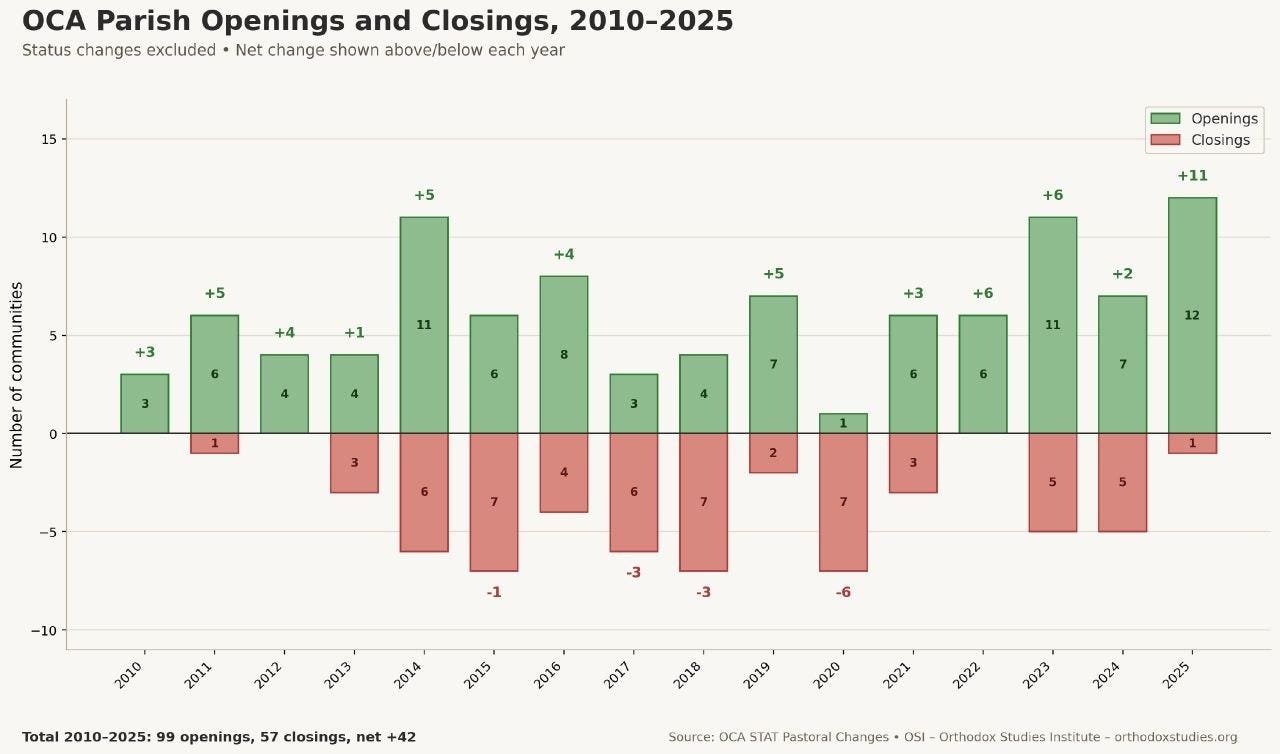
The mismatch becomes more pronounced when parish expansion is considered. The report emphasizes that new missions and growing communities are increasing demand for clergy faster than supply can respond.
Even if the OCA has been — just barely — breaking even on attrition over the past few years, the increased demand for active priests due to new parish openings and the rapid growth of existing parishes means that the jurisdiction actually needs many more priests than it is producing.
The OSI also underscores that even under highly optimistic assumptions, the gap would take years to close. The authors write, “But consider this: even if the OCA were to stop opening parishes altogether, and even if the ordination rate increases to 30..., and if the other rates hold steady..., it would take the OCA 17 years to make up its current deficit. Realistically, we know that many parts of the OCA are growing rapidly, with new missions and a growing need for second priests at established parishes. The difficult reality is that the OCA’s priest shortage is a serious problem for the jurisdiction and, unless something changes, is likely only going to worsen as Orthodoxy grows in the coming years.”
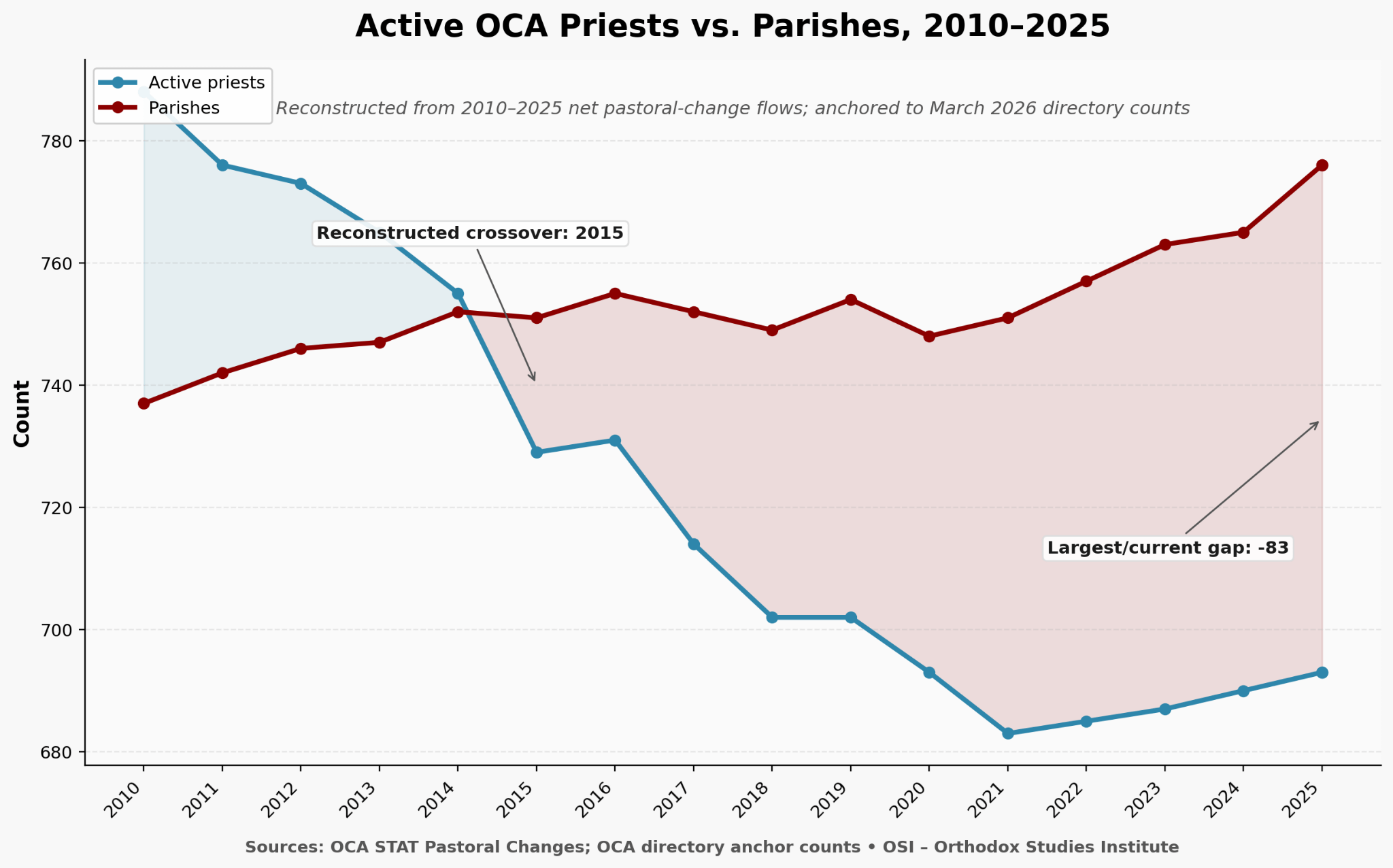
Taken together, the OSI report frames the issue not merely as a numerical shortfall, but as a structural mismatch between clergy supply and a rapidly expanding ecclesial footprint. It concludes that the divergence between OSI’s parish-based accounting and the Chancellor’s Office definitions is not just methodological, but materially significant for assessing the future stability of clergy deployment across the OCA.
"In light of the convert surge, there’s no reason to believe that parish openings will slow down any time soon," the report states.
Previously, the UOJ reported that the OSI warned of a potential crisis in American Orthodoxy in 2040.