Defense of The Faith
The Kyiv Post Proves Our Point
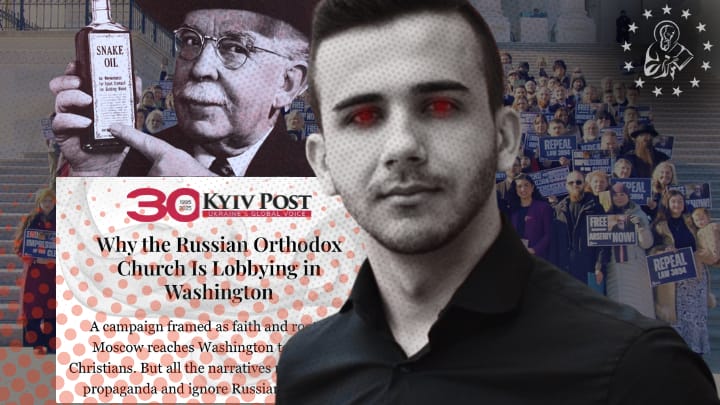
How media narratives about UOJ-USA and the Ukrainian Orthodox Church collapse under their own citations
In recent weeks, David Kirichenko published an article alleging that UOJ-America and the Society of Saint John are part of a Moscow coordinated effort to influence Washington and sway American Christians. That article followed an earlier piece by Kirichenko for Forbes, which was removed for containing defamatory claims and narratives. Because the new article repeats several of the same mischaracterizations—while introducing new ones—it requires a response.
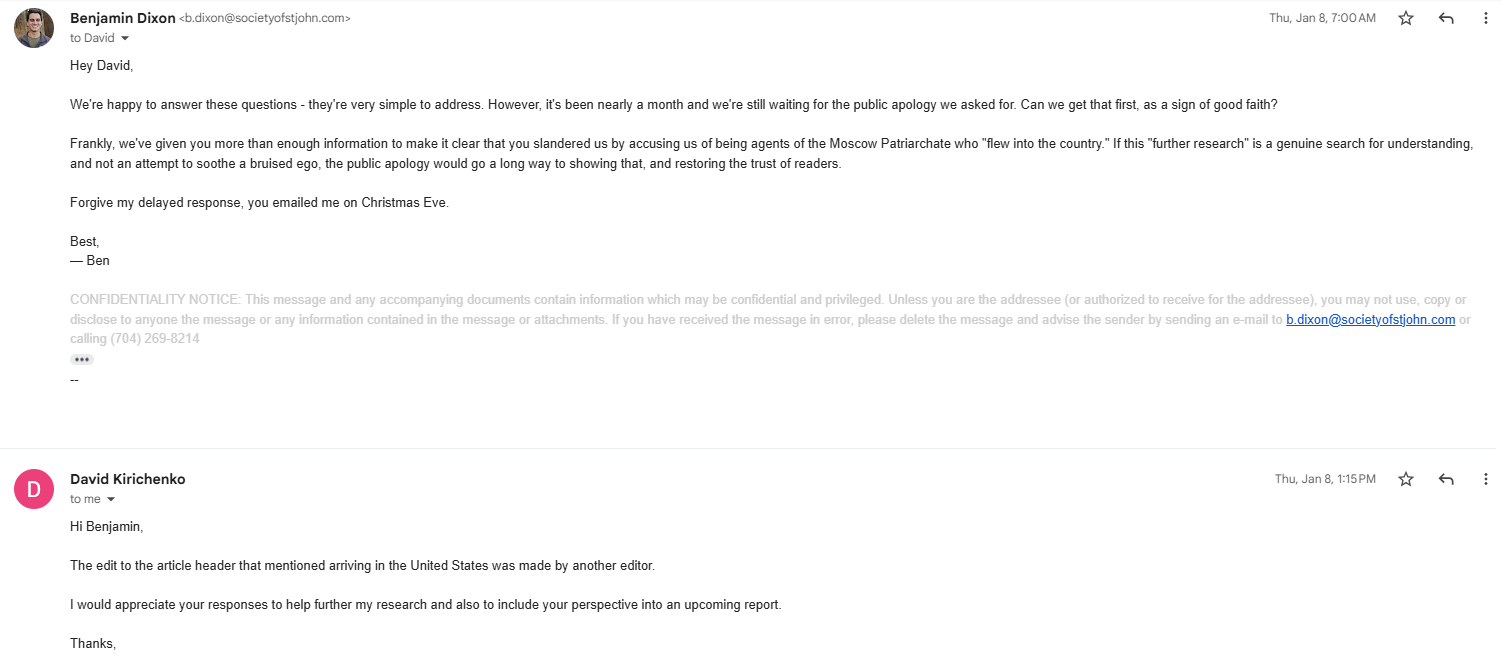
After the Forbes article was withdrawn, Kirichenko contacted the Society of Saint John to request comment for what he described as a new “investigation”—based largely on previously debunked claims. We responded that we were prepared to answer his questions, provided that an appropriate correction or apology for the earlier defamation preceded any further reporting. No such correction was issued—in fact, David tried to blame the editors at Forbes for the whole thing. Instead, a new article appeared, this time in Kyiv Post, advancing a familiar narrative while relying on sources that, upon examination, contradict many of its own claims.
This response is therefore not about disagreement or politics, but about accuracy.
What follows examines Kirichenko’s assertions against the record he himself cites, as well as publicly available data from Ukrainian institutions and international organizations. When those materials are read carefully, a different picture emerges—one that raises serious questions not only about this article, but about the broader narrative being promoted regarding the Ukrainian Orthodox Church.
When President Zelensky declared martial law, the state took control of the press. All information coming out of Ukraine is carefully crafted by the Security Services of Ukraine (SBU—the direct successor to the Ukrainian KGB). This, combined with a network of paid journalists, influencers, activists, and lobbyists make up Kyiv’s information-warfare apparatus. This apparatus carefully crafts narratives to be repeated by a broader network of activists, supporters, and bot networks to control the global narrative and maintain international support.
These narratives are sustained through redirection, selective and misleading statistics, false reports, and outright lies. Any narrative contrary to the approved narrative is branded as “pro-Russian narratives” under Ukrainian Law. According to Law 2265-IX, simply speaking of what is happening to the UOC is considered spreading pro-Russia narratives and inciting religious hatred or justifying the aggressor’s invasion. This is precisely what we see in David’s reporting; he says that while there is no evidence that we are tied to the Kremlin—because we’re not—the “narratives” we use allegedly originate in “Russian state propaganda.”
At the same time that Ukraine and its information apparatus label us “Russian propagandists” for reporting on the persecution of the UOC, they are remarkably open about this persecution when speaking domestically. On December 25, 2025, for example, the SBU released a TikTok video showing armed agents kicking in apartment doors. Across the screen appeared the caption: “What kind of carolers show up to the homes of those who celebrate Christmas on January 7th?”
This was clearly targeted at the UOC, the only Church in Ukraine that still officially celebrates Christmas according to the Julian Calendar.
More recently, Fr. Roman Hryshchuk of the state-aligned OCU posted on Facebook that “Ukrainian victory” could only be achieved once every UOC church had been seized. He lamented that, at the current pace, it would take another 45 years to eradicate the UOC.
Viktor Yelensky, head of the State Service for Ethnopolitics and Freedom of Conscience, told the Daily Caller that his agency is conducting a full-scale crackdown on the UOC.
This begs the question” why do Ukrainian officials accuse UOJ of being “Russian propaganda” when they themselves openly boast about persecuting the UOC? Why be so open about it at home, but attack those who bring attention to it in the West?
The answer comes from Julian Hayda, Associate Director of Public Engagement for Razom for Ukraine. During an emergency strategy call of the American Coalition for Ukraine, convened in response to the Society of Saint John’s Day of Action on Capitol Hill, he admitted that religious freedom is Ukraine’s Achilles’ heel. He cautioned activists against widely sharing images of destroyed Orthodox churches, noting that many were destroyed by the Armed Forces of Ukraine. Hayda further acknowledged that the Ukrainian army uses UOC churches as staging points for soldiers—actions that constitute violations of Article 4 of the Hague Convention, Article 53 of the Additional Protocol, and Article 8(2)(b)(ix) of the Rome Statute of the International Criminal Court.
What is perhaps most revealing about Kirichenko’s article is that nearly every link and photograph he includes undermines his own narrative.
For example, he links an article intended to support his claim that “media reports linked church-associated figures to the formation of a mercenary unit known as St. Andrew’s Cross.” Yet the second paragraph of that very source states that Patriarch Kirill “is still smarting from the loss of a third of his flock following the breakaway of the Ukrainian Orthodox Church.” If the Ukrainian Orthodox Church broke away, costing Patriarch Kirill one-third of his flock, how can the UOC simultaneously be described as the “Moscow Church”?
Kirichenko then elaborates on Russian targeting of Evangelicals and other religious minorities in Donbas, citing a source to justify the claim that “Russian forces have damaged or destroyed at least 660 churches and other religious structures, including 206 Protestant ones.”
I do not dispute that roughly 200 Protestant churches have been destroyed—and this is tragic. However, the narrative advanced by Kirichenko and Steven Moore is that the UOC is largely spared because they’re “collaborators” while Protestants, Greek Catholics, and the OCU bear the brunt of Russian violence. Yet Kirichenko’s own source says otherwise:
“…ironically, the largest number of churches Russian forces have damaged or destroyed have been those of the Ukrainian Orthodox Church, with its much-debated ties to the Moscow Patriarchate —187.”
Other studies place the number even higher. The Workshop for the Academic Study of Religions (WASR), a Ukrainian think tank, reports that between February 24, 2022 and August 24, 2025, at least 376 UOC churches were destroyed, compared to 181 Protestant churches. The OCU lost 66 churches, while Greek and Roman Catholics lost 26. According to WASR, the UOC has lost more churches to Russian bombing than all other religious groups combined. Moreover, because of Ukraine’s forcible seizure of UOC parishes, many churches reported as OCU losses were in fact UOC churches that had been forcibly re-registered.
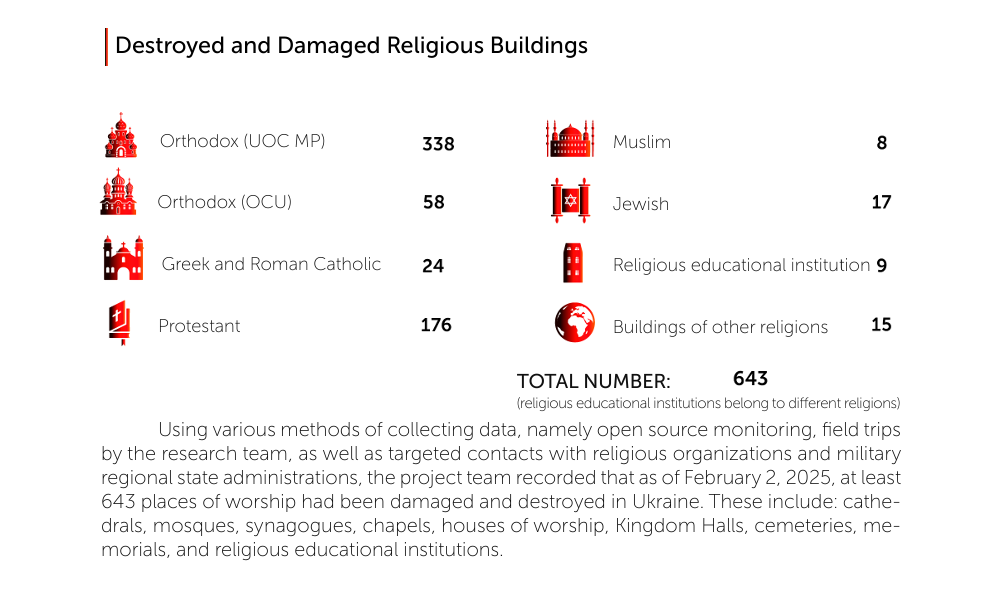
On both sides of the front line—Ukrainian and Russian—it is the Ukrainian Orthodox Church that bears the brunt of this conflict. This may come as a shock to readers, but it is not a shock to us. It is precisely why UOJ has been so vocal.
Russia accuses the UOC of spying or disloyalty, harassing clergy, seizing or destroying their parishes and absorbing them into the Moscow Patriarchate. Ukraine accuses the UOC of spying for Russia; it then harasses clergy, seizes or destroys their parishes, absorbing them into the OCU.
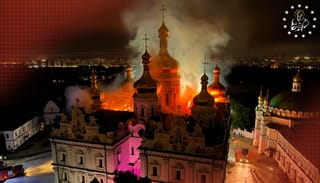
Ukrainian activists frequently share images of churches destroyed by Russian forces for propaganda purposes, but they consistently omit one detail: these are UOC churches. Kirichenko does the same in his Kyiv Post “analysis.”
After claiming that Russia targets “denominations not aligned with the Moscow Patriarchate” and that “Evangelical Christians have been particularly vulnerable,” he includes a photograph of the Church of the Annunciation in Bakhmut, destroyed in 2024. What he fails to mention is that the Church of the Annunciation was a UOC church.
The Ukraine lobby, and its ecclesiastical allies, likewise try to paint any local church who supports the UOC or calls for consensus between the Churches in resolving the Ukraine crisis of being “pro-Putin.” Kirichenko, linking to an Orthodox Times article that makes a similar claim, states that “the Antiochian Patriarchate has taken a position broadly aligned with Moscow on the war.” Antioch has, of course, done no such thing. Instead, the Synod expressed its “deep pain and great sorrow,“ in witnessing “the distressful escalation in Ukraine and raised their fervent prayers for peace in Ukraine.”
Nothing in this statement indicates support for the Russian war effort, nor justifying the invasion. But for the Ukrainian government and its surrogates, anyone who fails to support the OCU—or is opposed to the destruction of the UOC—is a Russian collaborator.
But Ukraine’s information apparatus survives only so long as it dominates the media space. Once that control weakens, its narratives collapse under the weight of reality. The more they attack us, the more attention they draw to the issue—and by extension, the more they’re forced to talk about it.
What this ultimately exposes is not a debate over facts, but a battle over narrative control.
The reality is straightforward: the Ukrainian Orthodox Church is being persecuted—by the Ukrainian state domestically, and by a network of lobbyists, activists and sympathetic media outlets internationally who work to obscure that persecution. When reporting is honest, the evidence is unavoidable: the UOC has lost more churches than any other Christian body in the conflict; its clergy and faithful are harassed, detained, and dispossessed; its holy places are seized, repurposed, or destroyed; and its communities are collectively branded as enemies of the state.
This is why criticism is deflected as “Russian propaganda,” even when it comes from international human rights bodies, Western governments, and global Christian institutions. It is why journalists like David Kirichenko must rely on insinuation, selective sourcing, and self-refuting citations. And it is why those who speak openly about religious freedom being Ukraine’s “Achilles’ heel” in private conversations, say something else in public.
None of this requires speculation. The admissions are on the record. The statistics are published by Ukrainian institutions themselves. The photographs and videos are real—and plentiful. The only thing required to see the truth is the willingness to look past the narrative.
The Union of Orthodox Journalists of America does not exist to launder information or serve geopolitical agendas, much less the Society of Saint John. We exist to report what is happening to the Church—clearly, accurately, and without fear. The more our work is attacked, the more evident it becomes that the issue is not misinformation, but exposure.
And exposure, in the end, is what those persecuting the Ukrainian Orthodox Church fear most.