Man and Church
A Righteous Man
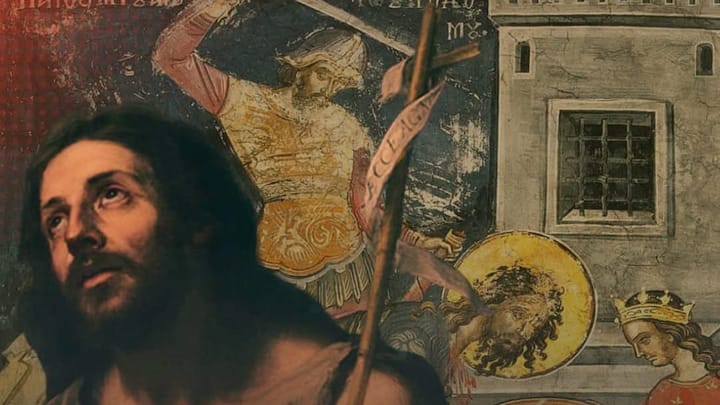
Reflecting on the “little Great Friday” that is the Beheading of the Holy and Glorious Prophet, Forerunner, and Baptist John.
“A righteous man.” In some translations of St. John the Forerunner’s troparion, this is how he is introduced to us before any other details are mentioned. Today, that righteous man is beheaded.
“This is why today is a little Great Friday,” St. Justin Popovic states. “Consider: senseless people murder the greatest of the righteous. Is he getting in their way? Yes, he gets between the perverse King Herod and the dissolute Herodias. God’s Truth, God’s immutable Truth gets in the way of the lawless, gets in the way of poor sinners, gets in the way of everyone stupefied by the various passions. Consider: do not Christ’s opponents even today still shout ‘Crucify Him, Crucify Him!?’ Even today, do not those who oppose Christ still demand the head of Jesus of Nazareth? They call for His head, not to mention calling for the head of John the Baptist.”
When we pray for “a good defense before the awesome judgment seat of Christ,” we could even say we pray that we will stand righteous before Him. There is no one greater born of women (Matthew 11:11) and no one more fitting as an example of this righteousness than St. John, who understood that there is no righteousness apart from God.
St. Paul tells us about this righteousness. In Romans 3:22 he states that “the righteousness of God apart from the law is revealed, being witnessed by the Law and the Prophets, even the righteousness of God, through faith in Jesus Christ, to all and on all who believe.” Just after the famous passage in Philippians 3 where the Apostle writes that he counts all things as rubbish for the knowledge of Christ Jesus, he shares that he wishes to “be found in Him, not having my own righteousness, which is from the law, but that which is through faith in Christ, the righteousness which is from God by faith; that I may know Him and the power of His resurrection, and the fellowship of His sufferings, being conformed to His death, if, by any means, I may attain to the resurrection from the dead.”
The Law and the Prophets were also witnesses to the Forerunner. Isaiah proclaims:
The voice of one crying in the wilderness:
"Prepare the way of the Lord;
Make straight in the desert
A highway for our God."
Malachi brings us back to this theme of righteousness:
"Behold, I send My messenger,
And he will prepare the way before Me.
And the Lord, whom you seek,
Will suddenly come to His temple,
Even the Messenger of the covenant,
In whom you delight.
Behold, He is coming,"
Says the Lord of hosts.
"But who can endure the day of His coming?
And who can stand when He appears?
For He is like a refiner’s fire
And like launderers’ soap.
He will sit as a refiner and a purifier of silver;
He will purify the sons of Levi,
And purge them as gold and silver,
That they may offer to the Lord
An offering in righteousness."
Who can endure the day of His coming, so that they may offer to the Lord an offering in righteousness? It was the righteous Forerunner’s mission to prepare the people, preaching repentance and the coming of the Kingdom of Heaven. This is made clear by the Archangel Gabriel to John’s father, Zechariah:
“And he will turn many of the children of Israel to the Lord their God. He will also go before Him in the spirit and power of Elijah, ‘to turn the hearts of the fathers to the children,’ and the disobedient to the wisdom of the just, to make ready a people prepared for the Lord.”
So essential was this mission that the Evangelists deeply intertwine it within their respective Gospel narratives. Matthew begins writing of the Forerunner in his third chapter. Luke and Mark start with him, and John the Theologian uses parts of his prologue to place the Forerunner within this cosmic picture. How beautiful and revealing it is that as the Theologian establishes Christ as the eternal Word Who was “in the beginning,” he also tells us of the Forerunner’s mission, which is something that all Christians can aspire to:
“There was a man sent from God, whose name was John. This man came for a witness, to bear witness of the Light, that all through him might believe.”
Numerous times throughout the Old Testament, the Lord refers to the people of Israel as His “witnesses.” Of course, we are all familiar with how often this calling was ignored or worked directly against. The Forerunner, then, is the Witness of all witnesses, the Messenger of all messengers, the Prophet of all prophets, the first Apostle of all the apostles.
This mission extended beyond the temporal realm. After Jesus hears about the beheading of His own cousin and Forerunner, we are only told that He withdrew in private to a solitary place. Christ resurrects Lazarus, whom He knows and loves. He even resurrects a stranger in the widow’s son. What about this righteous man, beheaded by a prideful sinner who kept a foolish promise? Why isn’t he resurrected?
“Because the Holy Forerunner must also become the first Apostle to Hades, to death’s kingdom – to which had departed the souls of all people from Adam to the time of the coming of the Savior into this world,” St. Justin Popovic states. He continues:
"In that kingdom of death called Hades, i.e. the impenetrable place, where no one can see anything, in that kingdom was to be found everyone: the righteous and the sinners, all of the people of the Old Testament, up to the coming of the Lord Jesus Christ. Sin had brought death into the earthly realm, into the world of men, and the kingdom of death became the sole abode for human souls in this world. The Forerunner had to become the Forerunner in Hades as well, in death’s kingdom, so that he might preach there as well to the souls of all human beings: Lo, the One whom you have been awaiting, Whom all you Righteous Ones: Moses, Abraham, David, all of the Holy Prophets and Righteous Ones, have been thirsting to see, has come to earth. Lo, He has come to earth as a man, as the Savior, and he is working such signs and wonders as you, all of you taken together, have never seen. His glance heals people of all diseases, His word resurrects everyone from death, His voice drives demons out of those possessed. Truly the Savior of the world, our Lord Jesus Christ has come to earth. And lo, I go before Him to preach to you as well this best of news: He will come down here to us as well. In a little while He will come down, and you will see Him. You will be able to see what kind of human soul He has, One filled with God and shining with infinite light.
"The Holy Forerunner appeared in death's kingdom as the first Evangelist, in order to preach the Good News of Christ to all of the souls in the kingdom of death. He appeared as well to all of them as the first Martyr, to show that people will joyously go to their deaths for True God, the Lord Jesus Christ, Savior of the world, until death is defeated and destroyed. They will not fear death, for they will be more powerful than death. Through his bodily Resurrection, the Lord grants the body victory over death. The glorious Forerunner also entered into the kingdom of death as the Forerunner of all of the true Confessors of Christ in the world, all of the true Prophets in the world, to announce to all of the souls in the kingdom of death: Lo, death is defeated, the demons destroyed, the kingdom of death will be destroyed when, in a little while, the Lord appears here, and you will be led out of this horror and into heavenly joy, into the Kingdom On High.
"This was why the Lord remained silent, why he did not resurrect the greatest man among those born of women, for that man was to complete his apostolic, evangelistic, martyric, confessor’s spiritual struggle in Hades, in the kingdom of death."
This is why today is a little Great Friday. The greatest of all men is murdered. God’s messenger is beheaded – there is no celebration, and the fast is strict. But just as we know the work Christ is accomplishing in Hades after His crucifixion, we also know that the Forerunner’s mission didn’t end with his lawless slaughter.
In the person of St. John the Forerunner, we see possession of all the virtues. In Galatians, St. Paul tells us the fruit of the Holy Spirit is love, joy, peace, longsuffering, kindness, goodness, faithfulness, gentleness, self-control. When Gabriel proclaims the conception of John to Zechariah, he says that the child will be one “filled with the Holy Spirit, even from his mother’s womb.” We see this in his recognition of Christ when Mary visits Elizabeth – even in the womb he knows and recognizes his Savior. As an adult, he possesses humility and remains faithful to pointing others toward Christ.
“It is He who, coming after me, is preferred before me, whose sandal strap I am not worthy to loose,” he says in John’s Gospel.
Even so, the Forerunner offers more than just a message or a “good life.” He offers himself completely. In this way, he truly lived the angelic life, and remains a prototype for the monastic life today.
St. Dorotheos of Gaza writes that the commandments were given to all Christians, and it is understood that every Christian observes them as if they were a tribute appointed to be paid to the King. He continues:
“There are, however, in the world great and illustrious men who not only pay the appointed tribute, but also offer gifts and they are thought worthy of great honor, great benefits and esteem. So also the Holy Fathers not only kept the commandments but also offered gifts to God. These gifts are virginity and poverty. These are not commanded but freely given.”
Of these Holy Fathers, we see the Forerunner as the model of the virtues, the offeror of the freely given gifts, the righteous man who fulfills his calling before God.
Just as the Theotokos was chosen to bear God in the flesh, the Forerunner was chosen to fulfill this unique mission, the one that all the prophets longed for and hoped to see. We understand these two as the ones who sit at Christ’s right and left hand, “for whom it is prepared by My Father” (Matthew 20:23). We see this represented in the Deisis icon and on the standard iconostasis in our parishes.
“Your father Abraham rejoiced to see My day, and he saw it and was glad,” Christ tells the unbelieving Jews.
St. John saw it, too, and he acted accordingly. Due to this unwavering faith, enduring beheading was not a heavy burden, but rather an accepted and even desirable result. This was just a fleeting moment which had to come before the Forerunner could be present in Hades to hear the call:
Lift up your heads, O you gates!
And be lifted up, you everlasting doors!
And the King of glory shall come in.
“It was completely dark in the stone cellar in which the Forerunner and Baptist of Christ was imprisoned,” St. Luke, the Blessed Surgeon of Simferopol, states. “There was no sunlight there, but the light shines in the darkness, and the darkness did not comprehend it” (John 1:5).
There was a man sent from God, whose name was John. This man came for a witness, to bear witness of the Light, that all through him might believe.
Now we must ask ourselves: do we?
Read also