Man and Church
A Russian Patericon at Last: Lives of the Saints of Rus’
Holy Trinity Publications’ new two-volume collection offers English-speaking Orthodox Christians a concise, beautifully produced guide to the saints of Rus—and a living introduction to the sanctity that shaped the Russian Church.
We finally have a concise Russian Patericon in the English language.
For Orthodox Christians in ROCOR, the Patriarchal Parishes, the Orthodox Church in America, and other parishes formed by the Russian liturgical and spiritual tradition, that is no small thing.
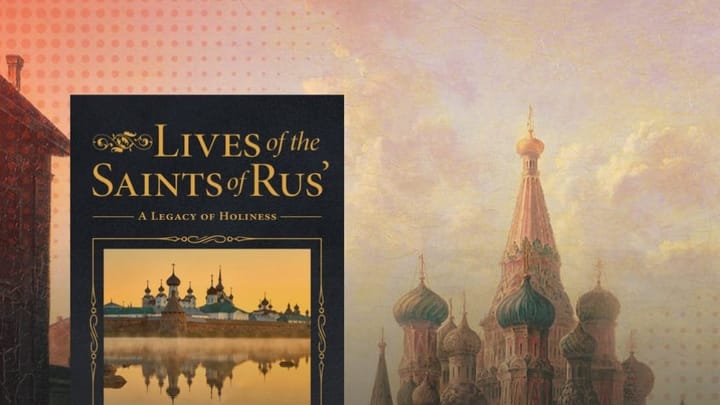
Lives of the Saints of Rus’: A Legacy of Holiness, Volume I, published by the Printshop of St. Job of Pochaev, an imprint of Holy Trinity Publications, gathers together the lives of the saints of Rus in a form that is both accessible and practical for ordinary readers. The lives themselves were originally compiled by Nun Taisia Kartsova and published in Russian at Jordanville in 1983, during the remarkable period of preparation leading up to the Millennial Celebrations of the Baptism of Rus.
We have, of course, long had great collections of saints’ lives in English. Saint Dimitry of Rostov’s monumental Lives of the Saints is perhaps the most obvious example, but at an eventual twelve volumes—each costing roughly $40—the complete set is simply beyond the reach of many ordinary parishioners.
Likewise, the Prologue of Ohrid and the Synaxarion, both available through Sebastian Press, are tremendous resources. Yet anyone following the Russian Church calendar closely will eventually notice that the commemorations do not always align perfectly. Sometimes the difference concerns rank; sometimes the date itself. With more recent saints, things can become even more confusing, due to attempts to sync commemorations.
For that reason alone, this new two-volume set is worth serious consideration for anyone worshipping within a Russian-tradition parish or jurisdiction.
The hardcover edition I reviewed is handsome and substantial, with gold-embossed lettering on the cover and binding. The interior is well laid out and abundantly illustrated with icons of the saints whose lives fill its pages. The volume also includes maps covering four major periods of Russian history: the principalities of Rus' during the Kievan period, Muscovite Rus' in the sixteenth century, the Russian Empire during the time of Peter the "Great," and finally a map of Russia under the Bolshevik Yoke.
These additions are more useful than they may initially sound. Russian ecclesiastical history spans enormous distances, shifting borders, changing political centers, and centuries of upheaval. The maps help situate saints within the world they actually inhabited—aiding the reader as the stories play out in their minds.
The editors have also included an alphabetical listing of the saints contained in the volume, a timeline of Russian history stretching from the Kievan period to the fall of the Soviet Union, extensive notes, and other supporting material. It is the sort of book clearly intended not merely to be read once, but to remain on a shelf within reach and be consulted again and again.
Particularly moving is the section devoted to the New Martyrs and Confessors of Russia. Here the reader receives something approaching a crash course in what was, by sheer scale, the largest and most acute persecutions and slaughters of Christians in the history of the Church. Reading these lives together has a cumulative effect. Statistics about persecution can become abstract; the names, families, monasteries, parishes, imprisonments, exiles, and deaths of actual people cannot.
Another aspect I especially enjoyed is something I have spoken about often: just how interconnected the saints of the Church are.
One reads, for example, of Saint Theodosius of Chernigov and Saint Dimitry of Rostov laboring together in the life of the Church and for the reunification of the Kiev Metropolis with the broader Russian Church; shortly afterwards, the reader encounters Saint John (Maximovitch) of Tobolsk—ancestor of our own St. John of Shanghai and San Francisco—succeeding Saint Theodosius. Again and again, the paths of beloved saints cross. They serve together, correspond, inherit one another’s responsibilities, preserve one another’s memory, and hand the Faith forward to the next generation.
The history of the Russian Church is full of these intersections. Our Faith truly is a golden chain of sanctity stretching from Pentecost to the Parousia.
Retailing at $50 per volume, Lives of the Saints of Rus’ is not exactly inexpensive. Yet even the complete two-volume set comes in far below the cost of many comparable collections. More importantly, this is not the sort of book one purchases, reads once, and forgets. It is a set to which readers can return year after year, continually finding new connections, forgotten examples, and small crumbs of wisdom to guide us along the way.
I would especially recommend it to anyone in a Russian-tradition jurisdiction or parish. But I would also challenge our Greek, Arab, Serbian, Romanian, Georgian, and other Orthodox brethren to pick up a copy.
At a time of tremendous strife in the Church more broadly, we need frequent reminders that our unity is not ultimately founded in politics, administration, ethnicity, or contemporary alliances. It is founded in holiness. And one of the great beauties of Orthodoxy is seeing how that same sanctity takes root within different peoples, producing something unmistakably local and yet immediately familiar.
Lives of the Saints of Rus’ gives English-speaking readers an unusually rich opportunity to encounter that holiness as it blossomed across the centuries among the peoples of Rus. It is a welcome publication, and one I expect will become a standard reference in many Orthodox homes and parish libraries for years to come.
Read also