Axion Estin: The Immediacy of Heaven

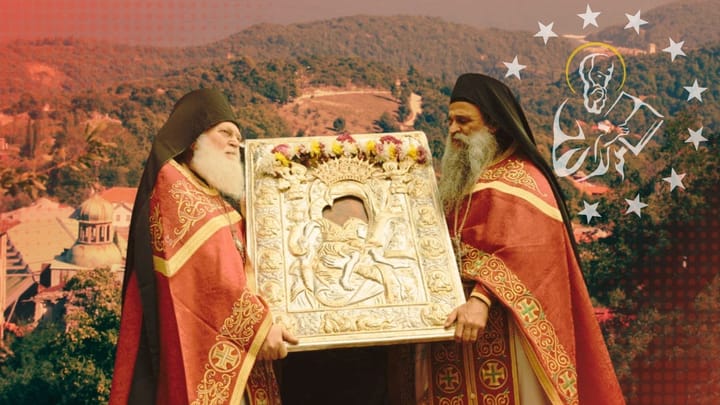
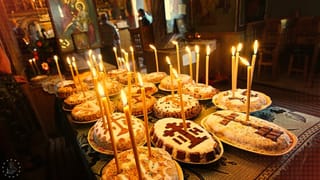
The original Panagia Eleousa / Axios Estin icon on procession in Karyes.

Today, Orthodox Christians on the Old Calendar celebrate the feast day of the appearance of the Archangel Gabriel on Mt. Athos, before the Panagia Eleousa icon, in which he gave the “Axion Estin” prayer to man.

Most Orthodox Christians are familiar with how the hymn, Axion Estin, or “It Is Truly Meet,” was revealed to us. One evening in 982, in a cell near Karyes on Mt. Athos, a young monk was visited by another monk who introduced himself as “Gabriel.” As the two monks were reading the All-Night Vigil together, Gabriel introduced a prayer that no one (outside of heaven) had ever heard before. He chanted, “It is truly meet to bless Thee, O Theotokos, ever blessed and most pure, and the Mother of our God,” before continuing with the familiar, “Greater in honor than the Cherubim.” When Gabriel chanted “It is truly meet,” the already-miraculous Panagia Eleousa (Mother of God of Tenderness) icon they were chanting before glowed with divine light. The young monk asked Gabriel to write down the new hymn, and Gabriel wrote it down on a roofing tile, using only his finger, as though the tile were wax. Gabriel then vanished from sight. It was then that the young monk realized he was speaking with the Archangel Gabriel.

There is one astonishing element of the story that comes to us through the Prologue from Ochrid. The young monk “was greatly struck both by the words and the heavenly singing. The stranger [Gabriel] turned to the monk and said: ‘We sing it like this at home.’” I think a lifetime of contemplation and prayer might never fully unpack all the implications of the Archangel’s use of the word “home” in this context, but I would like to point out a few. 

When the philosopher Plotinus was invited to a ceremony honoring the pagan gods, he famously replied, “It is for those Beings to come to me, not for me to go to Them.” While Plotinus’s idea of the relationship between heaven and earth differs radically from that which is taught by Orthodoxy, nevertheless his attitude is too often our own, an attitude full of tragedy: besides centering the entirety of heaven on ourselves, we divorce worship from understanding, man from God, heaven from earth.

Plotinus imagined that true spiritual knowledge could be attained apart from ordinary religious practice. The masses, he thought, required rituals and ceremonies; the enlightened adept could dispense with them. Orthodoxy teaches the exact opposite. Practice and understanding are inseparable. We do not first understand and then worship. We worship and then understand.

This is why the Orthodox Church so often insists that theology is not merely something studied but something lived. One of the boasts of Orthodoxy is that “Our worship is our theology, and our theology is our worship.” A man may read every theological text ever written, yet if he refuses to pray, fast, repent, forgive, and participate in the life of the Church, he will remain largely ignorant of the realities those texts describe. Orthodoxy is not merely a set of ideas to be mastered, but a life to be practiced.

The miracle of the Axion Estin reveals this truth in a striking way. The Archangel Gabriel does not arrive to deliver a lecture. He arrives singing. The revelation is not a philosophical proposition but a hymn. Even the angels express their knowledge of God through worship. Gabriel's understanding is inseparable from his praise. The beings who know God best are not those who stand above worship, but those who stand in worship, and who worship most perfectly.

This leads to the second implication of Gabriel's words: heaven is much nearer than we imagine.

Axion Estin of Emmaus, painted by Pdn. Paul Drozdowaski, available through the Ancient Faith Store. Photo: from public collection at Holy Apostles Orthodox Church in South Carolina

When Gabriel says, “We sing it like this at home,” he does not speak of heaven as though it were a distant realm. He speaks of it as one might speak of one’s home village, or one’s monastery. He brings part of that home directly into the life of the Church. The hymn of heaven becomes the hymn of earth, so that it is revealed that earth worships within the realm of heaven. What had been sung before the throne of God is suddenly being sung in a humble Athonite cell. Consider the humility inherent to this miracle: this hymn-from-heaven is given to people who will sing it a thousand years later, in the modern world, having only just stressed about getting to church on time and who will later scrutinize whether the coffee-hour coffee is too strong. 

The miracle collapses the distance we habitually place between ourselves and heaven.

Most of us carry around what might be called a pagan telescope. Through it our inner Plotinus keeps God, the saints, and the angels at a safe distance. We imagine heaven as a remote place and ourselves as isolated from it. We are willing to admire holiness provided it remains far enough away that it cannot demand our lives. We see heaven with all the security and admiration with which scientists view celestial bodies.

But the Archangel Gabriel destroys that illusion. Heaven is not merely somewhere else. Heaven is present. The angels are not spectators observing us from unimaginably distant heights. They worship with us. The saints are not historical memories. They are alive in Christ. The Mother of God is not a figure confined to the past. She intercedes now. The Archangel Gabriel collapses our pagan telescopes and we are forced to see that the starry constellation now stands fully embodied at our elbow, hymning with us Her who once wove a Body in Her womb — and he teaches us as his fellow creatures how to hymn Her better. 

The Axion Estin miracle shows that the boundary between heaven and earth is far thinner than we suppose. The hymn was not invented below and carried upward. It was received from above and placed into human mouths. Heaven came to earth. Heaven sings with earth, so that earth might sing in heaven. 

In this sense, Christianity answers Plotinus in a way he could never have anticipated. He demanded that the gods come to him. Christianity proclaims something far more astonishing: God actually has come to us. It is “meet” — it is “axion,” fitting, worthy — that we hymn Her. But we hymn Her because Her love is anything but “meet”: She loves the unworthy as if worthy. God comes to those who in their hubris demand that He come. We demand His love, and Hers, and they fill the cup until it is splashing (so unseemly) on the fully laden table. 

The Old Testament repeatedly warns mankind to prepare to meet God: Amos 4:12. Yet the fulfillment of that warning is not mere judgment and annihilation, although judgment is certainly part of it. The people of the Old Testament are being prepared to meet a God of judgment, as was threatened, but also of everlasting mercy, a God who can be crucified. The arrogant demand of Plotinus is answered with God’s own “unseemly” humility: “Very well,” the Lord answers. “You need not be stuck with your gods. You may have Me. And I will come to you. I will give Myself to you utterly.” The prodigal son approaches his father hesitatingly, fully expecting disappointment and rejection, as would be “meet” and “fitting.” But the father responds without resentment or disappointment, outside the bounds of what is “due,” and only with love and gratitude.

Yet there remains a third lesson. We discover the nearness of heaven only by practicing Orthodoxy.

It is not enough to agree intellectually that heaven is close. The truth must be experienced. The monk in the Athonite cell did not receive the revelation while constructing a theory about worship. He received it while worshiping.

This is why Orthodoxy continually calls us to concrete practices: prayer, fasting, almsgiving, repentance, confession, the Divine Liturgy, the veneration of icons, and the reception of the Holy Mysteries. These are not arbitrary religious exercises. They are the means by which our eyes are opened.

The person who refuses these practices often concludes that heaven is distant because he has chosen to stand away from the very place where heaven is revealed. We all do this. The person who enters into the life of the Church gradually discovers the opposite. What once seemed remote becomes immediate. What once appeared symbolic becomes real. The saints become companions. The angels become fellow worshipers. Christ becomes the center of all things. We are not the center of heaven, but we are the center of His love. Paradoxically, there in His love we find ourselves at the center. 

Plotinus believed that understanding could be separated from right practice. The Church says otherwise. Plotinus imagined heaven as something approached through private intellectual ascent. The Church reveals heaven descending into our midst. Plotinus thought the enlightened man could stand above worship. Gabriel shows us that even the angels worship, and that man cannot stand without worship: that when a man stands up to worship, he is both on earth and in heaven. If we fail to try to practice Orthodoxy, we will not merely fail to understand. We will die. And God’s mercy is such that even if we fail to try, we can still practice Orthodoxy by calling out to him, “Lord have mercy!” 

The miracle of the Axion Estin reminds us that heaven is not nearly so far away as we think — or, like Plotinus, would prefer. The songs of heaven have been placed in our mouths, like the coal placed on Ezekiel’s lips. The life of heaven has been offered to us in the Church. And it is only by living that life — by praying, worshiping, and practicing Orthodoxy — that we begin to realize just how close heaven has been all along.

One final point: one of the things that miracles do is remind us of the miracles we have already received. The water that is turned into wine should remind us that on a much slower level, water is turned into wine through the miracle of the natural order and man’s husbandry. These were performed for and given to us, as well, and the saints encourage us to have right feelings about them. If you’re like me, you doubtless wonder how that young monk felt immediately after the Archangel vanished from his cell; which is another way of asking, “How would I have felt?” When the Archangel finished “It is meet,” he continued with “Greater in honor”: a new miracle followed by an older and more familiar miracle. What the young monk was left with was the opposite: he was left with the old now fully charged with the astonishing and new. Today when I said my morning prayers, I did not have with me that fear and trembling by which those prayers were first received from heaven. But they are no less miraculous today. As a pagan’s mistake helped us understand the Axion Estin better, we’ll let another pagan’s accuracy help us. I am reminded of that scene in the “The Wind in the Willows” where Rat and Mole are enraptured by Pan as they approach him. Rat asks Mole in a terrified whisper: “Are you afraid?” To which Mole responds: “'Afraid? . . . Afraid! Of HIM? O, never, never! And yet—and yet—O, Mole, I am afraid!'”

"We sing it like this at home.” Now, so do we. Through the shared, common worship of our fellow men, the angels, and the Theotokos, God teaches us the fear and excitement and familiar comfort of coming home.

Archangel Gabriel pray unto God for us! Most Holy Theotokos save us!

Share

Read also