News
Ancient Aramaic Inscription Reveals Early Christians Closed Pagan Temple in Turkey
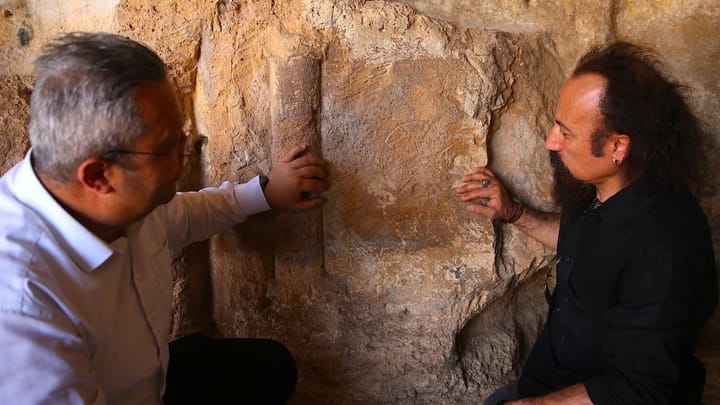
Newly deciphered writing at Zerzevan Castle provides rare archaeological evidence of the transition from pagan Roman religious practices to Christianity in the fourth century.
DİYARBAKIR, TURKEY — A newly deciphered Aramaic inscription discovered at the ancient Zerzevan Castle site in southeastern Turkey has revealed that early Christians symbolically sealed an underground Roman Mithras temple nearly 1,700 years ago, offering rare evidence of the religious transformation that followed the rise of Christianity in the Roman Empire. This was reported by Turkey Today.
The inscription was found at the entrance of the underground sanctuary during excavations at Zerzevan Castle, a former Roman military fortress located in the Çınar district of Diyarbakır. It was deciphered by Professor Mehmet Sait Toprak, head of the Syriac Language and Literature Department at Mardin Artuklu University.
Following an extensive epigraphic and linguistic analysis, researchers determined that the inscription dates to the third or fourth century A.D. and documents the formal closure of the Mithras sanctuary after Christianity became the dominant faith of the Roman Empire.
Researchers compared the inscription’s script and language with other Old Syriac and Aramaic texts from the second and third centuries, including inscriptions preserved at the Şanlıurfa Museum. Their study concluded that the writing, together with a carved Christian cross at the temple entrance, marked the deliberate sealing of the sanctuary.
The underground temple at Zerzevan Castle is considered one of the most significant surviving Mithraic sanctuaries connected with a Roman military garrison. The cult of Mithras, a mystery religion centered on the figure of the “Invincible Sun God,” was especially popular among Roman soldiers during the second and third centuries.
Excavation director Professor Aytaç Coşkun said the discovery provides long-awaited insight into what happened to Mithras temples after Christianity spread throughout the empire.
“Previous coin discoveries had already suggested when the temple was abandoned, but the newly deciphered inscription now provides direct evidence of its closure,” Coşkun said.
According to researchers, Mithraism increasingly came into conflict with Christianity after Roman emperors embraced the new faith. While some former pagan sanctuaries were converted into churches, others — including the Mithras temple at Zerzevan — were intentionally closed.
Professor Toprak said the inscription reflects the changing religious landscape of the period, containing references both to Mithras and to Jesus Christ.
“The text refers to the Holy Cross in the name of God, describing the one who commands, reforms and spreads love,” Toprak explained. He added that the inscription represents the first known Old Aramaic text documenting the closure of a Mithras temple.
The discovery is being viewed by researchers as an important archaeological window into the Christianization of the Roman Empire’s eastern frontier, showing how religious practices changed as Christianity replaced older pagan traditions.
Zerzevan Castle has been under excavation since 2014. Located on a rocky hill near the Demiröçek neighborhood, the former Roman frontier settlement was added to UNESCO’s World Heritage Tentative List in 2020 and has since become one of Diyarbakır’s most important archaeological sites.
Previously, the UOJ reported that an ancient monastic complex had been discovered in Egypt.
Read also