News
Attempted Takeover of UOC Church Underway in Odessa
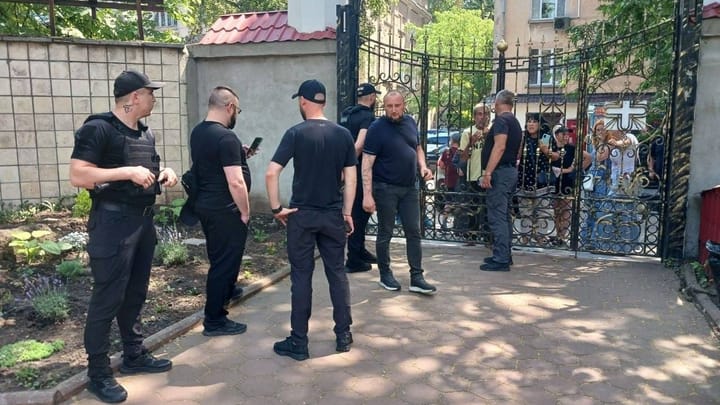
After years spent rebuilding St. Alexander Nevsky Church from ruin, Odessa parishioners now find themselves fighting to regain the sanctuary following a contested takeover.
ODESSA, UKRAINE — St. Alexander Nevsky Church in Odessa became the scene of a contentious takeover on June 23 after representatives of the Orthodox Church of Ukraine (OCU), accompanied by private security personnel, entered and assumed control of the parish, prompting sharp protests from the Odessa Eparchy of the Ukrainian Orthodox Church (UOC).
As first reported by UOJ-Ukraine, the seizure began early in the day when men dressed in black uniforms and carrying batons blocked access to the church grounds, preventing clergy and parishioners from entering. Eyewitnesses identified the men as employees of the Odessa-based Samson security company. The Odessa Eparchy alleged that physical force was used during the incident, claiming that a priest was thrown to the ground and choked, while parishioners, including women and diocesan officials, were assaulted.
Representatives of the OCU defended their actions by asserting that the parish had legally transferred to their jurisdiction. Theodore Orobets, an OCU cleric in Odessa, released videos from the church grounds, describing those entering the property as the parish’s “real parishioners” and announcing plans to rededicate the church to St. Agapitus of the Kyiv Caves. He also criticized several icons and frescoes inside the church, including depictions of the Royal Passion-Bearers, St. Andrew Bogolyubsky, St. Dmitry Donskoy, St. Matrona of Moscow, and St. Xenia of St. Petersburg.
The Odessa Eparchy rejected the transfer claims, insisting that the parish community never voted to leave the UOC and describing the documents presented by OCU representatives as illegitimate. Fr. Yevhen Hutiar, secretary of the Odessa Eparchy, called the incident a “raider seizure carried out according to a well-established scheme.”
For local UOC faithful, the loss of the church carried particular emotional significance because of the parish’s long history of restoration and sacrifice. Church representatives noted that when the property returned to the Odessa Diocese in the early 2000s, the church was in a severely neglected state. Parishioners say the building was little more than a ruin, requiring years of labor, fundraising, and reconstruction before it could once again function as a thriving parish.
According to the diocese, the faithful themselves financed and carried out much of the restoration work. Clergy and parishioners invested years of effort rebuilding the sanctuary, repairing the structure, beautifying the interior, and creating a vibrant liturgical community. The parish grew from a deteriorated property into an active center of worship through what diocesan officials describe as the dedication and sacrifice of local believers.
Following the takeover, the diocese publicly questioned why those now claiming ownership had not participated in the restoration effort when the church lay abandoned and neglected. In a statement, the Odessa Eparchy argued that true stewardship is demonstrated through years of service and sacrifice rather than through the acquisition of a restored property. The diocese cited biblical passages against theft and the unjust appropriation of what others have built through their labor.
During the confrontation, clergy reportedly removed the Holy Gifts, the antimension, and other sacred items from the altar before the church was locked. Diocesan representatives also reported that one activist tore apart a prayer book belonging to a priest. Lawyers for the Odessa Eparchy have begun preparing legal challenges to contest control of the property, while complaints have been filed with law enforcement concerning alleged assaults during the incident.
The seizure of St. Alexander Nevsky Church has become the latest chapter in the ongoing dispute between the UOC and the OCU over parish property and ecclesiastical jurisdiction. For the faithful of the parish, however, the controversy extends beyond legal questions. They point to the years spent rescuing the church from decay and restoring it to active life as evidence of their enduring connection to the sanctuary and their commitment to preserving what they regard as their spiritual home.
Previously, the UOJ reported that Ukrainian police seized control of St. Michael Monastery in Pereyaslav.
Read also