Why Halki Seminary Matters

The historic institution has educated saints and been targeted unjustly by the Turkish government. Its potential reopening also creates a potential pathway to “outside” candidates for the Ecumenical Throne.

Recent reports have indicated that Turkey is moving in the direction of allowing the resumption of theological education at the historic Halki Seminary. While there is still much to be sorted, Metr. Emmanuel of Chalcedon stated that “water has entered the channel.”

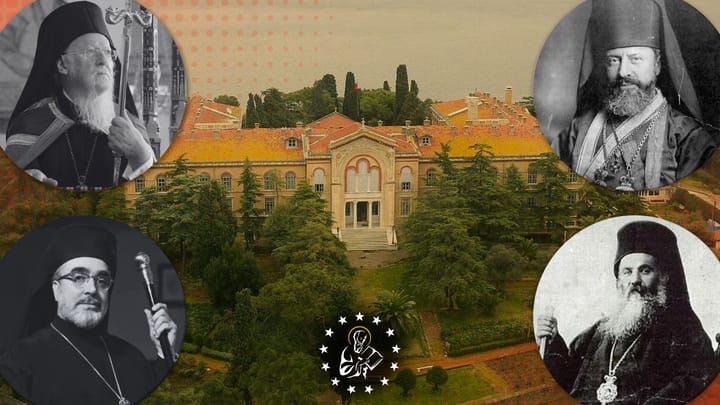
Closed for more than five decades, the seminary is located on the island of Halki (or in Turkish, Heybeliada) and shares grounds with the Monastery of the Holy Trinity. The latter was founded by St. Photios the Great in the ninth century, and after it fell into disrepair under Ottoman rule, the monastery was converted to a seminary in 1844. It remained that way until 1971.


Why Is It Closed?

Several major events occurred in the years leading up to Halki Seminary’s forceful closure in 1971. These events help us to understand why today’s Greek Orthodox community in Istanbul is so small, numbering only a few thousand.

As Giselle Soares also argued in a piece published earlier this year, we must look at the 1942 Varlik Vergisi (Wealth Tax), the events of Sept. 6-7, 1955, and the expulsion of nearly 15,000 Greeks in 1964. This goes without even mentioning the Greek genocide, which lasted roughly a decade between the 1910s-20s, depending on how one wishes to calculate it.

At a surface level, the Wealth Tax was a straightforward policy to raise funds as a defense provision in case Turkey needed to enter the Second World War. However, it was effectively used to eliminate non-Muslims from the economy through disproportionate application, with the Turkish researcher Ridvan Akar calling it “economic genocide against minorities.”

Another scholar, Basak Ince, stated:

“Converts paid about twice as much as Muslims, while non-Muslims ended up paying up to ten times as much. In addition, non-Muslims were required to pay their taxes in cash within 15 days; as a result, they had to sell their businesses or property to Muslim businessmen at low prices to cover the bill. The law was also applied to the many poor non-Muslims (numbering 26,000), such as drivers, workers, and even beggars, whereas their Muslim counterparts were not obliged to pay any tax.” 

If one was unable to pay the tax, they were sent to a labor camp, deported, or had their properties seized by the government. Out of the several thousand people sent to the camps, 21 of them died and had their assets sold to Turkish Muslims at a low price. Even the elderly and infirm, who were supposed to be exempt from the tax, were dragged to the train station and deported. 

At the same time this was taking place in Turkey, roughly 100,000 civilians in Greece had died under German occupation between 1941-42. The total number of civilian deaths would rise to several hundred thousand over the course of the war – whether it be from starvation, execution, or disease – corresponding to almost 10% of the population.

In 1955, “Krystallnacht in Constantinople” took place. As Orthodox historian Matthew Namee writes in his chronology:

“As the decades passed, that population declined, but even in the mid-1950s there were many tens of thousands of Greeks in Istanbul — I’ve seen estimates as high as 100,000. That all changed on September 6, 1955, when a Turkish mob launched a planned night of terror against the city’s Greek Orthodox population. Children were raped, churches were destroyed, and holy objects were desecrated. The cruelty of the Turks would have made the Bolsheviks proud.”

Greek historian Speros Vryonis, Jr., noted that it took seven hours to enact something that had been planned for years, and was the worst pogrom since Nazi Germany’s Krystallnacht in 1938.

According to Vryonis, the Turks destroyed 71 churches, 41 schools, 4,008 stores, the offices and printing presses of eight newspapers, and approximately 2,100 dwellings, all the property of the Greeks and their communities.

“The Turks killed 28 Greeks and also carried out the rapes of Greek women. They profaned and soiled the Greek Orthodox religious vessels; they smashed and dug up the graves in Greek cemeteries, throwing out the bones and remains of the dead; they effected circumcisions on some elderly priests on the streets.”

A telegram signed by Greek, Antiochian, Russian, Ukrainian, and Romanian clergy was sent to the U.S. state department after the destruction.

By 1964, what was already a dwindling and much-persecuted community suffered a final blow. As newspapers referred to Greeks as “genetically flawed” and the “exploiter” of the Turkish economy, the government took action. All books in the Greek language were removed from schools, 165 orphans were thrown on the street as the Greek Orphanage of Buyukada was closed, and eventually, over the course of several months, roughly 15,000 Greeks were expelled from Turkey. 

For the Ecumenical Patriarchate in particular, religious publications were banned and high-ranking priests were expelled along with all non-Turkish students at Halki Seminary.

In 1971, Turkey enacted a ban on private higher education that closed the theological school. By 1981, though, a new law was passed that allowed private higher education to return. Of course, this mysteriously didn’t apply to Halki Seminary, which remains shuttered to this day.

This can be summed up in the exchange between 60 minutes correspondent Bob Simon and Ecumenical Patriarch Bartholomew when the two took a visit to the seminary as part of the CBS program in 2009:

"It's a pity and a shame. It's a crime to keep such a school closed, unused, for no reason. Why?" Patr. Bartholomew, who is a graduate of the school, asked.

"Reasons of state?" Simon asked.

"Reasons of state," the Patriarch replied.


Why It Must Open

Well, religious freedom, for one. But this is obvious, so we will focus on the school’s heritage, alumni, and impact it could have in today’s Orthodox landscape.

As stated previously, the school is at the former Monastery of the Holy Trinity, which was founded by St. Photios the Great. More than this, past students include St. Raphael of Brooklyn, St. Chrysostomos of Smyrna, Abp. Iakovos of North and South America, and Ecumenical Patriarch Bartholomew himself. 

For St. Raphael, the school provided the means for him to begin his path in ministry which we recall so fondly today. As the Balamand Seminary had been closed since 1840, Patr. Joachim III invited the Patriarch of Antioch to send one deserving student to study at Halki on scholarship each year. St. Raphael was one of those students, and it is at Halki where he was ordained to the diaconate and received his Certificate of Theology before returning to his homeland.

Many patriarchs, archbishops, metropolitans, bishops, priests, and deacons were educated at Halki Seminary over the years. There are too many to list here, and the school’s influence extended beyond Istanbul, as many graduates would be sent out across the oikoumene for pastoral work.

An urgent reason for the reopening of the school is the exact inverse of this. If students from other countries go to Halki for theological education, this provides a pathway for them to become Turkish citizens and could ultimately broaden the pool of candidates for the Ecumenical Throne, as current Turkish policy requires the Ecumenical Patriarch to be a Turkish citizen. Of course, Turkey could continue to play games and say candidates must be natural-born citizens. This is a clarification that has never been publicly made, and if the latter is the case, there are only eight hierarchs in the world who meet the criteria. If it applies to those who have obtained citizenship, this applies to roughly 45 hierarchs. In any event, this is something to watch for as we will eventually live in a post-Bartholomew era.

Several U.S. presidential administrations have at least mentioned the reopening of the seminary as part of talks with Turkey, whether it be Hillary Clinton, Barack Obama, or, as of late, Donald Trump. And there has been hope that it will be reopened before, only to be let down after the cause loses steam or Turkey inevitably backpedals after receiving whatever kind of deal it was looking for. A simple internet search will find all kinds of stories from years past detailing how the school is “preparing to open its doors.”

Today, however, the possibility seems much stronger than it has in the past. As many are wary of Patr. Bartholomew’s attitude towards Western influence (and for good reason – see Ukraine), his lobbying with the Trump administration appears to have been effective on this issue.

All of the events that led up to the closure of the seminary paint a tapestry that can hopefully provide some understanding as to why this issue is so important for not only the Greek Orthodox in Turkey, but also for those in the diaspora.

Another exchange between the Ecumenical Patriarch and 60 minutes correspondent Bob Simon (which angered the Turkish government) further illustrates this martyrdom and witness of Orthodoxy in Istanbul:

"Do you sometimes fear that the community will be wiped out?" Simon asked.

"Not really," the patriarch replied. "We survived. We do believe in miracles… We prefer to stay here, even crucified sometimes. Because in the gospel, it is written that it is given to us not only to believe in Christ, but also to suffer for Christ.”

"You said even to be crucified sometimes?" Simon asked.

"Yes. Because we believe in the resurrection. After the crucifixion, resurrection comes," the patriarch explained.

Asked if he personally feels that he is being crucified sometimes, Patr. Bartholomew told Simon, "Yes, I do."


Aaron Hickman is the News Editor for UOJ-America and a lifelong parishioner of the Greek Orthodox Archdiocese of America. Follow him on X and watch the latest episode of the "Orthodox Dispatch" news podcast here.

Share

Read also