In His Own Words

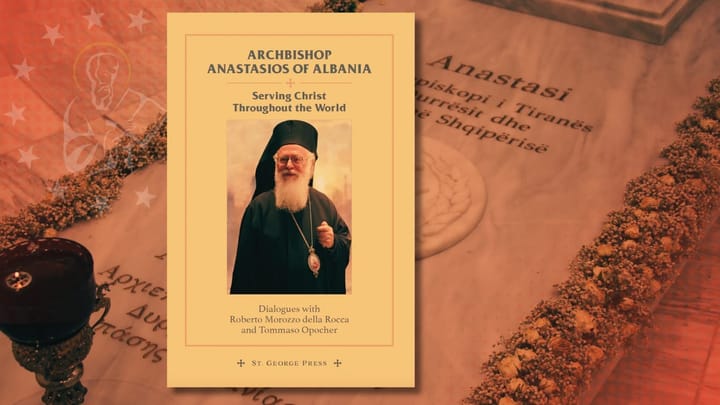
“Archbishop Anastasios: Serving Christ Throughout the World,” recently published by St. George Press, presents the beloved hierarch unfiltered and seeks to amplify his voice rather than overexplain it.

When I took a trip to Albania earlier this year, I was blessed to visit the resting place of Abp. Anastasios, which is located directly under the altar of the Resurrection Cathedral in Tirana. 

On any given Sunday following the Divine Liturgy, the faithful head downstairs and gather in a single file line to venerate his tomb and ask for his holy prayers before they proceed to the fellowship hall. While I did attend the liturgy on a Sunday, I did not visit him until later in the week. This was partially due to the need to take photos and record footage for our work at UOJ, but I also found it to be providential. My final act before departing Tirana and driving around the country was asking the prayers of the man who rebuilt all we were about to see. This is something that I will always cherish.

Seemingly every temple that was either reconstructed or built from scratch following the fall of communism in Albania was consecrated by Abp. Anastasios himself. The number of plaques I saw with the date and his name is too many to count.

Anastasios’ mother was advised to abort him, but she prayed to Panagia to help her give birth to her frail son, who she was told she would be too ill to take care of. Anastios would then live through the German and Italian occupation of Greece. His missionary endeavors in Africa and the adversity he faced there reveal a man who truly relied on God as his source of comfort, which was revealed even more so in the miraculous work he did resurrecting the Church of Albania. 

“For those who may be meeting Archbishop Anastasios for the first time through these pages, I believe you will encounter not only the words of a remarkable leader of our Church, but also the witness of a man whose life itself is a homily,” Fr. Stephanos Ritsi writes in his introduction. At only 129 pages, this book serves as a warm welcome to the life and work of His Beatitude.

As the preface states: 

“A distinctive feature of Anastasios’s Orthodoxy is living alongside others.” 

This simple practice has been made so complex by worries (often warranted) regarding ecumenism and how Orthodox Christians should generally act in the world. I propose the life of Abp. Anastasios as the proper answer to these questions.

Whether it be constructing a hospital which, on a month-to-month basis, served mostly Muslim and secular citizens, or standing in the street handing out basic necessities (even when the people hated and did not trust him) during times of turmoil, this was someone who took the Incarnation seriously, and who did all he could to actualize it for those who did not yet know Christ. He even kept the bullet from an assassination attempt lodged in his window as a reminder that his life could end at any moment.

And while it is wonderful to hear stories told by those who met various figures throughout Church history – and these stories are necessary – the way we primarily get to know the individual is by engaging with them in their own words. In this way, I find St. George Press’ latest release to be a success, and a fine addition to similar works based around Abp. Anastasios’ interviews like “In Albania: Cross and Resurrection,” published by SVS Press in 2016.

“Archbishop Anastasios of Albania: Serving Christ Throughout the World” contains dialogues with historian Roberto Morozzo della Rocca and Catholic priest Tommaso Opocher, and was translated to English from the original 2023 publication by the Church of Greece. After the typical series of pleasantries to start the book (acknowledgments, preface, introduction, biographical background), the text is split into eight chapters on these general topics:

  1. First period of life – Greece, studies, lay theologian
  2. Missionary endeavors in Africa, post-graduate research
  3. The unprecedented case of Albania
  4. The ecumenical movement
  5. Facing challenges in the Orthodox world
  6. Critical global issues
  7. Love and prayer
  8. Photographs

There are several gems in each section, and those who are familiar with Abp. Anastasios will find consistent, unwavering answers to several of the questions that he faced numerous times throughout his ministry. Many of these answers are now repeated by his spiritual successor, Abp. John of Albania, which I discovered in my interview with him back in February. One of the practices he has carried on is the following, stated by Abp. Anastasios when asked about interreligious dialogue:

“There are areas of doctrinal difference where it is not possible to have serious theological dialogue. It is more natural through encounters with people of other faiths to share in a ‘dialogue of life,’ discussing issues we face together (such as social justice, global peace, environmental problems, technology challenges, poverty, terrorism, and so on). Through this ‘dialogue of life,’ we may attain a peaceful coexistence as we have experienced in Albania.”

Another quote I found Abp. John repeating can also be found in this book:

“The Orthodox Autocephalous Churches do not constitute a federation of Churches, but the One Holy Catholic and Apostolic Church. Each local Church as she offers the holy Eucharist is the local presence and manifestation of the Holy Catholic and Apostolic Church.”

Of course, Abp. Anastasios can be a stumbling block to many. He acknowledges these realities yet staunchly supports involvement in the World Council of Churches. He even wrote the Message for the Council of Crete! For some, this is a bridge too far. Yet on matters of faith and canonicity, Abp. Anastasios stood firm on the most divisive issues facing Orthodoxy today.

Take, for instance, his position on Orthodoxy in Ukraine, found within the book:

Interviewer: “We go up a little to the North and East. The problem in Ukraine. There is a low-intensity war connected with political problems. Here, the religious dispute is also linked with war. We should distinguish religions from political and military problems because today there is great confusion among these aspects.”

Anastasios: “Unfortunately, there are interconnections of all these things. Personally, I don’t like to see ecclesiastical matters under the influence of geopolitical interests. When a delegation of the Ecumenical Patriarchate announced to us for the first time this operation, my main remark was: ‘You see this operation as a walk in a garden of laurels, but I see this as a walk through a minefield.’ Perhaps you have read the four letters I wrote about this to the Patriarch of Moscow and the Ecumenical Patriarch, as well as my Appeal-Supplication in Anticipation of Christmas 2019. Three elements secure Orthodox unity: the Eucharist, apostolic succession, and the synodical system. A real observance of these three will help us to overcome the crisis.”

Interviewer: “Do you think there is a way to obtain a re-composition of Orthodox unity in the Ukraine issue?”

Anastasios: “The reality created in this past year and a half is, unfortunately, very complicated and painful. No peace and order in the Ukraine has been achieved. On the contrary, the divisions have become deeper (confrontations between the parties have become more furious; even recently, the self-titled Patriarch Philaret ultimately denounced the Tomos, thus complicating the issue further). This unfortunate new reality is obvious; it obliges the protagonists, as well as all of us, to find a cure for this extremely dangerous situation that will bring tranquility among the Orthodox people. I pray that we will find ways of reconciliation and a peaceful resolution through our synodical tradition.”

Interviewer: “Do you see ways of overcoming this impasse?”

Anastasios: “It is apparent that it is not easy. We must continue to say the truth in love. Nevertheless, it is extraordinarily regrettable that, on such a sensitive issue, irresponsible persons are involved to deride those who express different views, while at the same time flattering those whom they support. We repeat that now (March 2020), we are facing a complicated new reality brought about by this issue. It is clear that the operation in Ukraine did not bring about the desired unity and peace as in the previous cases of the granting of autocephaly but rather brought about divisions and tension in the country, as well as in other Orthodox Churches and generally in the Orthodox world. It is a new type of virus that we must heal as soon as possible.

“The opinion that time will heal this situation is unrealistic. Time does not heal ecclesiastical schism but deepens and solidifies it. We need creative types of negotiations using the conciliarity of the Orthodox Church. We must sit together, according to tradition under the chairmanship of the First among Equals – the Ecumenical Patriarch (whose rights and obligations are undoubted), pray together and ask for the presence of the Holy Spirit in order to arrive at the necessary decisions. This is what we can do in a Pan-Orthodox Council, not as isolated persons, groups, or local Churches.”

As the Kyiv-Pecherska Lavra is in the news as of late, it is worth noting that Abp. Anastasios sent a letter of support to the monastic brotherhood due to the persecution they were – and still are – facing from the Ukrainian government and the state-backed Orthodox Church of Ukraine (OCU). The response he received throughout the Greek world for his consistent position on the matter resulted in the Holy Synod of the Albanian Church issuing condemnations of the behavior on multiple occasions.

As a primate not located in Constantinople or Moscow, Abp. Anastasios led the charge against the Tomos of Autocephaly granted to the OCU. When rebuked – and even condescendingly lectured – by Ecumenical Patriarch Bartholomew, he maintained his position.

For this, he was accused of being a “Russian plaything” who would “die unrepentant.” In spite of all this, Abp. Anastasios continually said a Pan-Orthodox Council chaired by the Ecumenical Patriarch needed to take place. He also raised his disagreement with Moscow for severing communion with Constantinople, and for its retaliatory “Patriarchal Exarchate” in Africa. 

In short, Abp. Anastasios was a figure who could not be pigeonholed. For me, personally, he has become a model for what Christian unity and dialogue should look like. If the rest of the Orthodox world had followed his wish for a Pan-Orthodox Council to convene every ten years following 2016’s Council of Crete, then the Ukrainian matter may have even been forcefully addressed this year.

“I don’t like to classify people using the terms conservative or progressive,” he says elsewhere in the book. “These terms are not always accurate. There are very progressive people that are conservative in some concrete principles. Personally, I believe that in many things, I am conservative. I drink the same water that the ancient Greeks drank in the past. I do not think I must replace this with Coca-Cola to be modern. There are things that are of eternal value: The Commandments of Christ. At the same time, I am open to the new challenges in history, gazing steadily at Him ‘Who was, Who is, and Who is to come, the Almighty’ (Rev. 1:8).”

I am reminded of a quote from St. John Chrysostom:

“I am a Christian. He who answers thus has declared everything at once – his country, profession, family; the believer belongs to no city on earth but to the heavenly Jerusalem.”

This is how Abp. Anastasios was able to be “all things to all people” (1 Cor. 9:22). He was simply a Christian, who trusted in God alone. He belonged nowhere and everywhere, as one who had fully integrated himself into a life in Christ.

I was moved by his recollection of a period of darkness he experienced during the Nazi occupation of Greece.

“I remember a night in our house in Athens during the dark period of occupation. I was alone on the terrace, and I prayed to God and said: ‘Oh my Lord, if You really exist, please give me a sign; help me believe…’ No angels came to tell me anything, but there began a deep certainty about the existence of God and His presence in our lives. There really is a God, a God of love.”

It was this God of love who Abp. Anastasios chose to serve in all circumstances. And for all of his thoughtful responses and well-educated reasonings, His Beatitude knew when to be still and contemplate the mystery.

“Prayer remains a very personal item, and one has to be a little silent in front of these aspects of life. I can just say that I try to put all my wishes and all my longings in front of God… In a small, simple chapel that I have next to my room, I express to the Lord all my concerns, troubles, agonies, despairs, and decisions. Moreover, since life is full of beauties, surprises, and difficulties, we find refuge in spontaneous prayer related to concrete situations, such as: ‘Guide me to the right assessments, to the right decisions, to the right efforts.’ Really, I feel that, after that, something different happens… Many times, it is enough to simply remain in silence before the Triune God, to express to Him your questions, your concerns, your problems – and then to wait. To wait.”

While we wait for the coming again of our Lord, God, and Savior Jesus Christ, let us endeavor, like Abp. Anastasios, to serve the God of love and to understand that, by our participation in this service, we can come to experience the Kingdom of Heaven within us (Luke 17:21). 

And while we wait, may we have his prayers.


Aaron Hickman is the News Editor for UOJ-America and a lifelong parishioner of the Greek Orthodox Archdiocese of America. Follow him on X and watch the latest episode of the "Orthodox Dispatch" news podcast here.

Share

Read also