Man and Church
The Life and Labor of St. Raphael of Optina
Radical Christian love under the Bolshevik Yoke
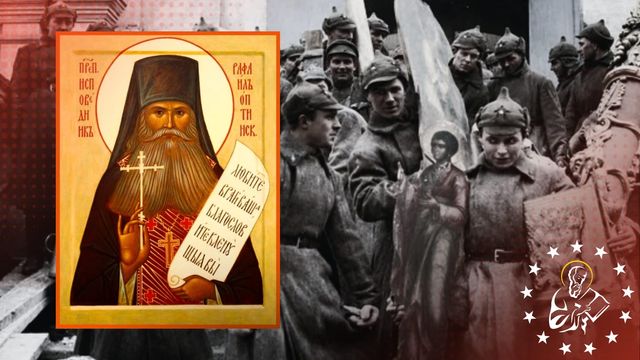
The life of the New Hieroconfessor Raphael of Optina is marked by suffering, exile, betrayal, imprisonment, and bodily weakness. He lived through the most acute persecution of Christians in the modern age. He saw the closure of the renowned Optina Hermitage, the scattering of her monks, the violence of the Soviet state, the humiliation of the camps, and the ruin of much that had been spiritually dear to him. Yet what stands out most clearly in his life is not the cruelty of his persecutors, but the warmth of his heart. St. Raphael was not merely a confessor who endured. He was a father who loved, forgave, and sought the salvation of those around him—even those who had wronged him.
Having served in the First World War, Rodion Sheichenko, the future St. Raphael, went to Optina after a family tragedy severed his attachment to the world. Optina, however, was already entering her own passion. The monastery was officially closed, then slowly strangled by the new atheist authorities. Its monks were driven from their walls, arrested, exiled, and accused of belonging to imaginary counterrevolutionary conspiracies. In 1930, Fr. Raphael was arrested with other Optina monks and laymen. He denied all false accusations against him, but the machinery of Soviet persecution had no interest in the truth. He was sentenced to ten years in the labor camps.
Even there, the shape of his soul became visible. Believers brought him a Gospel, a prayer book, and an icon. At one point, he was forced to live in a pigpen. Yet he rejoiced that, being separated from the other prisoners, he could pray without interruption, and he would even invite the inmates to join him. What was intended as degradation became a source of illumination and glorification. Such a detail reveals the man better than any formal praise.
After his release, Fr. Raphael eventually returned to Kozelsk and, in 1944, was ordained to the priesthood by Metropolitan Nicholas of Krutitsa. He was assigned to the Annunciation Church together with Hieromonk (later Abbot) Nikon Vorobiev. The church had been badly damaged by war and neglect. The bell tower had been destroyed, the building wounded, the flock scattered. The two hieromonks, physically weakened but spiritually alive, labored to restore both the temple and the people. They served at a hastily remodeled side altar and, without proper equipment, restored the church largely by hand.
But the enemy of our salvation couldn't just leave such work undisturbed. Discord arose between the two pastors, and the matter eventually became so painful that Fr. Nikon was suspended for a time. Yet here again the victory was not in the absence of conflict, but in repentance and reconciliation. Fr. Nikon took responsibility for his sin, and the two were reconciled. His preserved letter to Fr. Raphael is a testament to true Christian humility:
Dear Fr. Raphael!
I received your letter with its Christian forgiveness for my sins and lies regarding you!
I have had to live sixty years, not only to understand in mind, but to feel with all my soul that I am banished from Jerusalem and wounded all over by thieves, and that I am unable and powerless to do anything good myself without an admixture of evil; that only the Merciful Samaritan, that is, the Lord Himself, can save me, if I call upon Him for salvation.
In particular, my relationship with you was likewise saturated with sin, as was all my conduct. This is why I sincerely beg your forgiveness and thank you wholeheartedly for forgiving me “for everything.”
I forgave you long ago, and with the present letter I confirm it:
May the Lord forgive you all your voluntary and involuntary mistakes committed against me, and with all my heart I forgive you. I wish for you peace, salvation, and a speedy return to serving in the Holy Church.
—unworthy Hieromonk Nikon
St. Raphael would be betrayed again. A brother priest and the parish warden falsely accused him, seeking advantage and position and the saint was imprisoned once more. Yet he forgave them at once. Not later, once the wound had cooled; not after vindicatio or apology. He forgave them “at the very hour” of his sorrow.
When the warden, Tonya, later wrote to him in anguish and admitted that she could not forgive the priest who had deceived her into accusing him, Fr. Raphael answered not as a wounded man, but as a father.
Child Tonya! For the fact that you bear the serpent of hostile feelings in your heart toward Fr. Sergius—and even, as you write, “I have not forgiven him, and I will probably never forgive him!”—for this I don’t praise you. This feeling is not Christian and is destructive to the soul.
The Son of God, Who redeemed us sinners on the Cross through His Passion on Golgotha, in His prayer before His death cried out to His Father for His crucifiers: Father, forgive them; for they know not what they do.
And so, my dear child, I beg you, both for me and for yourself: don’t be angry at anyone, especially at Fr. Sergius. I’m not angry at anyone, and I forgave everyone—everyone—at the very hour of my sorrow, back on July 11, as well as now. Even right up to my death I’ll pray for them—not as for my enemies or for those who have offended me, but as for the benefactors of my salvation.
May the Lord have mercy on them and save them.
Everything that has happened with me is not according to man’s wish, but according to God’s will, for my salvation. And I am obedient to God’s will, in all forms of suffering and death, wherever and whatever they are, with the same words on my lips and in my heart as those with which St. John Chrysostom died in exile: “Glory be to God for all things!”
There is perhaps no clearer window into the heart of the saint. He did not minimize evil or pretend betrayal was harmless. But he understood that resentment is not justice—it is a serpent in the heart. For St. Raphael—as with all the saints—his persecutors had not merely failed to destroy him, but by his repentance and forgiveness, they had become, unwillingly, “benefactors” of his salvation.
This same heart can be seen in another incident near the end of his life, after his release in 1955. In Kozelsk, Fr. Raphael sought out Ivan Mitrofanovich Belyaev, the brother of Elder and New Hieroconfessor Nikon of Optina—not to be confused with the aforementioned Fr. Nikon. Ivan had once entered Optina Skete with his brother, but his soul remained restless. He left more than once, was drafted during the First World War, married an atheist nurse named Nadezhda, and eventually lost his own faith—let this be a warning to those seeking a bride outside of the Bride of Christ. His life became a wound both to himself and to those who loved him.
Fr. Raphael had never known Ivan at Optina—Ivan had left before Fr. Raphael arrived. But he had heard of him from Fr. Nikon, who had grieved deeply over his brother’s spiritual condition. This grief did not die with Nikon. Instead, St. Raphael took it into his own heart. After years of imprisonment, sickness, and exile, when he might have been excused for thinking only of his own weakness and impending death, he instead found Ivan’s address and began corresponding with him. In February 1957, he wrote:
Peace to you, and salvation from the Lord, beloved in Christ brother Ivan Mitrofanovich!
Your kind, heartfelt, and brotherly letter, which was given to me only on February 25, brought my heart yet closer to yours.
Your desire to know about much that is common and dear to our hearts urges my love for you to beg you to be so kind as to come under the roof of my unworthiness at any time, where we can, face to face, recall bygone days and express our thoughts.
I would be extremely happy to enclose you in my embrace as a brother in Christ, and as the brother of the closest of all the Optina monks to me, the dear and unforgettable Batiushka Fr. Nikon.
I have neither the time nor the strength to write much and in detail. I’m tired from the people and overloaded with correspondence, in addition to services in the holy church and my many physical ailments, which I acquired, being in a far-off land for nineteen and a half years...
Glory be to God for all things!
I await your quick response as to when you will be coming, and even more do I await your arrival.
I embrace you in the Lord and guard you with God’s blessing.
May the Lord preserve and save you!
Your brother and well-wisher, the sinful and unworthy Hieromonk Raphael.
And Ivan came. Not long before Fr. Raphael’s repose, the two sat together behind the house. Before them, through the haze, stood the ruined outlines of their beloved Optina. There Ivan opened his heart and spoke of the inner struggle that had tormented him throughout his life, coming to deep repentance. At seventy years old, he asked St. Raphael for a blessing to leave the world and end his days near Optina. The saint refused, not from coldness, but from discernment. Ivan was told that if he wished to be saved, he must bear his family cross to the end. And this he did.
In the broader drama of persecution and confession, this moment may seem small. It was not. It reveals the depth of St. Raphael’s love perhaps as clearly as any prison record or martyr’s sentence. By this time, Optina had been closed for nearly 40 years; St. Nikon had reposed 16 years prior. And yet, he remembered the brother for whom Nikon had prayed, he remembered the grief of his departed friend—and he took it on as his own.
Across the boundary of death, the bond of Christian love remained unbroken. Nikon’s sorrow became Raphael’s sorrow; Nikon's love for Ivan became Raphael's love. With death approaching, the Saint set out to call home the lost sheep of the House of Israel. And through a Christian heart, overflowing with love and compassion, the lost sheep whom St. Nikon had carried in his heart was sought out by Raphael and brought, in repentance, back to Christ.
This is the heart of St. Raphael of Optina: a heart enlarged by suffering rather than narrowed by it; a heart that forgave instantly, prayed for enemies, corrected spiritual children with tenderness, and sought out the wounded even when he himself was exhausted and near the end of life.
May we, through the prayers of the Holy New Hieroconfessor Raphael of Optina, learn something of this love. May we forgive before bitterness takes root. May we seek the lost as we were sought—not as projects or to pat ourselves on the back, but as a grieving brother. And may we become, in our own small way, instruments of reconciliation between our wayward brethren and the Merciful God Who wills that all men be saved.
Benjamin Dixon is the Founder and Editor-in-Chief of UOJ America. Follow him on X and Substack.