Defense of The Faith
Ending the Carolingian Latin Schism
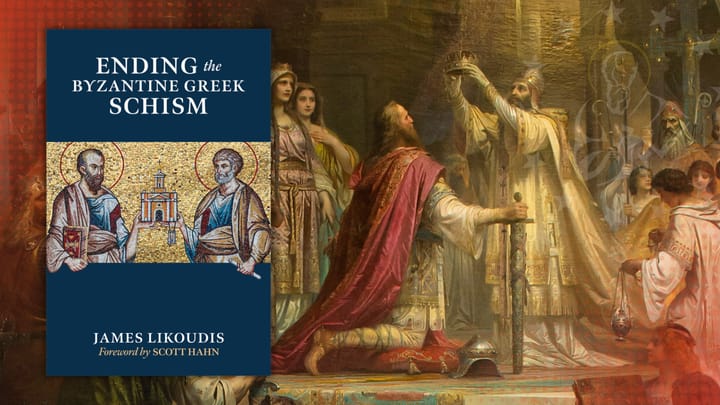
A review of ‘Ending the Byzantine Greek Schism’ by James Likoudis
They say never to judge a book by its cover. Yet there’s so much we can learn about James Likoudis’s book Ending the Byzantine Greek Schism just by considering its title.
For instance, it will come as little surprise that this book was originally published in 1993. (The text now under consideration is a revised edition published by Emmaus Road earlier this year.) It’s a real throwback. Except for the most hardened traditionalist, no Roman Catholic would refer to Orthodox Christianity in such dismissive terms as “the Byzantine Greek schism.” The tone of Catholic-Orthodox dialogue in 2026 is characterized by deep—some have said excessive—warmth and respect.
Anyway. This, to me, is a snapshot of the book itself. Frankly, it is dated.
The Curious Case of Demetrios Kydones
The first part of the text is dedicated to the life and work of Demetrios Kydones, a 14th-century convert from Orthodoxy to Roman Catholicism. Likoudis also includes his own translation of Kydones’s “Apologia for His Conversion” as a chapter.
From a historical perspective, the Apologia is fascinating. Kydones talks about his service in the court of Emperor John VI Kantakouzenos. It was there that Kydones met travelers from the West—“emissaries as well as merchants and the well-known mercenaries.” His desire to converse freely with these foreigners led him to the study of Latin. From there, he discovered the works of Thomas Aquinas and, in time, comes to embrace Roman Catholicism. It’s a fascinating story, one that gives us plenty of insights into the political, religious, and cultural life of the late Byzantine Empire.
Kydones does not offer a complete and rigorous argument for Roman Catholicism or any single Roman Catholic teaching. That is not surprising. He is writing an apologia, which is not quite the same as an apologetic. He is defending himself, not his new religion. So, he simply touch upon the arguments which he found compelling.
In fact, an Orthodox reader might find that Kydones’s theological arguments have the opposite effect to the one Likoudis intended. They may instead demonstrate that the Roman Catholicism has changed considerably since the 1300s.
Consider, for instance, Kydones’s defense of papal primacy. He writes that, “If the Bishop of Rome has been entrusted with the primacy, then it would appear sensible that there is a presumption in favor of our following him.” This is altogether different to the modern Roman teaching, that the Pope’s decrees must be received with “religious submission of mind and will” (Code of Canon Law, 752). If we speak merely of a “presumption in favor” of the pope’s teachings, we implicitly rule out that his teachings are, in some circumstances, binding to the faithful.
And here is what Kydones has to say about the Pope’s teaching authority: “In addition, the Bishop of Rome can well lay claim to representing the opinions of the majority of advisors, and, I might add, the best advisors, so that what he decrees is protected by all manner of excellent safeguards.” This, too, is in sharp contrast to modern Catholic theology, which makes the following claim:
Indeed, all the venerable Fathers have embraced, and the holy orthodox doctors have venerated and followed, their Apostolic doctrine; knowing most fully that this See of holy Peter remains ever free from all blemish of error according to the divine promise of the Lord our Savior made to the Prince of his disciples: “I have prayed for thee that thy faith fail not, and, when thou art converted, confirm thy brethren.” (Pastor Aeternus, 6)
The fact that Kydones explicitly names European scholars among those “excellent safeguards” but not the divine promise of Christ to St. Peter might suggest that Kydones did not believe in papal infallibility as it is taught by the Catholic Church today.
Now, I’m sure our Catholic friends could make a decent argument for the continuity between Kydones’s Apologia and modern Catholic teaching. Yet I think the best of them would also admit that the Apologia is the furthest thing from a “slam-dunk” proof that a Vatican I-style papacy was affirmed and believed in the Middle Ages.
So, why would Likoudis devote his first hundred pages to Kydones and his Apologia, as though the “Byzantine Greek schism” could be ended by a 600-year-old polemic? Well, in the early 1990s, this would have been an impressive text. Not only does it offer a fairly meaty argument for a “papalist” ecclesiology in the Middle Ages: it is articulated by a Greek, a member of the Church of Constantinople.
In 2026, this is less impressive. More recent works like A. Edward Siecienski’s The Papacy and the Orthodox and Fr. Laurent Cleenewerk’s His Broken Body offer a more systematic treatment of a much broader range of sources by more notable figures than Kydones, on both the Orthodox and Catholic sides. For those interested in apologetics, Erick Ybarra’s The Papacy and Craig Patrick Truglia’s The Rise and Fall of the Papacy also survey a greater range of sources.
Towards an ‘Ecclesiological Apollonarianism’
The next part of Likoudis’s book is devoted to arguing that Orthodoxy’s deficient ecclesiology follows naturally from its erroneous position on the filioque.
He begins by citing Thomas Aquinas’s statement in the Contra Errores Graecorum that, “To say the Vicar of Christ, the Roman Pontiff, does not hold primacy in the universal Church is an error analogous to that which denies that the Holy Ghost proceeds from the Son.” He then points of Yves Congar, the 20th-century Dominican theologian who exercised a profound influence on the Second Vatican Council. Congar develops Aquinas’s argument. According to Congar:
It has often been observed that a theology which denies the eternal procession of the Holy Spirit from the Word of God tends to minimize the part played by the definite forms of authority in actual life, and this leaves the way more open to a kind of independent inspiration. The ecclesiology of the Orthodox Churches has a distinctly “pneumatic” tendency and declines to accept Catholic ideas of authority which seem to savor of legalism.
He follows another 20th-century Catholic thinker, Dismas Purcell, in characterizing Orthodoxy as a kind of “ecclesiological Apollonarianism.” Amazingly, Likoudis then makes the following assertion:
Both Catholic and non-Catholic theologians agree that the doctrine of Eastern Orthodoxy, which teaches that the Holy Spirit proceeds from the Father alone, has a direct relationship to the separated Greco-Slav churches’ ecclesiological position on the primacy of the Bishop of Rome…
His footnote cites exactly two theologians to this effect. The first is Congar, a Roman Catholic. The second is Karl Barth, a Protestant. No real attempt is made to show that Orthodox Christians might accept this as a fair characterization of our Faith.
In fairness, certain Orthodox thinkers have toyed with this idea—most notably Philip Sherrard in his book Church, Papacy, and Schism. Sherrard’s thesis is, essentially, a mirror image of Likoudis’s. He argues that the whole panoply of Western errors, most notably the authoritarian papacy, follow naturally from the Latin Church’s embrace of the filioque.
Sherrard’s book has many valuable insights. However, most contemporary Orthodox scholars find his thesis reductive. Likewise, Likoudis’s position would be rejected by virtually all Catholic scholars today. Leading voices in both churches recognize that disputes over papal authority go back to the very first centuries of Christian history. Such sweeping narratives as those put forward by Likoudis and Sherrard have a certain polemical appeal but do not align with the academic consensus.
Contra Errores Latinorum
We should also note that—again—contemporary Roman Catholic sources tend to be far more generous in their treatment of the Orthodox tradition.
For instance, Likoudis refers dismissively to the “protestantizing theology of the nineteenth-century Slavophile theologians,” which he says “has wrought ecclesiological havoc among Orthodox thinkers.” Yet Catholic authors like Catherine Doherty and Caryll Houselander (both converts from Orthodoxy) have made generous use of the Slavophile theologians, seeing them as offering valuable insights even to Roman Catholic believers.
And of course, many leading Catholic theologians of the 21st century—including popes Benedict XVI, Francis, and Leo XIV—have incorporated the thought of Fyodor Dostoyevsky into their writing. Dostoyevsky was, of course, an integral member of the Slavophile movement. Yet no Catholic thinker today would characterize him as a mere “protestantizer.”
Likoudis also makes use of pejoratives such as “neo-Palamite” and “neo-Photian” to describe Orthodox theology. These terms are still occasionally thrown around by online apologists. However, any Catholic scholar hoping to be taken seriously in 2026 would be sensitive to the work done by John Paul II, Antonin Dvornak, and Christiaan Kappes (among others) to rehabilitate Palamas and Photius in the eyes of their fellow Catholics.
While we’re on the topic, Likoudis devotes a mere five pages to the subject of “Palamism”—this, in a work that claims to be “the definitive Catholic treatment of the theological issues that have divided East and West for nearly a thousand years.” These five pages consist mostly of the author listing Catholic theologians who disagree with St. Gregory Palamas’s essences-energies distinction.
The reader will also, no doubt, be struck by the chapters devoted to Thomas Aquinas’s Contra Errores Graecorum, which Likoudis translates and reproduces in full. Those who know nothing about the Graecorum will marvel at the dozens of patristic quotations demonstrating the Catholic position on the papacy, the procession of the Holy Spirit, etc.
There is a catch, though—and rather a large one. About 80% of the “Greek” sources quoted by Aquinas are forgeries. In other words, four out of five quotes that Aquinas attributes to the Eastern Fathers were not, in fact, spoken by the Eastern Fathers. Today, this is common knowledge. No serious author, Catholic or Orthodox, lends any credence to Aquinas’s treatise.
Remarkably, Likoudis insists that the Graecum is authoritative, despite acknowledging its reliance on spurious quotes. Why? Because, in his words, “All questionable quotations are easily replaced by genuine ones from Eastern Fathers and Councils.” Again, he may be right! But why bother with Aquinas’s treatise at all? Why not simply begin a fresh inquiry into the patristic texts?
That is precisely what Roman Catholic apologists like Ybarra have done. And that’s why I can’t help wondering why any respectable press bothered with a new edition of this hopelessly outdated book.
Back to the Bad Old Days
James Likoudis died in 2024. It brings me no joy to argue with a dead man. In fact, I wouldn’t have reviewed this new edition of his book at all, except that it fits into an alarming pattern.
Over the last few years, good Catholic publishers have begun to reprint anti-Orthodox texts that are (if nothing else) hopelessly outdated. This new edition of The Byzantine Greek Schism from Emmaus Road is one example. Another is The Orthodox Eastern Church by Adrian Fortesque, newly released by Os Justi Press. And we could name a few others.
On the one hand, it’s easy to see why these texts are attractive to certain members of the Roman Church. Many complain that the Vatican regime is too friendly to the Eastern schismatics. They’re looking for authors who will really take a swing at Orthodoxy.
But will their punches actually land?
These older writers certainly took a more combative stance. The trouble is that modern scholarship has proved that—even from a Catholic perspective—these older authors had a poor grasp of the primary sources. For the most part, they were responding to a caricature of Orthodox theology. Very often, they relied on forged documents to buttress their position.
In one amusing passage, Likoudis says that “we can expect increasing embarrassment on the part of Orthodox theologians engaged in dialogue” as the supposed contradictions in our ecclesiology are weighed against the documents of Vatican I. In reality, the opposite has happened. The joint Catholic-Orthodox declarations issued at Balamand (1999), Ravenna (2007), Cheiti (2016), and Alexandria (2023) have largely vindicated the Orthodox position.
The Cheiti Document, for example, famously claims that, in the first millennium, “Appeals to the bishop of Rome from the East expressed the communion of the Church, but the bishop of Rome did not exercise canonical authority over the churches of the East.” Even many Catholics interpret this statement as conceding the most basic arguments to the Orthodox.
Our Catholic friends will point out that Cheiti, et al., are not “ex cathedra” and therefore not binding for members of the Roman Church. At the very least, however, we can admit that Likoudis was exactly wrong. If anything, the Roman Catholics have suffered from “increasing embarrassment” as a result of the ongoing Orthodox-Catholic dialogues.
This is all quite obvious to anyone who follows these dialogues. So, why did the new edition of Likoudis’s book receive endorsements from major Catholic apologists such as Scott Hahn, Trent Horn, Michael Lofton, and Joe Heschmeyer? We would hate to conclude that these men are less concerned with good scholarship and productive dialogue than they are with scoring cheap shots against the Orthodox. God forbid they should have endorsed the book without even reading it!
In any event, I sincerely hope that our Catholic friends will lay aside these worn-out polemics.
To be clear, I have nothing at all against Roman Catholics who try their best to defend their theology and ecclesiology. My only hope is that they try to keep up with modern scholarship and contemporary ecumenical dialogue. The modern popes have demonstrated their deep love for the Orthodox Church—its theology, it spirituality, and (yes) its ecclesiology. Hopefully these Catholic “influencers” will follow their good example.