Defense of The Faith
Put Out More Rainbow Flags
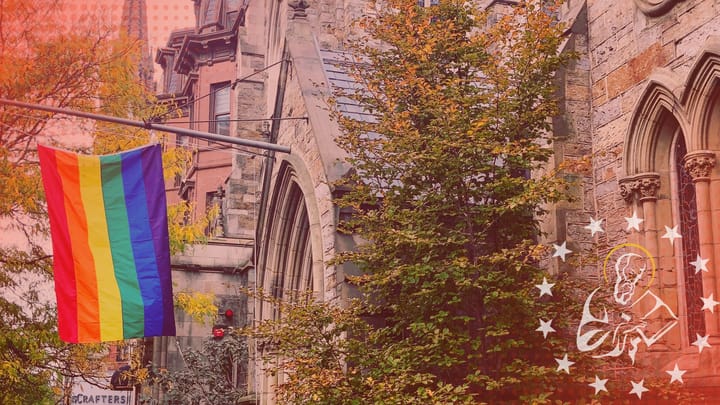
All the tyrants of history have tried to murder Christ’s Church, to no avail. Now these “mainline” denominations are committing suicide.
I was delighted to learn this year that Blessed Fr. Seraphim Rose had grown up a white-bread Methodist, just as I had. We were separated by several decades and a few hundred miles (I was born in Oregon, he in California). Reading about his early life, however, brought back many fond memories of Sunday school and Bible camp.
I learned last week that the Methodist parish of my youth is being sold. There is talk—you can’t make this up—of turning it into a mosque, to support our little city’s growing “Muslim community.” I wonder what will become of the stained-glass window on the eastern wall showing the baptism of Christ in the Jordan. As a little boy I gazed up in awe at that (slightly groovy) image, with the morning sun illuminating the dove as He descended from Heaven. When I thought of the Father saying, “This is My beloved Son, in whom I am well pleased,” it was in the resonant bass of our minister, John.
Today I am an Orthodox Christian. I thank God for that. Still, I feel nothing but gratitude for that “church in the wildwood,” which seems like something out of the Andy Griffith Show, though I was confirmed in the late Eighties. The women all wore dresses with short sleeves and pearls with their hair done up. The men were all in thick glasses and baggy grey suits with pictures of Bibles on their neckties. Pastor John wore a black robe and a colorful stole when he preached from the King James Version. The choir wore matching robes of shimmering blue and sang old hymns like “Bringing in the Sheaves” and “Rock of Ages,” accompanied by Mrs. Ethel Thompson on the electric organ. Communion was day-old bread from Albertsons and Welch’s grape juice.
Whatever else might be said about the Methodist Church (and I’ll say plenty in just a moment), it was there I first learned to confess Jesus Christ as my Lord and Savior, and to love God with all my heart and soul and mind and strength, and to love my neighbor as myself.
Change came quickly for the United Methodist Church, especially on the West and East coasts. I don’t remember when exactly we started marrying same-sex couples. It didn’t bother me at the time. I wasn’t especially progressive, but I didn’t think of myself as a conservative either. I found arguments for the individual conscience (“Don’t like gay marriage? Don’t get one”) rather persuasive.
I was, however, bothered when the new pastor—the Rev. Susan—decided to hang a rainbow flag outside the church. It is one thing to tolerate homosexuality; it’s another thing to encourage it. It is one thing to allow same-sex marriage and another thing to promote it. Whatever the Rev. Susan might have said, that flag had a political dimension. When did support for the “LGBT community” become so integral to our Methodist identity that good Protestants— we who are so wary of images and symbols!—decide to place the Pride Flag next to the old, rugged Cross? Who decided that this should be the face that we show to the world?
Eventually the Rev. Susan invited me to join the vestry. I was the token representative of a dying breed in the UMC: bespectacled men who in tacky neckties. My offspring made up fully one-third of the children in the parish; the other two-thirds belonged to African immigrants, who became our best friends in the church.
At my first meeting, the Rev. Susan asked me what we could do to attract more families. Without thinking, I said, “Take down the rainbow flag.” She gave me a look of sheer horror, as though I had proposed that we begin performing blood sacrifices on our table altar. I quickly explained that I had no issue with homosexual marriage (which, at the time, was true). However, that flag signaled that we were more interested in politics than the Gospel. Somewhere along the line, we seemed to have gotten our priorities mixed up.
The Rev. Susan nodded politely. That was the last vestry meeting I ever attended. Somehow, my email address was removed from the mailing list, and it seems my absence wasn’t noticed at subsequent meetings.
In 2020, our family was received into the Orthodox Church.
A couple of years ago I happened to drive by our old Methodist parish. The rainbow flag still hung by the door. It was joined by a rainbow banner saying, “ALL ARE WELCOME.” There was a new sign hanging from the wooden post at the end of the driveway; it had a rainbow flag next to the logo of the United Methodist Church. The words “An Open and Affirming Parish” had also been added. Most bafflingly of all, a row of Adirondack chairs had been arranged on the lawn. There were six in total: one red, one orange, one yellow, one green, one blue, and one purple.
I heard from an old neighbor that the Rev. Susan and her partner Becky now lived together in the parsonage.
It doesn’t come as a terrible surprise to me that the parish is now closing. I had tried to warn the vestry of this precise eventuality. No one is going to wake up at 8 AM on a Sunday and drives to a church for a political rally. If they’re interested in “affirming” the “LGBT community,” they can do that at any number of coffee shops and music halls throughout the Pacific Northwest. If someone comes to church, they’re probably looking to do church things.
There are lots of places to play politics in this great country of ours. There are not as many places to hear the Gospel preached, or to sing hymns, or to partake in the Lord’s Supper. This is, in theory, what the churches are for. When they deviate from that mission, it tends to go badly for them.
When I joined the vestry, I wasn’t aware of the studies which show that the “mainline Protestant” churches will go extinct in the 21st century. The United Methodist Church, Episcopal Church, Evangelical Lutheran Church, and their fellows are hemorrhaging members so quickly that, within the next 30 to 50 years, they will (statistically) hit zero.
Of course, it’s unlikely that they will completely disappear. A few parishes will survive in big cities. The dying mainline denominations may then choose to merge into a single “Uniting Church” as they did in Canada and Australia. Still, I can’t imagine what the leaders of these churches say behind closed doors, what secret doubts they might harbor. All the tyrants of history have tried to murder Christ’s Church, to no avail. Now these “mainline” denominations are committing suicide.
No doubt Orthodoxy is growing, in no small part, as refugees from mainline Protestantism seek out a church that has preserved “the faith delivered once, for all, to the saints” (Jude 3). And thank God for that. Still, I can’t help feeling a twinge of regret… or if not regret, then nostalgia… or if not nostalgia, then perhaps simple gratitude. The Methodists and Episcopalians and Lutherans of old planted the seed of the Gospel in so many of our hearts. They helped prepare the soil where the seeds of Holy Orthodoxy are now being planted. Please forgive me if I dare to hope that God—in His infinite and inscrutable mercy—remembers them forever in His kingdom.