History and Culture
The Orthodox Remnant in Medieval Rome
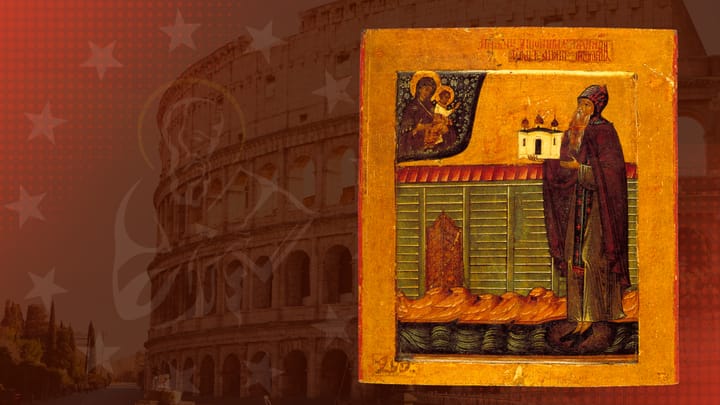
St. Anthony the Roman belonged to an “Orthodox underground” that survived in the Latin Church follow the events of the so-called Great Schism.
Venerable Anthony the Roman, founder of the Antoniev Monastery in Novgorod, is commemorated in the Orthodox Church on August 3 (and also January 17 and the first Friday after the Feast of Saints Peter and Paul). According to his hagiography, he was born in Rome around 1067 to wealthy parents who remained faithful to the Orthodox confession of the Eastern Churches in the years immediately following the Great Schism of 1054.
The issues dividing East and West were many: the unilateral Western addition of the filioque to the Creed, the pope's claim to universal jurisdiction, and certain liturgical and disciplinary differences. Anthony’s family adhered to the faith of the Seven Ecumenical Councils and the Church Fathers rather than the innovations of the Latin Church. They secretly instilled this same piety within their son, hiding their true faith because—as Archpriest Gregory Dyachenko put it—Rome persecuted those who “deviated from the Western Church.”
Orphaned at about age 17, Anthony studied the Holy Scriptures in both Latin and Greek and continued to immerse himself in the writings of the Church Fathers. He distributed part of his inheritance to the poor before receiving monastic tonsure at a wilderness skete where he lived in asceticism for some twenty years.
A persecution of the Latins against the Orthodox forced the brethren to disperse. Anthony wandered until he settled on a large rock by the seashore, living there a year in fasting and prayer. On September 5, 1105 (or 1106 in some accounts), a storm tore the rock from the shore. By divine providence it floated across the sea and rivers, arriving near Novgorod on the banks of the Volkhov River on the Feast of the Nativity of the Theotokos.
Unable at first to speak the local tongue, he was aided by Greek- and Latin-speaking merchants. Soon he met Bp. Nikita of Novgorod and received permission to found a monastery at the landing site. Miraculously, a barrel containing church, later washed ashore miraculously as well. He sold the treasure to buy land for the monastery and placed the church vessels in the chapel.
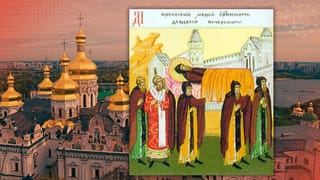
He built a wooden church, which was later replaced ny a stone cathedral named in honor of the Nativity of the Theotokos. Anthony was appointed igumen by St. Niphon of Novgorod in 1131. Known for care of the poor, orphans, and widows, he reposed on August 3, 1147, and was buried by Niphon. He was formally glorified in 1597.
The vita presents Anthony’s family and monastic companions as part of a small circle of Orthodox-leaning Christians in post-Schism Rome who recognized that the Eastern Churches preserved the faith more faithfully. Historical sources confirm a continuing Greek/Byzantine presence and monastic communities in Rome—especially southern Italy into the 11th–12th centuries. Little is known, however, about the “Orthodox underground” to which Anthony belonged.
The hagiography states that when discovered, such monks were pressured to submit to Roman authority and forced to disperse; Anthony’s path led him eastward to Rus. A later parallel figure, Saint Macarius the Roman of Novgorod (15th–16th century), also left Rome for Orthodoxy in Russia.
May Sts. Anthony and Macarius, the "Romans of Novogorod," intercede with Christ on behalf of those who seek to rekindle the flame of Orthodoxy here in the West!