News
Archaeologists Uncover Fourth-Century Christian Basilica Beneath Italian City
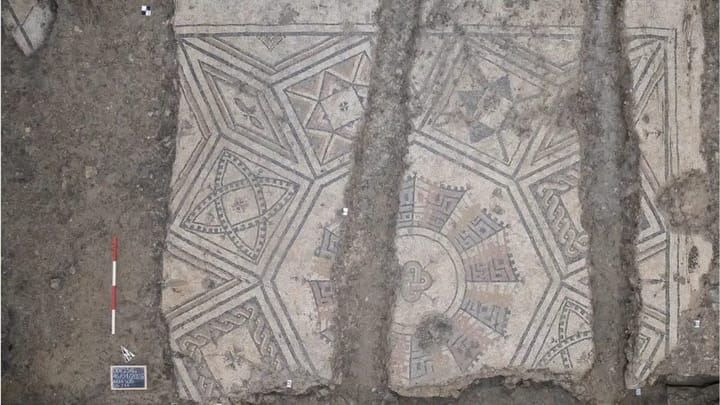
Discovery of richly decorated church and mosaics in Oderzo offers new insight into the spread of Christianity in northern Italy during Late Antiquity.
ODERZO — Archaeologists have uncovered the remains of a large early Christian basilica beneath the former fish market in Oderzo, Italy, in what experts are calling one of the Veneto region's most significant recent archaeological discoveries. This was first reported by La Divina Cultura.
The basilica, discovered during excavations ahead of a construction project, is believed to date to the late fourth or early fifth century A.D. The structure features a spacious three-aisled layout, substantial perimeter walls, and numerous burials surrounding the building, all of which indicate it served as an important Christian place of worship.
Among the most remarkable finds are exceptionally well-preserved polychrome mosaics decorated with intricate geometric and floral designs. Archaeologists say the craftsmanship reflects a high level of artistic and technical achievement. Protective structures have been erected over the site to preserve the fragile mosaics while excavations continue.
Researchers believe the church's architectural plan, burial sites, and remains of the presbytery firmly identify it as an early Christian basilica. The mosaics also bear close similarities to those found in the renowned early Christian churches of Aquileia and Concordia Sagittaria, placing Oderzo within one of the most important artistic and religious traditions of Late Antiquity.
The discovery sheds new light on the history of ancient Opitergium, modern-day Oderzo, demonstrating that the city continued to thrive after the decline of the Roman Empire as Christianity reshaped urban life across northern Italy.
Archaeologists will continue excavations in the coming months to determine the basilica's full extent, establish a more precise chronology, and better understand its various phases of construction. Experts believe the site could significantly advance knowledge of the early development of Christianity in northeastern Italy.
Previously, the UOJ reported that a newly deciphered Aramaic inscription discovered at the ancient Zerzevan Castle site in southeastern Turkey has revealed that early Christians symbolically sealed an underground Roman Mithras temple nearly 1,700 years ago.
Read also