Defense of The Faith
‘The First See Is Judged By No One’: The SSPX and Papal Halakha
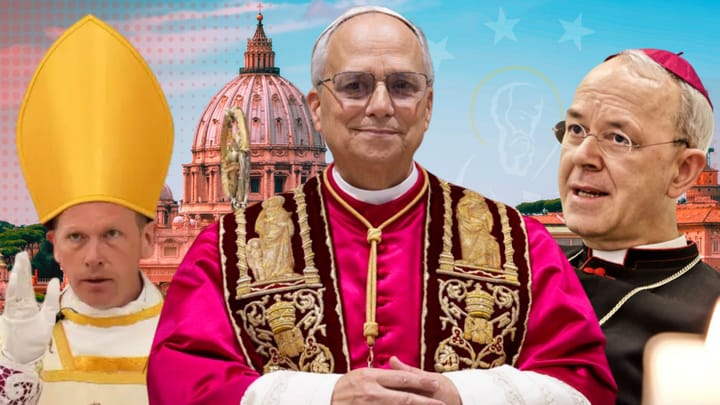
Without all the lawyering and loopholing, it would cease to be Roman Catholicism.
Recently, UOJ editor Michael W. Davis penned an open letter to members of the Society of St. Pius X. In it, Mr. Davis invited Society members to consider the parallels between their recent excommunication and the events that led up to the Great Schism.
Mr. Davis’s letter has some valid insights. In both instances, Rome showed great tolerance for “progressives” while pursuing a zero-tolerance policy towards dissident “traditionalists.” In both instances, those traditionalists were the papacy’s strongest supporters. And in both instances, the progressives were protected and promoted by worldly powers.
Nevertheless, I’m afraid that Mr. Davis’s appeal will fall on deaf ears. Unlike the Orthodox Christians of 1054, the SSPX is not steeped in the Apostolic and Patristic Faith. Rather, they are heirs to post-schism Latin legalism.
As such, their response to the excommunications has not been to SUBMIT TO ROME™. They have not, pace Mr. Davis, been moved to reconsider their papist worldview. Rather, they counter the Vatican’s “papal lawyering” with papal lawyering of their own.
And why not? This is all they know.
Papal Lawyering and Jewish Halakha
The point of Rabbinic Judaism is, essentially, to trick God by finding loopholes in the halakha: the 613 rules which they believe God imposed on the Jewish people.
For instance, the halakha says that Jews may not travel from one domicile to another on the Sabbath. They get around this by tying a string around their village or neighborhood; they treat this string as a “wall,” and say that the village/neighborhood constitutes a single “house.”
Clearly, this is not what God meant when He gave this commandment! Hence. St. Paul warning that “the letter killeth, but the spirit giveth life” (2 Cor. 3:6). Also the Lord’s teaching, “The sabbath was made for man, and not man for the sabbath” (Mark 2:27).
The response of the SSPX and its supporters have taken the same attitude towards the papal excommunication.
For instance, the traditionalist Catholic blog Rorate Coeli has published an article by the “Canon of Shaftesbury” (a pseudonym), who claims to be a judicial vicar in a major archdiocese. Shaftesbury claims that the decree is invalid—or at least not fully valid—according to the current Code of Canon Law. The author makes four basic arguments:
- The SSPX is guilty of disobedience, not schism. Disobedience is a single act; schism is the “withdrawal of obedience” to the pope (canon 751).
- The canon invoked by Rome is relevant only in instances where automatic excommunication has not been incurred (canon 1335§2)—and yet the Vatican insists that the SSPX has incurred latae-sententiae excommunication.
- The decree’s “grammar” supposedly “defeats broad application.”
- The matter is not sufficiently grave to merit group excommunication (canons 1323–1324; 1720).
Shaftesbury concludes that the Vatican’s decree “did not declare the excommunication of any priest.” Moreover: “The faithful who attend SSPX Masses and seek the Society's sacraments have not been excommunicated.”
Orthodox Christians—indeed, all non-Catholics—will immediately understand why this argument is so absurd. Nevertheless, let’s spell it out.
The Code of Canon Law was adopted by Pope John Paul II in 1983. Its legitimacy rests on this fact: the fact that it was promulgated by the Supreme and Infallible Vicar of Christ. It is not meant to limit the pope’s authority: it is an exercise of his authority.
Indeed, it says explicitly that the Pope “possesses supreme, full, immediate, and universal ordinary power in the Church, which he is always able to exercise freely” (canon 331). It also explains that the pope is able to dispense from “universal and particular disciplinary laws,” as well as “procedural or penal laws” (canon 87).
What’s more, it explicitly states that the pope’s decrees cannot be appealed in a canonical court (canon 1405). Indeed: “The first see is judged by no one” (canon 1404).
It is important to spell this out, in order to demonstrate the foolishness of pitting canon law against papal fiat. Just like Rabbinic Jews, the SSPX is acting as though they can make up loopholes in the law in order to “put one over” on the lawmaker himself.
The Pope has extended his hand and declared the Society of St. Pius X—its bishops, priests, monastics, and lay faithful—to be excommunicated. This means they are, according to the Roman Catholic system, excommunicated. There can be no argument, no appeal. There’s no room for loopholing or lawyering. If the pope says you’re out, then you’re out.
And yet, as we said, lawyering and loopholing are the essence of Roman Catholicism—as they are Rabbinic Judaism. So, we cannot be surprised when the Lefebvrists refuse to give up the game.
Yes, they must sustain dangerous levels of cognitive dissonance, performing outrageous mental gymnastics, in order to continue identifying with the Roman Catholic Church. But cognitive dissonance and mental gymnastics are not a departure from the Latin tradition. They are the Latin tradition!
The Papacy as Post-Truth
In the days before the excommunication, the traditionalist bishop Athanasius Schneider said: “If the excommunication would be applied, it would be in some way not valid because there is no intention to do a schismatic act on the side of the Society of Pius X [sic], and you cannot be punished when you have not the intention to do it, according to the canon law.”
This is ridiculous. No one has ever said, “I am going to commit the sin of schism today.” No: everyone thinks of himself as preserving the true Faith, of remaining loyal to the true Church. It’s the other side that is schismatic and/or heretical.
For instance, the “Old Catholics,” who broke with Rome over the First Vatican Council, did not see themselves as schismatic. Rather, as their name suggests, they saw themselves as the true Catholics; they viewed the promoters of papal infallibility as breaking with Catholic tradition.
The same is true of modern sedevacantists. They do not see themselves as being in schism from the papal church. Rather, they view the modern popes as antipopes. From their perspective, the world’s 1.3 billion Roman Catholics are schismatic. It is only the tiny “sede” minority who constitute the real Body of Christ.
What Bp. Schneider doesn’t understand is that to defy Rome is itself a schismatic act. Pope Leo told the Society not to consecrate new bishops, or else he would excommunicate them (i.e., they would go into schism). They proceeded with the consecrations, and so Leo excommunicated them. Again, “The first see is judged by no one”—not even an auxiliary bishop from Kazakhstan.
Let me say this again: No one is claiming that the SSPX consecrated their new bishops in order to become schismatic. Obviously, that was not their “goal.” However, there is no effective limit on the Pope’s ability to excommunicate members of the Roman Church. Whether Bp. Schneider (or anyone else!) thinks the pope has a “good reason” for excommunicating them is totally irrelevant. His opinion does not matter. The Canon of Shaftesbury’s opinion doesn’t matter. The only person whose opinion matters is Pope Leo XIV. Roma locuta, causa finita est.
Roman Catholicism: ‘Rabbinic Christianity’
It is possible that a small handful of Lefebvrists will wake up to their former delusion and join the Holy Orthodox Church, the one true bastion of Apostolic and Patristic Tradition. There will be no mass exodus, however.
Rome is bringing down the hammer upon the SSPX for defending the pre-Vatican II faith. Meanwhile, they allow the German bishops to promote homosexual marriage, abortion, and women’s ordination. And why? It is, in part, because the German bishops are serving Europe’s ruling elite, promoting Europe’s ruling ideology. The SSPX, on the other hand, are fighting a guerrilla war to restore Western Christendom.
The SSPX are more authentically Catholic than the German bishops—theologically, liturgically, culturally, and politically. And yet the Lefebvrists top the Vatican’s Most Wanted list. The Germans don’t even make an appearance. As Mr. Davis points out, this absurd double-standard goes back to the 11th century (at the very least!).
Again, Catholics treat papal decrees the way Rabbinic Jews treat the halakha. They simply do what they want and then make up some bizarre explanation as to why that doesn’t technically break the law (even though it clearly does). And that is why the SSPX excommunications will have no real effect on the Catholic Church—not for the Society “schismatics” nor for the Vatican “loyalists.”
Sure, Catholics refer to the Pope as the Supreme and Infallible Vicar of Christ. They demand the whole world submit to his throne and kiss his feet. And yet they themselves only obey him if they happen to agree with his teaching!
If they don’t agree with him, they make up some excuse about to why his edict doesn’t count. They’ll say he wasn’t speaking “ex cathedra,” or that it fell outside of his “ordinary and universal magisterium,” or that he wasn’t teaching about faith or morals, or that the SSPX didn’t intend to commit the sin of schism.
This is the way it has always been. This is the way it always will be, for as long as the Roman Catholic sect survives. It is a Christian form of halakha. Without the lawyering and loopholing, it would cease to be Roman Catholicism.