Defense of The Faith
Without the Sacraments, We Have Nothing
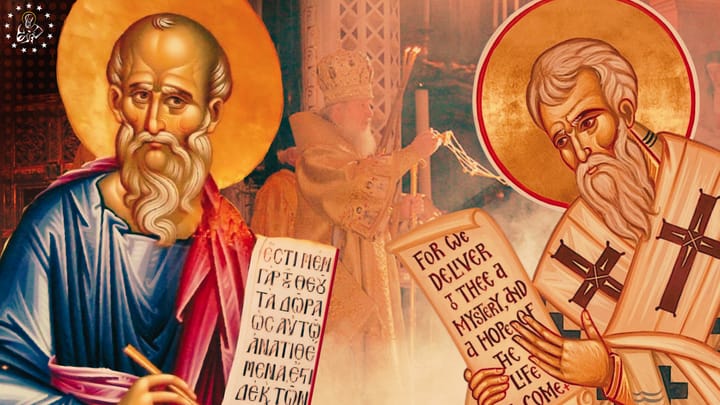
On June 20, the Orthodox Church commemorates St. Nicholas Cabasilas, one of the most significant theologians of the Byzantine period.
Cabasilas was a staunch ally of St. Gregory Palamas. Like Palamas, he was a champion of the hesychasts of Mount Athos. He is perhaps best known, however, for his book on the Holy Sacraments.
St. Nicholas titled his book Life in Christ—and that tells us everything we need to know. For Cabasilas, the Sacraments are the means by which we achieve union with Jesus. As he himself wrote:
Baptism confers being and in short, existence according to Christ. It receives us when we are dead and corrupted and first leads us into life. The anointing with chrism perfects him who has received [new] birth by infusing into him the energy that befits such a life. The Holy Eucharist preserves and continues this life and health, since the Bread of life enables us to preserve that which has been acquired and to continue in life. It is therefore by this Bread that we live and by the chrism that we are moved, once we have received being from the baptismal washing.
Elsewhere, he puts it even more succinctly:
By dispensation of His grace, He disseminates Himself in every believer through that flesh whose substance comes from bread and wine, blending Himself with the bodies of believers, to secure that, by this union with the Immortal, man too may be a sharer in incorruption.
Of course, this does not discount the importance of other means by which we are united to the Lord. Prayer is the most obvious example, especially the Jesus Prayer. However, these spiritual practices must be built upon a firm foundation: full and continual immersion in the sacramental life of the Church.
Of course, there are saints who received grace by different, extraordinary means. St. Dismas the Good Thief was not baptized; St. Mary of Egypt only received the Eucharist once in her life. However, these examples are so rare that they effectively prove the rule.
In his procatechesis, St. Cyril of Jerusalem makes a similar point about our understanding of Church teaching. He says that participation in the sacraments allows us to know and comprehend divine realities that are, for the most part, forbidden to the uninitiated:
See with me the great dignity Jesus gives to you! You were called a catechumen, one who hears only externally, hearing hope but not knowing it, hearing mysteries but not understanding, hearing the Scriptures but not knowing their depth. But now you hear internally, not externally. For the indwelling Spirit makes your mind into a divine house.
These themes were taken up together by the great 19th-century theologian Alexey Khomyakov, who said: “The Church does not ask, Which Scripture is true, which Tradition is true, which council is true, which work is pleasing to God? For Christ knows His own inheritance, and the Church in which He lives knows with inner knowledge and cannot help but know her own manifestations.”
This is why, on the one hand, the Orthodox Church has always taken such care that our priests stay close to the sacramental practices handed down to us by Christ, the Apostles, and the Holy Fathers. It is also why the Orthodox Church has tended to question the validity of sacraments performed by heterodox Christians.
To many, this seems elitist or needlessly exclusive. Yet St. Cyril of Jerusalem might wonder: If whole Christian sects have fallen into grave and persistent error, they evidently no longer “hear internally” the true meaning of the Gospel. And what can we conclude, if they no longer “hear internally”? Either the Holy Sacraments somehow stopped working, or else they no longer have true Sacraments to begin with.
Likewise, St. Nicholas Cabasilas might posit: Participation in the Holy Sacraments brings one into unity with the Body of Christ. So, if the Sacraments exist in two “groups” that are not in communion with each other, then either the Body of Christ is divided or Christ has two bodies. And yet St. Paul clearly teaches that Christ has one, undivided Body (cf. 1 Cor. 12:12-13). So, how can there be true Sacraments outside the Orthodox Church?
On this feast of St. Nicholas Cabasilas, may we give thanks to Christ our God for giving us new life within His own Body—the Orthodox Catholic Church—through the Holy Sacraments!