Man and Church
A Living Faith: The Homilies of Metropolitan Neophytos of Morphou
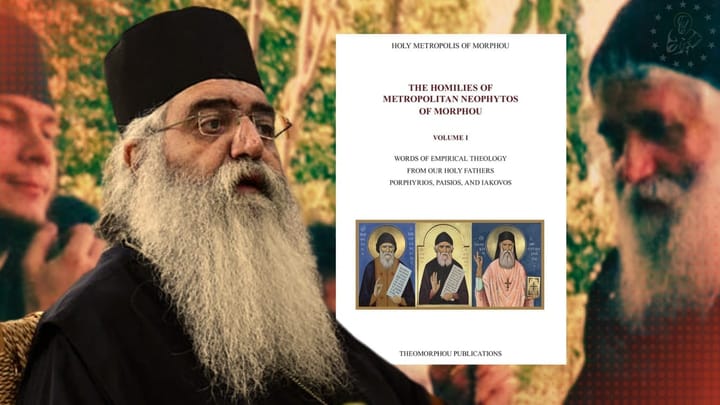
Through memories of Saints Paisios, Porphyrios, Iakovos, and the Orthodox people who formed him, Metropolitan Neophytos offers a glimpse into a culture thoroughly baptized by the Faith.
There are books about saints, and then there are books which allow us, however briefly, to feel as though we have met them. The Homilies of Metropolitan Neophytos of Morphou, Volume 1, belongs decidedly to the latter category.
Published by Theomorphou Publications in Cyprus and distributed in the United States by Uncut Mountain Press, the volume collects homilies delivered by His Eminence Metropolitan Neophytos of Morphou over the years, many of them relating his personal encounters with some of the greatest saints and elders of our own times: Saint Paisios the Athonite, Saint Porphyrios of Kafsokalyvia, Saint Iakovos of Evia, and others. But these are not detached biographies: Metropolitan Neophytos knew these men and—in the case of St. Iakovos of Evia—counted them as spiritual fathers. He sought their counsel, received their correction, witnessed their gifts, and, perhaps most importantly, was providentially formed by them.
Consequently, the saints emerge from these pages not as distant figures from an inaccessible spiritual age, but as living personalities. They joke, rebuke, console, prophesy, pray, and direct those whom God sends to them. Metropolitan Neophytos recounts these interactions with an obvious affection, but also with the understanding that the providential instruction he received through these holy men was intended to bear fruit far beyond himself.
While the bulk of the book deals with the three great saints mentioned above, there are other beloved elders (and eldresses) of Cyprus and Greece mentioned as well: Saint Sophrony of Essex, Saint Philoumenos of Jacob's Well, Elder Isaac Abdallah, Eldress Macrina Vassopoulou, and many others. I was especially pleased to see included the great Elders of Stavrovouni, Cyprian and Gerasimos.
Some of my favorite passages concern what His Eminence calls “folk piety”—the lived Orthodoxy of ordinary Greeks and Cypriots, and of those whose families carried the traditions of Cappadocia into the modern world. Here we encounter something largely foreign to us in America: not simply Orthodox individuals, but Orthodox families, neighborhoods, villages, habits, instincts, and ways of understanding the world.
For those of us approaching the Church in America, in this generation, this glimpse is of tremendous importance—it's one reason I have so often recommended Saint Nikodim of Belgorod’s Russian Ascetics of Piety of the 18th and 19th Centuries, published in English by Old Paths Orthodox Press. In both works we see how Orthodoxy comes to permeate the very texture of ordinary life. Not merely in when families pray or participate in processions; but in how they build homes and towns, how they care for themselves and others, deal with life's triumphs and tragedies, how they interpret the ways and whims of providence, of governments, et al. Every aspect of life and society orthodoxized.
This presents a lesson worth considering for American Orthodox Christians. We speak frequently today of an eventual “American Orthodoxy,” usually in terms of jurisdictional unity, language, or mass conversion. Yet none of these things, by themselves, can create an Orthodox culture. Before we can seriously speak of an American Orthodoxy, Americans must first become thoroughly Orthodox—as Orthodoxy has actually been handed down to us: a living faith incarnate within actual families and communities, lived in every nook and cranny of our lives.
Books such as this one help because they allow us to see what that looks like. So do pilgrimages, monasteries, and life within the “ethnic” Orthodox communities sometimes too quickly dismissed as relics of an immigrant past. America will not become Orthodox merely by placing an American veneer over the institutions we have inherited, or through forcing church music, art, and architecture into an artificial American mold—too often based on American secular or Protestant models. No! We must first learn the habits, instincts, and piety which made those institutions possible.
But I digress...
As a physical publication, the volume is attractive. It is richly adorned with icons of the saints from the Metropolis of Morphou, something I particularly appreciated; anyone who knows me knows my particular love and attachment to Cypriot iconography. Several photographs of the saints and elders discussed throughout the book are also included. The paperback binding, complete with French flaps, feels sturdy enough for repeated reading.
The editing, however, leaves something to be desired. Typos and inconsistencies in spelling occur frequently. Throughout the section on Saint Porphyrios, for example, “Kafsokalyvia” is sometimes rendered correctly—particularly in footnotes and image captions—while appearing as “Kafskokalyvia” elsewhere in the text. At times the English also gives the impression of a translation completed by someone for whom English is a second language without a final review by a native speaker. Some formatting, particularly during extended back-and-forth dialogue recounted by His Eminence, can likewise become confusing.
Now, to be fair, transforming spoken homilies into polished written prose presents difficulties of its own. The rhythms of speech do not always transfer naturally to the page, and editing such material without stripping it of the speaker’s voice requires considerable skill.
But these are ultimately minor shortcomings beside the substance of the book. The spiritual profit to be found here greatly outweighs its editorial imperfections.
I highly recommend The Homilies of Metropolitan Neophytos of Morphou, Volume 1 to anyone with a love for the great saints of our own times, and particularly to those who, like myself, have a deep affection for the Church and island of Cyprus. More than a collection of stories about holy men, it offers us a glimpse into the Orthodox world which formed them—and perhaps, if we are attentive, a glimpse of the kind of world we ought to be building ourselves.
The book is available from Uncut Mountain Press, and can be purchased here.
Read also