Man and Church
Abba Dorotheos on the Need for Consultation
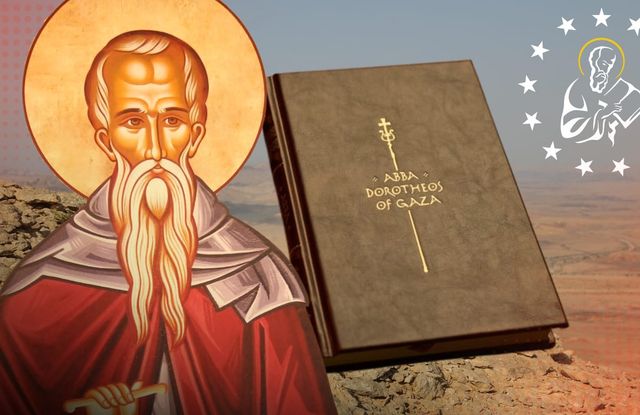
Our culture promotes independence and self-righteousness. Yet St. Dorotheos of Gaza warns us, “I know of no fall that happens to a monk that does not come from trusting his own judgment.”
When I was young, I came to believe that the highest possible virtue one could strive for was to become capable of handling everything yourself with no help from others. In other words: total, unabashed independence.
That wasn’t to say that I would reject having relationships with friends and family who I cared about, but I would only rely on myself. Problems would be solved by me. Emotions wouldn’t be talked about. Struggles would be internalized.
This was partially due to experiences with people who had proven themselves to be untrustworthy, but mostly it was due to my own inflated ego. I was overly competitive, always right, and smarter than the person next to me. Why should I consider someone else’s thoughts when my own are sufficient?
Over the course of time, I grew out of this. By the grace of God, some help from St. Ephraim the Syrian (who I began to have a deep appreciation for) and through conversations with people who did prove themselves to be trustworthy, I began to shift my thinking. Most importantly, I began to comprehend the healing that I had been denying myself, and that it was Christ Himself Who was offering it to me.
But perhaps no one pointed out my glaring need for outside counsel more than Abba Dorotheos, the sixth century monk and spiritual teacher. With his help, I took the work that I had begun and completely turned a new leaf.
His discourses and sayings – which are preserved in literary form and heralded as one of the most essential monastic texts – had a profound impact on me. Every chapter is golden, but his admonition “On the Need for Consultation” was exactly what I needed at the time that I read it. The chapter begins:
“In the Book of Proverbs it says, ‘Those who have no guidance fall like leaves but there is safety in much counsel.’ Take a good look at this saying, brothers. Look at what Scripture is teaching us. It assures us that we should not set ourselves up as guide posts, that we should not consider ourselves sagacious, that we should not believe we can direct ourselves. We need assistance, we need guidance in addition to God’s grace. No one is more wretched, no one is more easily caught unawares, than a man who has no one to guide him along the road to God.”
This was a novel idea for me. I thought safety came from handling things yourself – not seeking guidance. I was arrogant enough to think that I could conform my own will to God’s will entirely through my own efforts and without someone more experienced to direct me. Abba Dorotheos instructs us:
“If a man would safeguard his soul, he will do so by laying bare all his secret thoughts and hearing from an experienced director. ‘Do this, avoid that. This is right, the other is not. This is virtue, that is self-will.’ Or again he hears, ‘It is not the right time for doing this,’ or at another time, ‘Now is the time for this,’ and the devil finds no opportunity to do him harm or to strike him down, since in everything he is controlled and he takes precautions about everything and is made secure. ‘There is safety in much counsel.’ The devil does not want this, and hates it. What he wants is to do evil and he rejoices the more over those who do not accept direction. Why? ‘Because they fall like leaves.’”
In fact, Abba Dorotheos states that the evil one hates even the very mention of caution. If we would only pause and inquire whether a particular course of action is profitable before forming an opinion, the devil would flee far away from us, “because the devil knows that his malice is brought to light though this inquiry and discussion about the advantage of doing a thing, and there is nothing he hates and fears so much as to be known, because then he finds himself unable to lay snares as he wishes.”
The devil told St. Makarios that there was one brother “who when he sees me changes like the wind.” These people Abba Dorotheos calls “the ungoverned,” because they do not have someone they are subject to in living a life in Christ. Such people, the evil one rejoices over.
“I know of no fall that happens to a monk that does not come from trusting his own judgment. Some say, ‘A man falls because of this, or because of that,’ but I say, and I repeat, I do not know of any fall happening to anyone except from this cause. Do you know someone who has fallen? Be sure that he directed himself. Nothing is more grievous than to be one’s own director, nothing is more pernicious.”
Notice how Abba Dorotheos begins in the monastic context and then extends the teaching to everyone. He knows of no fall happening to anyone except from this cause. His teachings are not only for the monastics – they are for all of us.
With all of this being said, counsel also does not always have to come through conversations with a priest or peer. The Church gives us the tools to pause and consider our actions. Before we make a meal, we can consult the fasting calendar. Before we go about our day or begin a particular task, we can pray and read Scripture. If we are struggling with a particular passion, we can consult the lives of the saints who dealt with the same issues.
When we talk about the concept of “American Orthodoxy,” I believe this is one of the major dominoes that has to fall. I was baptized as an infant and grew up in the Church, yet our culture in the United States led me into thinking that “my way or the highway” was what constituted good living. As long as I had the name of Jesus Christ on my lips, everything would be OK.
But it isn’t! And we have to be honest about that. I’ve had to work on becoming much better about simply talking to my wife about things I used to keep to myself, let alone spiritual guides. St. Dorotheos of Gaza has been one of my biggest helpers in that regard.
In fact, I began to revere him before I even knew much about his life or even his feast day. I had only read some of his discourses. After doing some research, I discovered that his commemoration is June 18/June 5 (Old Calendar/New Calendar) in the Slavic tradition, and my devotion reached an entirely new level as my birthday is the latter date.
I have come to understand St. Dorotheos as a powerful intercessor and someone who I desperately needed at the time that I came across his writings.
Near the conclusion of the chapter “On the Need for Consultation,” the blessed elder states:
“I have told you all this so that you may know how much rest and tranquility a man may have – and that with all security – by not settling anything by himself, but by casting everything that concerns himself upon God and on those who, after God, have the power to guide him.”
I can tell you that “these words are faithful and true” (Rev. 22:6). As the great modern theologian Metr. Hierotheos of Nafpaktos states in one of his homilies about St. Dorotheos:
“In these texts of his, his God-given wisdom can be seen, together with the spiritual experience he had, and it is proven he was a deep anatomist of the human soul, a deep hesychast Father who formulated his teaching with simplicity… His writings are amazing and distinguished for God-given psychotherapy and unattainable practicality, since he knows very well the world of the passions of the soul, the world of intrusive thoughts and the world of virtues.”
Abba Dorotheos, pray to God for us sinners!
Troparion
By a flood of tears you made the desert fertile, / and your longing for God brought forth fruits in abundance. / By the radiance of miracles you illumined the whole universe! / O our holy father Dorotheos, pray to Christ our God to save our souls!