Romanian Orthodox Episcopate Opens 94th Annual Congress in Florida
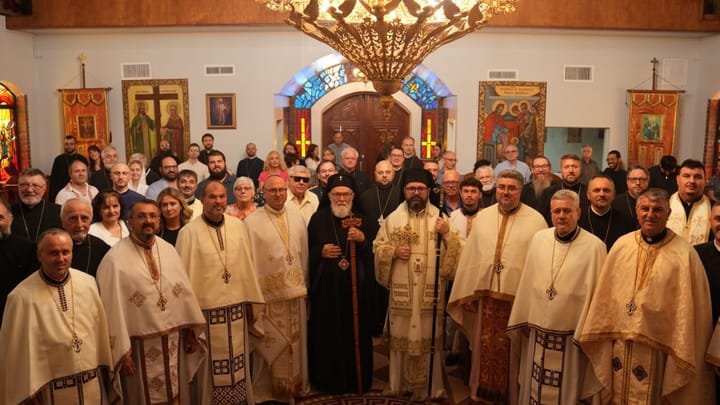
The gathering in South Florida brought together clergy and lay delegates for discussions on missionary work, Romanian-American history, parish life, stewardship, and the future of the Church in North America.
MIRAMAR, FL — The 94th Annual Congress of the Romanian Orthodox Episcopate of America – part of the Orthodox Church in America (OCA) – opened in South Florida on Thursday, with the annual Clergy Conference at Holy Trinity Romanian Orthodox Church in Miramar.
The day began with the Divine Liturgy celebrated by Bp. Andrei of Cleveland, Auxiliary Bishop of the Romanian Orthodox Episcopate of America, in the presence of Abp. Nathaniel of Detroit and the Romanian Orthodox Episcopate of America. Priests and deacons from Florida and other parts of the Episcopate concelebrated.
Following the Liturgy, clergy gathered for an agape meal hosted by the Holy Trinity Parish Council, Ladies Auxiliary, and faithful. The afternoon Clergy Conference opened with remarks from Bp. Andrei and Fr. Ștefan Stoleru, Dean of the South USA Deanery.
The first session focused on missionary work and evangelization; particularly how Orthodox parishes can welcome and accompany the growing number of people seeking to learn about and enter the Orthodox Church.
Presentations were given by Fr. David Subu of Protection of the Holy Mother of God Parish, Fr. David Wey of Saints Constantine and Helen Parish, and Fr. Thomas Frisby of Exaltation of the Holy Cross Parish. The clergy highlighted hospitality, prayer, catechesis, parish life, and effective use of online communication as important elements of missionary ministry.
Fr. Subu described how websites, livestreams, YouTube, homilies, and social media have become an important “first door” to Orthodoxy for many inquirers, particularly since the COVID-19 pandemic. He also explained his parish’s extended catechetical process, in which those interested in Orthodoxy are first given time to become familiar with the Church before being formally received as catechumens.
Fr. Wey emphasized prayer and hospitality as foundations of missionary work, while Fr. Frisby described the rapid growth of his parish, where regular attendance increased from approximately 30 to 120 people in about two years. He noted that many newcomers come from atheist or agnostic backgrounds or after personal and spiritual struggles and therefore require patient pastoral guidance.
The discussion also addressed the challenge of preserving Romanian language and cultural heritage while serving increasingly diverse communities in the United States and Canada. Participants emphasized the traditional Romanian gift of hospitality and the importance of communicating the Orthodox Faith in ways accessible to contemporary seekers.
The second conference session, presented by Fr. Remus Grama, examined the history of Romanians in the United States and their contributions to American civic, military, religious, and cultural life.
Fr. Grama traced Romanian immigration to North America from the late 19th and early 20th centuries, noting the establishment of churches, newspapers, cultural organizations, and mutual-aid societies. He highlighted the role of Romanian Americans during World War I and World War II and in subsequent conflicts, as well as their charitable and humanitarian efforts.
Particular attention was given to General George Pomutz, a Romanian-born Union Army officer who later served as U.S. consul in St. Petersburg under President Ulysses S. Grant and was involved in diplomatic matters surrounding the acquisition of Alaska.
The presentation also reviewed the development of Romanian Orthodox communities in North America, including St. Nicholas Romanian Orthodox Church in Regina, Saskatchewan, founded in 1902, and St. Mary Romanian Orthodox Church in Cleveland, Ohio, founded in 1904. These communities eventually contributed to the establishment of the Romanian Orthodox Episcopate of America in 1929.
Fr. Grama emphasized that Romanian-American history is closely connected with the broader history of the United States, encompassing military service, civic engagement, religious life, charitable work, cultural preservation, and community building.
Following the Clergy Conference, participants received a newly published English-Romanian Akathist to St. Herman of Alaska prepared by the Episcopate’s Department of Publications. The day concluded with the Akathist, celebrated by Bp. Andrei with participating clergy. The service was particularly significant because a fragment of St. Herman’s holy relics had been brought to South Florida for veneration during the Congress.
The Congress itself brought together clergy and lay delegates at a gathering that Abp. Nathaniel described as more than an administrative meeting.
“We have gathered as clergy and lay representatives not merely to conduct the administrative business of the Episcopate, but to bear common witness to the unity, responsibility, and missionary vocation of the Church,” Abp. Nathaniel said.
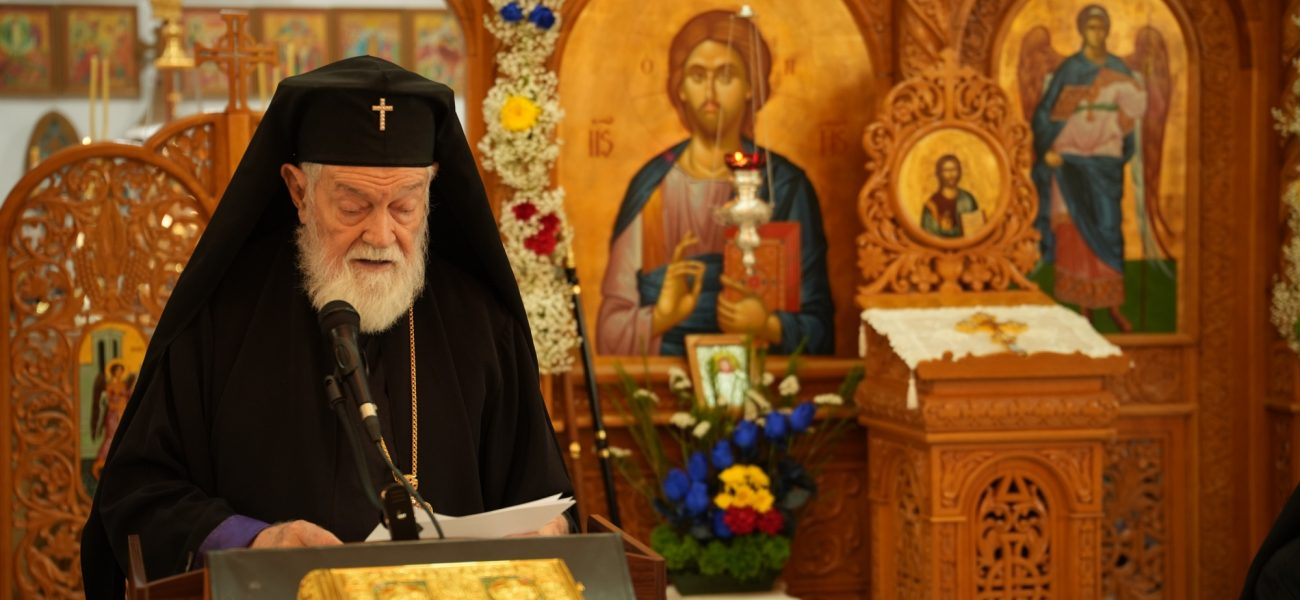
This year’s Congress is the first held in Florida, with Holy Cross Romanian Orthodox Church in Hollywood and Holy Trinity Romanian Orthodox Church in Miramar hosting the gathering.
Abp. Nathaniel encouraged delegates to study the history of the Episcopate and the sacrifices of previous generations who established Romanian Orthodox institutions throughout North America. He also highlighted the continuing importance of Solia, established in 1938, and the work of the Department of Publications in producing liturgical, theological, and educational materials.
“This publishing ministry remains an essential part of our responsibility to preserve the faith, communicate it clearly, and transmit it faithfully to future generations,” His Eminence said.
Addressing the work of the Congress, Abp. Nathaniel urged delegates to view parish and Episcopate reports as reflections of the Church’s pastoral and missionary life rather than merely administrative documents. He also discussed parish membership, stewardship, clergy compensation, financial accountability, youth ministry, and care for elderly parishioners.
He stressed that stewardship extends beyond membership dues, saying, “Parish stewardship is not merely the payment of dues, but the offering of time, ability, prayer, and material resources for the work of Christ.”
Abp. Nathaniel also called on parishes to examine whether their priests receive adequate compensation and urged communities to support clergy participation in the Orthodox Church in America Pension Plan.
He further emphasized the importance of financial transparency and accountability, recalling a saying attributed to Abp. Valerian: “The faithful will not ask the priest about the Holy Trinity, but, ‘Where did my dollar go?’”
The Archbishop returned to the missionary vocation of the Episcopate, urging parishes to welcome converts and seekers while preserving the Romanian Orthodox heritage of their communities.
“Let us welcome them with patience and genuine love,” he said. “Let us explain our worship without condescension, teach the faith without dilution, and integrate new members without asking them to abandon the legitimate gifts of their language or culture.”
Youth ministry was another focus of the address. Abp. Nathaniel highlighted the renewal of American Romanian Orthodox Youth under Bp. Andrei and emphasized the central role of families in transmitting the faith.
“The first school of faith is the home,” he said. “The Orthodox Christian home is the foundation upon which the parish and the Episcopate are strengthened.”
He likewise called on parishes to care for elderly members, particularly those experiencing illness, isolation, grief, or limited mobility, stressing that “no one who has grown old in the life of the Church should be made to feel forgotten by the Church.”
In connection with the 250th anniversary of the United States, Abp. Nathaniel also remembered those who have served in the U.S. and Canadian Armed Forces, including those who gave their lives and veterans carrying physical or unseen wounds. He called on the faithful to understand freedom in terms of responsibility, service, virtue, and love.
Concluding his address, Abp. Nathaniel remembered the hierarchs, clergy, monastics, parish founders, benefactors, and faithful who have reposed since the previous Congress.
“To remember them rightly is not only to speak their names, but also to carry forward what was faithful, worthy, and holy in their example,” he said.
The Archbishop called upon the delegates to conduct the Congress with truth, patience, mutual respect, and love for the Church, seeking to strengthen the unity, mission, and spiritual life of the Romanian Orthodox Episcopate of America.