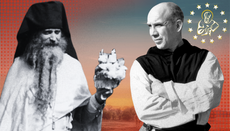


The Sarov Doctrine

This Lent, as Orthodox Christians prepare to put off the old man of rage and contention, we might finally take Christ at His word and test whether acquiring the Spirit of Peace—rather than winning arguments—could be the true path to inheriting the earth and drawing thousands around us to salvation.
Jesus said, “Blessed are the meek, for they shall inherit the earth.” I wonder if we believe Him. Do we think meekness is a viable strategy for... well, anything?
Take evangelism, for example. Let’s say you’ve got a Catholic friend, and you want him to become Orthodox. How do you go about it? Maybe you text him some playlists of Russian chant. Maybe you listen to hours of debates between Catholics and Orthodox on YouTube and send him the best arguments.
What about cultivating meekness? Does that even cross your mind?
We all love that quote by St. Seraphim of Sarov: “Acquire the Spirit of Peace and thousands around you will be saved.” He was just rephrasing the Second Beatitude. Before we can inherit the earth, we must be meek. If thousands around us are to be converted, we must acquire the Spirit of Peace.
When I was entering the Church, the Orthodox had a reputation for peacefulness. They were thought to be quiet, gentle, and modest. They were also known for their traditionalism—and that was something of a paradox.
For most of us, “religious conservatism” is an angry, fearful thing. There’s a sense that we, the faithful remnant, are constantly under siege from “Modernity.” We must defend ourselves, our values, and our beliefs; otherwise, they will vanish from the earth.
The religion of the religious conservative doesn’t bring him peace. In fact, it precludes it. He tends to view peace as a luxury he can’t afford. He has to sleep with one eye open.
The Orthodox were different. They had the ancient liturgy, the ancient theology, the ancient spirituality. If anything, their liturgy and theology and spirituality were much older than ours. And it’s not like they don’t know what the stakes were. Caliphates, Ottomans, Bolsheviks… The Orthodox had also suffered more than we had.
And yet they had this peace.
I don’t think the Orthodox have that reputation anymore. And who’s to blame for that?
Well, I am.
I’ve done everything I can to give Orthodoxy a bad name. I argue with strangers on the internet. I argue with friends at parties. I argue with my family at the dinner table. And maybe that’s okay… to a certain extent… at least sometimes. But the thing is, I seek it out. And here’s the other thing: whether it’s online or in real life, I’m a huge jerk. I mock and I jeer and I rage.
Sometimes I’ll go back the next day to read what I’ve read and think, “Gosh, that doesn’t even sound like me!” Then I realize: actually, it does. That’s the Old Man—the one who “grows corrupt according to the deceitful lusts” (Eph. 4:22). I was supposed to put him off when I became an Orthodox Christian. And yet he’s still hiding under there, underneath the big beard and the three-barred cross and the black “Death to the World” hoodie.
For the record, I think the long beards and the black hoodies are cool. Ditto the Seraphim Rose quotes, the Tsar Nicholas icons, and all the rest. A lot of people are first drawn to the Church by that Orthobro vibe. That’s all great—as long as it grows into something more than a vibe. As long as it’s just the first stage in our journey as Orthodox Christians.
Because it’s true that “the whole world lies under the sway of the wicked one” (1 John 5:19). But it’s also true that “whatever is born of God overcomes the world” (1 John 5:4). That’s where the Orthodox get their peace.
Let me tell you something. Satan really is “the god of this age” (2 Cor. 4:4). The world is full of his slaves. And they’re miserable.
I was one of those slaves once. Chances are that you were, too. And I bet what drew you to Orthodoxy wasn’t the “arguments,” but the silence. Arguments probably had some role to play! But at the end of the day, what made Orthodoxy utterly irresistible was the fact that it brought a little peace to your soul, so that you could really hear the “still, small voice” (1 Kings 19:12).
You’d heard it before, of course. But it was random, fleeting. As soon as it appeared, the earthquakes and the fire would start up again, and you’d lose it. What Orthodoxy offered was a way to cultivate that silence, that meekness—what we call the Spirit of Peace.
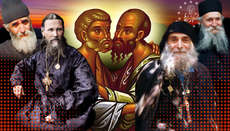
The Spirit is infectious, you know. Look at a photograph of St. Paisios of Mount Athos or St. John the Wonderworker or St. Thaddeus of Vitovnika. The lesson is written on their faces: the lightness, the joy. There’s always a note of sadness, too, with the saints. But even then, you can tell: the sadness of St. Paisios is sweeter than any pleasure I’ve experienced in this life.
Where do they get this joy, this lightness? How do they acquire the Spirit of Peace? For starters, they “avoid foolish disputes, genealogies, contentions, and strivings about the law; for they are unprofitable and useless” (Titus 3:9). Instead, they take Moses’s advice: “The Lord will fight for you, and you shall hold your peace” (Exo. 14:14).
Now, I’m not saying the saints would never try to convince anyone of Orthodoxy! They did, however, follow the Lord’s example. You’ll notice that whenever Christ realizes that someone is asking Him a question in bad faith, He’ll refuse to answer. Sometimes He’ll ask a question of His own, which exposes their hypocrisy; sometimes He just keeps silent. But He doesn’t bother arguing with men whose hearts are closed against Him.
This is what St. Isaac the Syrian meant when he said, “Do not dispute over the truth with someone who does not know the truth; but from the person who is eager to know the truth, do not withhold words from him.”
I wonder if we Orthodox Christians could make this our strategy going forward—or, at the very least, for Lent.
What would happen if we trusted in Christ’s promise that the meek will inherit the earth?
What if we act as though, by acquiring the Spirit of Peace, thousands around us would be saved?
That would mean ignoring Orthodoxy’s critics. And not just the trolls, but also the high-level Catholic and Protestant apologists. When honest seekers have questions, answer them. But if someone just wants to argue, smile and change the subject.
Above all, it would mean focusing on the beauty of Orthodoxy—and of all Creation. Our own souls would be nourished by these whole foods, bringing us peace and joy. Then, in time, this contagious peace will spread to those around us, as it spread to those who met St. Seraphim and St. Paisios and all the others.
I’ll say it again: what our neighbors want is not another theory or ideology to buy into. It’s not another party or sect to join. What they want is an escape from the world of theories and ideologies and parties and sects.
Ultimately, they don’t want arguments. They want love—love that “casts out fear” (1 John 4:18). They want joy—“joy inexpressible and full of glory” (1 Pet. 1:8). And they want peace—“the peace of God, which surpasses all understanding” (Phil. 4:7).
So, I think we should focus on love and joy and peace instead of arguments. That’s my grand strategy for Orthodox evangelism in the 21st-century West.