



Old Calendarists and the Politics of Slander
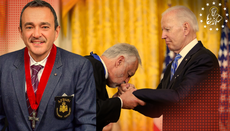
Old Calendarists are lining up behind Joe Wilson and other would-be persecutors of Orthodox Americans.
For several years now, the enemies of the Church have tried to paint American churches from the Russian tradition as “potential collaborators” and “ripe for recruitment by the FSB.” These attacks have only intensified since the start of the Ukraine war, as Western governments go on a witch hunt to vent their frustration at the flagging war effort in Ukraine. The Greek Old Calendarists in America, shameless opportunists that they are, have decided to throw their lot in with the enemies of the Church.
Many today don’t realize just how tense—and at times toxic—the discussion surrounding the restoration of communion between ROCOR and the Moscow Patriarchate really was. There was some significant localized resistance to the reunion, particularly in the D.C. metro area, and several parishes and individuals defected afterward, often due to their close ties with various federal agencies. Those opposing the reunion (often called “ROCOR-A,” or “ROCOR-Agafangel,” after the single bishop who refused to sign) launched a campaign of gossip and outright slander against those in favor of it.
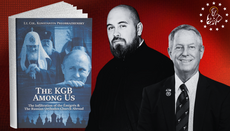
One such figure was Konstantin Preobrazhensky, a former lieutenant colonel in the KGB. Preobrazhensky compiled an entire book titled The KGB Among Us: The Infiltration of the Émigrés and the Russian Orthodox Church Abroad. It was based largely on hearsay: So-and-so said that her aunt in Russia has a cousin who worked with the KGB, and he said that Father so-and-so accepted a large villa on the Black Sea in exchange for supporting the reunion.
At the time, no one took his work seriously. After its single, small print run it faded into obscurity, much like the feds-turned-schismatics themselves. Fast forward to 2026, and the book has been republished by “Subdeacon Nektarios” Harrison.

Harrison presents himself as an inheritor of ROCOR-A. Like his predecessors, he has allegedly worked as an FBI agent, though his current employment status is unknown. Perhaps this explains why, at a time when figures like Joe Wilson and Don Bacon are attacking ROCOR and the OCA as “extensions of the Kremlin,” Harrison has chosen to republish The KGB Among Us.
I own a first edition of the book, from the late 2000s. Like virtually everything Harrison publishes, it contains no academic citations of any kind and is composed entirely of hearsay and bizarre tales fit for a low-budget Netflix series. It is a truly pathetic account, and whatever credibility Harrison hoped to gain for the Old Calendarists through his publishing operation has been immediately undermined by his own lust for attention.
But Preobrazhensky’s tired old tales aren’t the real issue here. The issue is just how shameless, hateful, and un-Christian the republishing of this book proves Harrison to be. He is so lacking in genuine Christian love—so foreign to the spirit of Orthodoxy—that he is, effectively, attempting to provide justification for the U.S. government to bring the persecution seen in Ukraine to our own shores. His “fans” should pause for a moment and consider this.
Unfortunately, this has become the standard M.O. for the Old Calendarists. Whenever we report on the persecution of the Ukrainian Orthodox Church, it never fails that some “priest” in the GOC will jump into the comments to say, “They’re not persecuted. We’re persecuted! We’re the true Church!”
Sure, Fr. Joseph. You, in your tiny storefront parish in Oklahoma, are the one being persecuted—not the elderly nuns being thrown out of their convent into the snow while their spiritual father is dragged off to the front to die.
When Joe Wilson stated that he was asking the FBI to investigate Orthodox churches in America, “Old Calendarist News” was in the comments cheering him on. Let’s be clear: Harrison is republishing this book specifically to aid certain elements within the U.S. government in their crusade against the Orthodox Church.
This hateful spirit is precisely why the GOC has lost ground in Greece, in Romania, in Bulgaria, and is now all but lost in America. The faith of the modern Greek Old Calendarists is grounded in paranoia, resentment, and hostility. Their primary method of evangelism is not converting the heterodox (whom they so boldly condemn) but sheep-stealing from canonical churches within a two-hour radius of their parishes.
When one’s faith is built on resentment and paranoia, heightened paranoia and resentment begin to masquerade as piety. As a result, those elevated to the priesthood are often among the most toxic individuals. This pattern is clearly visible in the GOC. Because clergy are so few—and often among the most problematic—zealous young men coming from canonical churches are quickly used, abused, and cast aside.
The GOC has done a good job of maintaining the externals of Orthodoxy and places great emphasis on them. As a result, new converts—captivated by aesthetics and outward forms—are often drawn in. Once there, they are quickly put to work beyond their spiritual maturity and burn out. Having been burned by the GOC, these young men—convinced that this small and fractured body is the only remnant of true Orthodoxy—often end up abandoning the faith altogether.
It is a tragedy, and one we see all too often in ROCOR parishes, as GOC groups frequently establish missions nearby for the express purpose of drawing people away. This same spirit is evident in Harrison’s publishing operation. The books he publishes are not aimed at converting the heterodox, nor at offering a broad theological critique of “world Orthodoxy,” but rather at directly targeting ROCOR.
Just consider the titles:
• The Russian Orthodox Church Abroad and the Genuine Orthodox Christians of Greece: A History
• Saint Seraphim Rose on the Old Calendarists: 1962–1982
• In Their Own Words: The Private Letters of Saint Philaret of New York and Bishop George Grabbe
• The Canonical and Legal Position of the Moscow Patriarchate
• The KGB Among Us: The Infiltration of the Émigrés and the Russian Orthodox Church Abroad
Direct attacks on ROCOR account for nearly half of these works. Another significant portion attempts to present the GOC as “more ROCOR than ROCOR.” This does not even include Harrison’s social media presence, which consists largely of bold accusations of apostasy supported by little (if any) evidence, always grossly misrepresented. The entire effort appears designed to target those new to the Church—individuals without the experience to see through such arguments.
The final irony is that GOC apologists loudly denounce the Greek Archdiocese and “ecumenism,” while themselves collaborating with heterodox figures when it suits their purposes. Harrison—the first subdeacon of schism—has aligned himself with figures such as Barbara Larin in order to attack the canonical Church. Birds of a feather, as the saying goes.
Harrison will align himself with anyone—Barbara Larin, Joe Wilson, or others—so long as they are willing to attack the canonical Orthodox Church. Because, in the end, he does not love the Church—he stands opposed to it. He is a schismatic, an apologist for persecution.
May God have mercy on his soul.
Ben Dixon is Editor-in-Chief of the UOJ-USA. Follow him on Twitter and Substack.