Defense of The Faith
The Case for the Old Calendar: A Response to Fr. John Chryssavgis
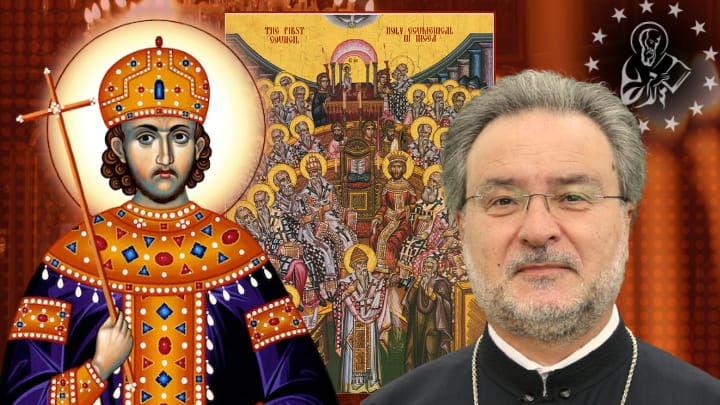
Orthodox scholars who urge us to abandon the Julian Calendar think they are fostering unity with Rome. In fact, their proposal would bring about a new and terrible schism within the Orthodox Church.
Recently, a group of Orthodox scholars and clergy led by Fr. John Chryssavgis issued a bold statement urging the Orthodox Church to change the dating of Pascha.
Their essay, “Toward a Common Date of Easter”, argues that the Orthodox must abandon the Julian Calendar. Instead, we must find a new method, one that is faithful to both the “rules established at the Council of Nicaea and accurate astronomical realities.”
Fr. John and his cosignatories (whom we’ll refer to collectively as “Chryssavgis,” for simplicity’s sake) seek to “encourage open and frank discussion” about the Church calendar. We are glad to offer our thoughts.
A Lamentable Lack of Unity
As the title of Chryssavgis’s essay implies—and as the text makes clear—the main impetus behind this argument is ecumenism. Fr. John seeks to redress the “lamentable lack of unity among Christians in celebrating the most important feast of the Resurrection of Christ together.”
Yet how was this unity fractured? Let’s consider the facts.
In the first few centuries A.D., Christians disagreed widely on how to calculate the date of Pascha/Easter. One group, known as the Quartodecimans, believed it should take place on 12 Nisan—the date of Jewish Passover—regardless of the day of the week. Others felt that Pascha should always fall on a Sunday. There were at least a dozen alternatives, variations, and hybrids used throughout the Church.
In A.D. 325, Emperor St. Constantine convened the First Ecumenical Council at Nicaea. The Council was charged with (among other things) settling a common method for dating Pascha. In the end, the Fathers of Nicaea I declared that Pascha would be celebrated on the first Sunday after the full moon following the Spring Equinox; also, it must take place after Jewish Passover. And since the majority of Christian bishops lived within the Roman Empire, they followed the Julian Calendar.
This is ecumenism in the truest sense of the word. It is a coming-together of the whole Church to make decisions in a spirit of cooperation and consent. “The truth cannot be made clear in any other way,” as the Fathers of Constantinople II pointed out to Pope Vigilius, “since everyone requires the assistance of his neighbor.”
The Orthodox and Catholics continued to use this method for dating Pascha even after the Great Schism. Then, in 1582, Pope Gregory XIII introduced a new calendar: what is now known as the Gregorian Calendar. Of course, the Eastern patriarchs were not consulted in this matter. Gregory promulgated his new calendar and then wrote to the Orthodox churches urging them to adopt it.
So, we already have an “ecumenical” method for dating Pascha, one that was formulated and promulgated by the universal Church. This is the very same formula that the Orthodox use today. The simplest and easiest way for us to settle upon a common dating system would be for Rome to revert to the Julian Calendar.
As it happens, several Vatican theologians have signaled their willingness to do just that! A number of Melkite (Eastern Catholic) dioceses have already switched to “Julian Easter,” out of solidarity with their Orthodox neighbors.
By All, and in Every Place
Unfortunately, what Chryssavgis proposes is the opposite of ecumenical. He urges the various Orthodox jurisdictions to adopt a “local approach” whereby different synods, dioceses, and even parishes choose their own method for the dating of Pascha. Such a choice “would not require the consent or corroboration of other autocephalous churches,” Fr. John insists.
As we’ve seen, this goes entirely against the spirit of the First Ecumenical Council. The Nicene Fathers made it abundantly clear: their primary objective was to create a system for the dating of Pascha that could be followed by all Christians, everywhere in the world—again, this being the proper definition of “ecumenical.”
In his letter announcing the decisions of Nicaea I, St. Constantine makes this point explicitly:
It was resolved by the united judgment of all present, that this feast ought to be kept by all and in every place on one and the same day. For what can be more becoming or honorable to us than that this feast from which we date our hopes of immortality, should be observed unfailingly by all alike, according to one ascertained order and arrangement?
The Council Fathers, likewise, in their famous Epistle to the Egyptians, wrote:
We further proclaim to you the good news of the agreement concerning the holy Easter, that this particular also has through your prayers been rightly settled; so that all our brethren in the East who formerly followed the custom of the Jews are henceforth to celebrate the said most sacred feast of Easter at the same time with the Romans and yourselves and all those who have observed Easter from the beginning.
The Council did not establish a selection of acceptable dates. No: they settled upon one date for the whole Church to celebrate in common.
Now, one may disagree with St. Constantine’s perspective. One may argue that the Nicene Fathers placed too much emphasis on uniformity in the Church calendar. Those are the arguments Chryssavgis has to make, though, if he wants to advance this “local option.”
It should be noted that the 1923 Council of Constantinople, which promoted the Revised Julian Calendar, retained the old, “unrevised” Julian dating. Even Patr. Meletios IV (Metaxakis) did not dare to introduce a second Paschalion. Even he recognized that the whole Church must celebrate the Lord’s Resurrection together, as one Body. Likewise, the entire Church must consent to change the dating of Holy Pascha—or else it cannot be changed at all.
But to Observe the Stars
Chryssavgis further argues that the Julian Calendar must be abandoned because it is inaccurate.
According to Nicaea, Pascha is to be celebrated on the first Sunday after the full moon following the Spring Equinox (and the Jewish Passover). However, the Julian Calendar does not accurately calculate the date of the Spring Equinox. Therefore, in Chryssavgis’s words, “The Orthodox Church’s current method of calculating the date of Pascha is no longer consistently faithful to the Nicaean norms.”
Yet how can that be, when (as we said) the Fathers of Nicaea I also used the Julian Calendar? Are the Orthodox “unfaithful” to the Council Fathers by following their example too closely?
Moreover, the Fathers attached no significance to the Spring Equinox per se. Of course, they understood the spiritual significance in the order of nature! But they also knew that the spiritual reality grants significance to the natural order; the natural order does not determine or dictate the spiritual reality in some pantheistic way.
This is not a new debate, either. It goes back to the 16th century, when Rome first adopted the Gregorian Calendar. Even then, the Orthodox accused Catholics of embracing a sort of “astronomical fundamentalism”—of attaching far too much significance to the movements of these celestial bodies, to the point where they broke with the patristic method for dating Pascha.
For instance, we mentioned that, in 1852, Pope Gregory XIII wrote to the Eastern patriarchs urging them to adopt his new calendar. Joachim V of Antioch wrote him a searing reply:
Our community, our bishops, our kings and all our people, scattered in the four cardinal directions—Greeks, Russians, Georgians, Vlachs, Serbs, Moldovans, Turks, Arabs, and others... from the time of the Holy Apostles and God-bearing fathers of the Seven Ecumenical Councils down to this day recognize one faith, one confession, one Church, and one baptism... and all our nations agree in the four corners of the inhabited world with one word and one affair...
And we did not receive the confession and the holy tradition which is in our hands... from unknown people, like other, foreign communities. But we pray with the Holy Apostles and the 318 fathers [of the Council of Nicaea] whose signs and miracles shine forth from them manifestly. And so how can we change the tradition of such holy fathers and follow after unknown people who have no other trade but to observe the stars and examine the sky?
Now, perhaps a future Ecumenical Council could “update” our method for dating Pascha—one that more accurately reflects these “astronomical realities.” There has been talk of this in the past, as Chryssavgis notes.
The point is that the Fathers of Nicaea I were concerned less with astronomy and more with creating a stable, universal tradition for calculating the date of Pascha. The idea of different Orthodox groups choosing their own preferred method for dating Easter is the worst violation of “Nicaean norms” one could possibly imagine.
Conclusion
To sum up the Chryssavgis thesis: We should weaken the unity of the Orthodox Church in order to strengthen our ties with the heterodox.
The bonds that unite the Orthodox Church are already strained nearly to the point of breaking. Chryssavgis’s solution is to deliberately weaken the Church’s unity further. And for what? A feeling of togetherness with those who long ago departed from our common path.
If Rome is sincerely interested in unity with the Orthodox, let them return to the Ecumemical Calendar that the East and West agreed upon in A.D. 325, and which served us both very well for over a thousand years.
Nicaea I made it abundantly clear: the entire Church must observe a common celebration of Easter. This is not a matter of convenience. It’s one of the very pillars of ecclesial unity.
If Chryssavgis’s proposal were to be adopted by the Ecumenical Patriarchate, it would almost certainly lead to full-blown schism. This should be painfully obvious to any student of Church history and/or any observer of the Orthodox Church today.
I wonder, who in the Phanar would want that on his conscience? Who would answer for such a grave and pointless error on Judgment Day?