

Why Does the Church Day Start in the Evening?
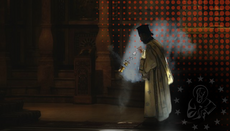
Vespers, the ancient evening prayer service that marks the beginning of the liturgical day in the Orthodox Church, traces its origins to the early Christian communal "meal of love" and continues to invite believers into a spirit of expectant preparation for the Eucharist and the true Light of Christ.
In the early Church there were no familiar, major services as we know them today, such as Vespers or Matins. Christians prayed at certain hours of the day (the third, sixth, and ninth hours) with a short domestic rule consisting of a few psalms and the Lord’s Prayer.
Vespers developed from the common evening meal—the agape (“meal of love”), which concluded with the celebration of the Eucharist.
Over time, as the Mystery of the Eucharist was moved to the morning and the agape became a charitable and memorial meal, the ancient evening gathering began to develop its own distinct prayer order. It inherited from the ancient gatherings the spirit of expectation and inner preparation for the Eucharist.
That is why Vespers is still considered today a pre-Eucharistic service. Through it, the Church begins the liturgical day, following the biblical order of creation: “and there was evening and there was morning” (Gen. 1:5).
The Different ‘Kinds’ of Vespers
The duration of Vespers is short, and this is not accidental, as it is celebrated at a time when people’s strength has already diminished.
The Typikon distinguishes several types of Vespers:
• Daily, on weekdays
• Great (or Festal), on the eve of Sundays and major feasts (as part of the All-Night Vigil)
• Little, rarely performed in modern conditions, only in some monasteries before the meal that precedes the All-Night Vigil
The modern Vespers service incorporates elements both from the ancient parish “psaltic typikon” (of the Constantinopolitan cathedral order) and from the monastic evening rule.
What does the service consist of?
A Brief Outline of Vespers
Vespers begins with the usual opening (Trisagion Prayers, “Our Father,” “Lord, have mercy” twelve times, “Come, let us worship…”), Psalm 103, the Great Litany, and the Kathisma.
Then follow Psalms 140, 141, 129, and 116 with their stichera, “Lord, I have cried unto Thee.” These are the first variable troparia that appear in Vespers. Depending on the feast, their number may vary: ten, eight, or six.
The next most important hymn is the ancient hymn “O Gladsome Light” (Φῶς ἱλαρόν).
After that, the Prokeimenon—a short refrain that includes selected psalm verses (different for each day of the week)—is chanted. On major feast days, readings from the Old Testament (Paremiya) are added.
To Depart in Peace
The next important evening prayer is “Vouchsafe, O Lord, to keep us this evening without sin…” It consists of selected verses from Holy Scripture. Its importance can be compared to that of the Great Doxology in Matins. According to the Typikon, it should be read by the superior (while in family prayer, by the head of the household).
After the litanies, the stichera at the Aposticha are sung. They are called Aposticha because they do not have fixed psalm verses; instead, special verses are chosen each time that correspond to their content and to the feast being celebrated. For example, the stichera from the Octoechos correspond to the themes of the days of the week (weekly cycle), while those taken from the Menaion narrate the event being celebrated (annual cycle). In this way, the connection between the liturgical cycles is realized.
Then follows the reading or chanting of “Now lettest Thou Thy servant depart in peace,” the words of thanksgiving of the righteous Simeon the God-Receiver when he met the Infant Christ in the Temple. According to the Typikon, this prayer at Vespers is also read by the superior, which shows the importance of the text.
It reminds us of the meaning of every day of human life and death. If a person, like Simeon, lived the day with Christ and in prayer to Him, then that day is meaningful and does not pass in vain. At the same time, this prayer emphasizes the significance of Vespers as a service that includes the theme of waiting for the Savior.
At the end of Vespers, the troparia—short hymns that highlight the main meaning of the day—are chanted, followed by the augmented litany and the final prayers.
Waiting for the True Sun
The Hieromartyr Cyprian of Carthage wrote about the meaning of the evening service as follows:
We must pray at the setting of the sun and at the end of the day; for Jesus Christ is the true Sun and the true Day. By praying at the setting of the sun and at the end of the day, and asking that the light may rise again for us, we are praying for the Second Coming of Christ, that He may bring us the grace of eternal light.
After Vespers, according to the Typikon, supper and the evening meal are provided, after which monks are forbidden to converse: “It is not fitting for monks to converse with one another, but to depart in silence to their cells, and to perform prayer and reading…”
This article was originally published by the UOJ's Mount Athos bureau.