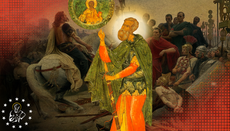




Love Is Better Than Prayer

In the final year of her life, St. Scholastica—the twin of St. Benedict—prayed for one last night of heavenly talk with her brother. God sent a storm to override Benedict's strict prayer rule. Love triumphed over rigid piety, and she who loved more prevailed.
On February 10, the Church commemorates the feast of St. Scholastica—one of the greatest of Western saints. Though details of her life are sparse, the most enduring account comes from Pope St. Gregory the Great’s s, which paints Scholastica as a model of contemplative love.
Born around 480 in Nursia, Italy, she was the twin sister of St. Benedict—often known as the renowned founder of Western monasticism. While Benedict established his monastery at Monte Cassino, Scholastica founded a nearby convent for women, becoming the first Benedictine nun. Their sibling bond was not merely familial but deeply spiritual, rooted in a shared devotion to God. As abbess, she guided her nuns in the Benedictine way, emphasizing stability, obedience, and communal worship.
The siblings had a tradition of getting together once a year at a small house midway between their monasteries, spending the day in fervent discussion of heavenly matters. These encounters were more than mere reunions: they nourished the siblings’ souls and reinforced their vocations.
The most famous episode in Scholastica’s life occurred during one such visit, which occurred not long before she died. As evening fell, Benedict prepared to depart with his accompanying monks, adhering strictly to his monastic rule, which forbade spending the night outside the monastery. Scholastica, sensing this might be their final conversation, implored her brother to stay longer.
“Please,” she begged, “let us talk until morning about the joys of heavenly life.” Benedict, ever the disciplinarian, refused, insisting that he could not violate his rule for the sake of sentiment.
Undeterred, Scholastica bowed her head upon the table, her hands folded in prayer, and wept tears of supplication to God. In that moment, she did not argue or demand; she simply entrusted her desire to the Divine.
Almost immediately, the sky darkened. Brilliant flashes of lightning illuminated the room, thunder roared like the voice of heaven, and a torrential downpour unleashed, flooding the paths and making travel impossible. Benedict and his companions were stranded.
Astonished, he exclaimed, “God forgive you, sister! What have you done?” With gentle wisdom, Scholastica replied, “I asked you, and you would not listen; so I asked my Lord, and He listened to me. Now go if you can—leave me and return to your monastery.”
Finally, Benedict conceded. And so the siblings spent the night rapped in conversation, comforting one another with tales of God’s grace and the eternal kingdom. The storm, a divine intervention, ensured their bond of love prevailed over rigid observance.
Three days later, from his cell at Monte Cassino, Benedict beheld a vision: his sister’s soul ascending to heaven in the form of a radiant dove. He sent monks to retrieve her body, burying her in the tomb he had prepared for himself. When Benedict died four years later, he was laid to rest beside her, their earthly remains united as their spirits had been in life.
This is more than a charming anecdote. It illustrates a timeless Christian truth, echoed centuries later by St. Symeon the New Theologian (949–1022), a Byzantine monk and mystic. Symeon taught: “Visit the sick, console the distressed, and do not make your longing for prayer a pretext for turning away from anyone who asks for your help. Love is greater than prayer.”
In Scholastica's story, we see this principle vividly at work. Benedict's insistence on departing stemmed from a holy “longing for prayer”—his commitment to the monastic horarium, which structured his day around communal worship and solitude with God. This was no frivolous rule; it was the backbone of his spiritual life, designed to foster union with the Divine.
And yet Scholastica's plea was an act of love, a request for consolation in what she intuited as her final hours. Her prayer was not a selfish whim but a deep yearning for the comforting presence of St. Benedict, her brother and oldest friend.
By sending the storm, God affirmed that love, expressed in attending to another’s need, supersedes even the most pious routine. Benedict’s rule, while essential, became a potential “pretext” for turning away; divine providence intervened to prioritize charity. As St. Gregory notes, Scholastica prevailed because “she who loved more had greater power.”
This teaching resonates today, especially in a world of hurried schedules and digital distractions. We often prioritize personal devotions or “rules” over human connections, using busyness as a camouflage for our hardheartedness.
Scholastica reminds us that God honors the heart’s cry for communion. Her feast, falling in the quiet of winter, calls us to reflect: When has love asked us to linger, and have we listened?