



Orthodoxy Forms Saints, Not Conference Speakers
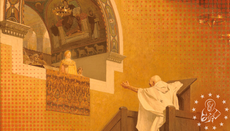
The Orthodox know that true holiness doesn't grow up in the packed stadiums of Nineties evangelical revivalism. It blooms slowly, quietly, in the wilderness of the heart.
Growing up in Evangelical America, the heroes of the faith were almost always great orators. They were theologians and pastors who traveled the conference circuit, spoke to enormous crowds, and inspired people with stirring messages about the holiness of God or what it meant to be a good man, a good woman, a good husband or wife, a good father or mother.
In the 1990s, the Promise Keepers movement swept through the evangelical world in the United States and abroad. Headed by Bill McCartney and enthusiastically endorsed by James Dobson and Focus on the Family, the events drew sold-out crowds of eighty thousand men at a time. Celebrity preachers like Tony Evans, Jack Hayford, and others filled stadiums. Christian music stars led worship. It was, by every outward measure, a success.
I was a teenager then, newly armed with a driver’s license, when Promise Keepers first exploded onto the scene. I attended one of those events. It was also the first time in my life that I realized I did not understand what was happening.
Friends around me were weeping. Pentecostals, Baptists, Charismatics, Roman Catholics, all stood shoulder to shoulder, embracing one another as they sang songs led by famous worship bands. The energy was overwhelming. The emotion was unmistakable. And yet, I simply did not get it.
I did not understand the excitement. I did not understand the hype.
CNN was present at the event I attended. A young female reporter approached me. She was without her cameraman and seemed to be looking for someone, anyone, who could help her make sense of what she was witnessing. She asked something like, “Why are you here?” or “What is this all about? Why are so many Christian men excited about Promise Keepers?”
I cannot remember her exact words. We were standing in the atrium, and the noise was deafening. The thunder of tens of thousands of men roaring in response to speakers who held their attention with practiced ease made conversation difficult. What I felt she was really asking was this: What is happening to these people?
I think she was surprised when I answered honestly. I told her, “I am not really sure. I do not get it at all.”
Promise Keepers stood firmly within the tradition of nineteenth-century American revivalism. When men like Charles Finney roared into town, they did so with the organization and flair of a traveling circus. Finney knew how to stir a crowd. His success was measured by emotional response. The more visible the excitement, the more dramatic the displays, the more confident he was that salvation had occurred.
It was radical American individualism put on public display. Faith was validated by intensity, volume, and movement.
But as with all manufactured excitement, the noise eventually faded. The stadium lights were turned off. The speakers moved on to the next city. What remained was quieter and far less dramatic. In the weeks that followed, dozens, sometimes hundreds, of Promise Keepers men’s groups formed in local churches. Fresh from the revival, men gathered weekly with sincere intentions. They wanted accountability. They wanted to be better husbands, better fathers, better men.
Yet enthusiasm, when it is not rooted deeply, burns quickly and leaves little behind. One by one, the meetings grew smaller. Attendance thinned. Conversations became repetitive. Life resumed its ordinary pressures. Within a few months, most of those groups quietly dissolved. No announcement marked their ending. They simply stopped meeting, as though the movement itself had exhaled and moved on.
Becoming Orthodox was an entirely different experience.
I was raised Methodist. It was a third-generation dairy farmer and part-time Methodist preacher who set me on a one-way trajectory toward the ancient Church. For nearly seventeen years, he met me for coffee and prayer every Saturday morning. Through those conversations, I learned what it meant to sit with someone and talk about life, faith, failure, and God.
He was not only a dairy farmer and a preacher. He was also a retired school counselor. Years of listening to young people had shaped him. His wisdom was gentle. His presence was calm. His love was patient. Through him, I learned to slow down. I learned to reflect. I learned to seek God not through manufactured excitement or emotional spectacle, but through attentiveness to the still, quiet voice that Elijah knew.
I learned that to find God, to experience sanctification, or what the Orthodox call “theosis”, the spiritual life is not about chasing the next conference, the next event, or the next worship concert. It is about withdrawing from chaos. It is about learning to pray in quiet places where peace and tranquility reign.
It is no accident that Orthodox sanctuaries are designed to resemble both the ancient Jewish synagogue and the Temple of Solomon. The Temple was adorned with images of angels, palm trees, fruit, and flowers. It was meant to evoke the Garden of Eden. To enter it was to step backward into paradise, to be surrounded by beauty and the host of heaven.
From a historical perspective, we understand that the Temple was designed as a return to the Garden. Orthodox churches continue this vision. When you walk into one, you are surrounded not only by images of Eden, but by two thousand years of saints who have died and risen in Christ.
They remind us that we are not isolated individuals on a private spiritual journey. We are members of a family. We are grafted into the seed of Abraham. Our faith is not separate from the Church. It is inseparable from it.
I try to be at church whenever the doors are open. Whether it is the Divine Liturgy, Vespers, or the Paraklesis, there is something profoundly countercultural about walking into an Orthodox church in America. You encounter quiet. You encounter calm. You encounter peace.
You do not come to perform. You do not come to be entertained. You come to be still. You come to pray.
When people ask me what I mean by prayer, I often use the phrase contemplative prayer. The world around us is relentlessly noisy. We are surrounded by engines, advertisements, conversations, and constant demands. Coworkers are stressed. Customers are impatient. Friends and family carry heavy burdens. We carry our own.
Political turmoil saturates everything. The conflict between Left and Right presses in from every direction. There is no end to the chaos.
The Orthodox saints knew this chaos well. They did not imagine it away. They fled from it, again and again, not in fear, but in wisdom.
It is no coincidence that saint after saint sought refuge in deserts and forests. St. Anthony the Great withdrew deeper and deeper into the wilderness. St. Seraphim of Sarov spent years in the forest. They did not do this to escape the world, but to learn how to love it rightly by first learning how to love God.
What makes saints is not speaking to conference crowds of tens of thousands.
What makes saints is not being a best-selling Christian author.
What makes saints is not being a famous YouTube personality or online debater.
None of these things make saints. In fact, one might argue that many of them actively work against sanctity by inflating the ego.
This past weekend, we spent time at our cabin in the countryside. I am a city boy through and through, and I love Chicago more than many realize. But surrounded by forest, with no neighbors nearby and no constant noise, I remembered why the saints went to the wilderness.
They went there to get away from the chaos, so they could worship God in peace.
This article first appeared at Becoming Orthodox. It is reprinted here with the author’s gracious permission.