



Pope Leo the Great: Champion of Orthodoxy
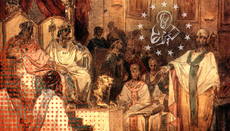
Today, the Orthodox Church today commemorates St. Leo the Great, who championed Orthodoxy against the Monophysite heresy at the Council of Chalcedon.
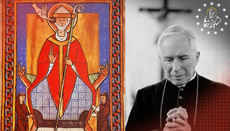
Today, the Orthodox Church commemorates Pope Leo I—also known as St. Leo the Great.
Leo is remembered as one of the great champions of Orthodoxy in the first millennium, ranking alongside figures like St. Athanasius and St. Cyril. His pivotal role in articulating and safeguarding Dyophysite Christology—the doctrine that Christ possesses two distinct natures, divine and human, united in one person—remains a cornerstone of orthodox, catholic theology. Affirmed at the Fourth Ecumenical Council (Chalcedon) in A.D. 451, it neither divides nor conflates Christ’s two natures, thus preserving the mystery of the Incarnation.
Born around A.D. 400 in Tuscany, Leo ascended to the papacy in A.D. 440 during a tumultuous era. The Church grappled with lingering fallout from the Council of Ephesus (A.D. 431), which condemned Nestorianism—the heresy that separated Christ’s divine and human natures into two persons. Yet new threats emerged, particularly from Eutyches, a monk in Constantinople who propagated a form of Monophysitism, asserting that Christ’s human nature was absorbed into the divine, resulting in a single divine nature. This view, often labeled Eutychianism, distorted the Incarnation by undermining Christ’s full humanity, making Him unable to truly redeem mankind as both God and man.
Leo’s response was masterful and decisive. In A.D. 449, he composed his famous “Tome” (Epistle 28): a letter to Flavian, Patriarch of Constantinople, elucidating the Dyophysite position. Drawing from Scripture and the Fathers, Leo affirmed that Christ is “perfect in Godhead and perfect in manhood, truly God and truly man,” with the two natures united “without confusion, without change, without division, without separation.” This formulation echoed the Alexandrian emphasis on unity while incorporating Antiochene precision on distinction, balancing the concerns of both theological schools.
The Tome’s impact crystallized at Chalcedon, convened by Emperor Marcian to resolve the Christological crisis exacerbated by the “Robber Synod” of Ephesus in A.D. 449, which had wrongly exonerated Eutyches. Leo’s legates presented the Tome, and after scrutiny, the council fathers acclaimed it as orthodox. The Chalcedonian Definition, influenced heavily by Leo’s work, declared Christ as “acknowledged in two natures, without confusion, without change, without division, without separation.”
This Dyophysite framework safeguarded the soteriological truth: only a Christ fully divine could forgive sins, and only fully human could atone for humanity’s fall. Leo’s contribution thus fortified Orthodox theology, enabling the Church to proclaim the Incarnation without diminishing either nature’s reality.
Orthodox Christians celebrate Leo not just for his doctrinal clarity but for his pastoral zeal. He confronted Pelagianism and Manichaeism as well., defended Rome against Attila the Hun through peaceful means, and emphasized the Church’s unity under apostolic tradition. His sermons on the Nativity and Passion vividly illustrate Dyophysitism, portraying Christ as the bridge between God and man.
Our Roman Catholic friends often invoke Chalcedon as proof of papal infallibility/supremacy, citing the Council Fathers’ exclamation: "Peter has spoken through Leo!” They interpret this as proof that the Pope of Rome speaks ex cathedra with unerring authority, binding the universal Church. Vatican I (1870) formalized this dogma, linking it to Peter’s primacy in Matthew 16:18-19.
Unfortunately, the Catholics take this passage out of context:
After the reading of the foregoing epistle, the most reverend bishops cried out: This is the faith of the fathers, this is the faith of the Apostles. So we all believe, thus the orthodox believe. Anathema to him who does not thus believe. Peter has spoken thus through Leo. So taught the Apostles. Piously and truly did Leo teach, so taught Cyril. Everlasting be the memory of Cyril. Leo and Cyril taught the same thing, anathema to him who does not so believe. This is the true faith. Those of us who are orthodox thus believe. This is the faith of the fathers… These are the things Dioscorus hid away.
Clearly, the Council Fathers acclaimed Leo because his Tome aligned with Cyril of Alexandria and Apostolic Tradition—not due to any personal authority the Patriarch of Rome might possess. The council examined and approved the Tome collectively, underscoring conciliar authority over unilateral papal decree.
Yet consider the irony: While Catholic apologists invoke Chalcedon to defend their papalist ecclesiology, Catholic ecumenists now argue that the Oriental Orthodox (i.e., modern-day Miaphysites) are not heretics. In recent decades, Catholic-Oriental dialogues have attributed the schism to linguistic misunderstandings rather than substantive heresy. This stance, aimed at reunion, downplays Chalcedon’s condemnations, suggests that the Orientals are truly “orthodox” despite rejecting the formulas of an Ecumenical Council.
So, we must ask: was Leo’s Tome binding upon the whole Church? If so, then the Miaphysites are not orthodox. If not, then Chalcedon cannot be the basis for claims of papal infallibility/supremacy.
Ultimately, Leo’s true heirs are the Orthodox Christians, who faithfully uphold Chalcedon’s Dyophysite legacy without innovation. We continue to champion his formulas—not merely because he was Pope of Rome, but because he was an Orthodox Christian, a worthy Successor to St. Peter.