St. Constantine: More than a Patron

Learning to receive St. Constantine not as a hero of history, but as a patron and intercessor

For thirty-one years I carried my name with little thought as to who else it might have belonged to. It wasn’t until I first walked into a Greek parish in 2024 that I learned it was a popular shortening of the name Constantine. A year later, before my baptism, I asked my priest which patron saint I might receive. His response: “I like your name. I want to keep it.”

“Dean” was a family name. It was passed down for generations by men who had no thought of a fourth-century Roman emperor. It was given to me a second time by a man who did. In neither case did I get to choose. Now I had to learn what to do with what I’d been given.

What I found was a man the world cannot make up its mind about. Outside Orthodoxy he is often treated as a punching bag. Inside it, there is a tendency to hurry past his life to the one thing everyone can safely agree on: the power of repentance, even at the eleventh hour. If, as one Greek Archdiocese article puts it, my patron "becomes a true hero/heroine for us to emulate," how was I to honor a saint with so much baggage?

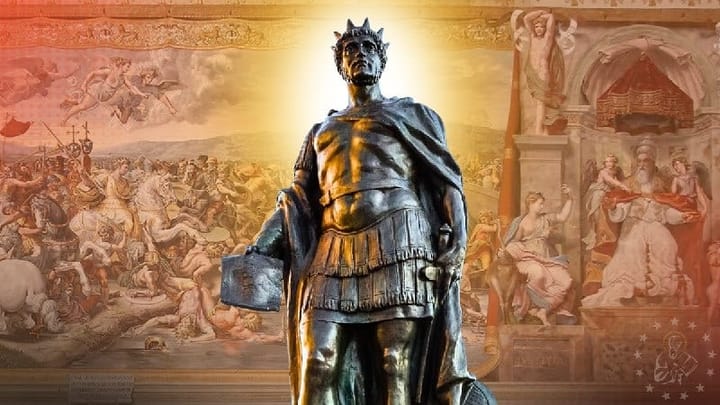
The saint’s conversion story is spectacular. On the eve of battle, Constantine and his whole army beheld a cross of light in the heavens bearing the inscription Ἐν τούτῳ νίκα ("By this, conquer"). That night Christ appeared to him in a dream and commanded him to carry the sign against his enemies. He marked it on the shields of his soldiers, and the next day he won. Christianity was legal within a year. Before he died, he convened the council that gave us the Creed and founded a New Rome at Byzantium. The Church calls him Equal to the Apostles, a title that still turns heads at my parish among those who don't know the story.

Were that all, his sainthood would be beyond doubt.

But, in 326, Constantine had his eldest son Crispus executed. The reasons are unknown to us; the ancient sources that claim to know are hostile and late. Within months his wife Fausta was dead as well. Both were subjected to damnatio memoriae, struck from the records as though they had never lived. He put off baptism until he was dying, receiving it at last from Eusebius of Nicomedia, a bishop who had backed Arius. Though delay was ordinary in that century, the Fathers hated it; St. Gregory of Nazianzus asked his hearers why they would wait for a fever to bring them what God was offering now.

So there was the man. Even his virtues were of no use to me. I will never lead an army, and taking Rome does not figure into my plans. How was this man meant to be my hero? What here was I to emulate?

The Church does not hand out patron saints the way a sixth-grade class might choose role models to write essays about. It gives them the way a family gives a surname. In Orthodoxy, the naming of a Christian is a rite of its own, traditionally celebrated on the eighth day after birth in imitation of Christ's naming. The priest signs the child's forehead, lips, and breast and pronounces the name. What matters for my question is the grammar of the thing: the name is received, not selected. Most Orthodox Christians never chose their patron. A parent chose, or a priest chose, or the calendar chose.

This is why traditionally-Orthodox cultures make more of the name day than the birthday, and why the one celebrating gives gifts rather than receiving them. My birthday marks my arrival. My name day marks whose I am.

So what is my patron actually doing? The first answer I found wasn't in a book. It was at the chalice.

When I come forward to receive, the priest doesn't say "Dean." He says the name I was given at baptism, the emperor's name, and then he gives me Christ. The same name is spoken over me in confession. It was spoken at my Chrismation. It will be read out over my body at my funeral. Whatever else a patron saint is, his is the name under which the Church knows me, and I hear it said aloud at every threshold I cross.

That reframed the question. I had spent a year reading about St. Constantine’s victories, his council, and his crimes as though he were a subject and I were the one with the file open. But this street runs both ways. St. John of Kronstadt writes that when we call on the saints and pronounce their names from the heart, "we bring them near our heart itself," and that they hear us and lay our prayers before the Lord in the twinkling of an eye. He has been hearing his name in my mouth since before I understood whose it was.

I had been reading his worst deeds with something like suspicion. He already knew mine.

Which brings me back to my problem. If a patron is family rather than a hero, then the question changes. I do not have to approve of my family. I do not audition my grandfather. I inherit him, and I pray for him, and he prays for me, and the relationship does not wait on my verdict.

Once the pressure to admire is off, I can finally see what there is in St. Constantine to imitate. It’s not the empire, but the moment before the empire.

The saint saw a sign in the sky and had no idea what it meant. Eusebius says he was perplexed, that he turned it over in his mind, and that afterward he sent for men who knew the faith and asked them who this God was. Before he was the emperor of anything Christian, he was a man holding a symbol he could not read, willing to admit he could not read it, and willing to be taught by people who knew better.

I was handed a name I could not read either. It came to me through men who did not know what they were giving, and it was kept for me by a priest who did. I have spent the year since asking what it means, which is the same thing my patron did, and which is apparently how this works.

The Church does return again and again to his repentance, and I understand now that this is not sentimentality. Metropolitan Augoustinos of Florina preached that God will not judge us because we sinned, but because we did not repent, and then added the line: "Without repentance, Paradise would be empty." A patron who arrived late, by a crooked road, with a great deal to answer for, is not a lesser patron. He is the one I can actually follow.

Holy Emperor Constantine, Equal to the Apostles, pray to God for us sinners!

Share

Read also