History and Culture
With Faith and Love, Draw Near
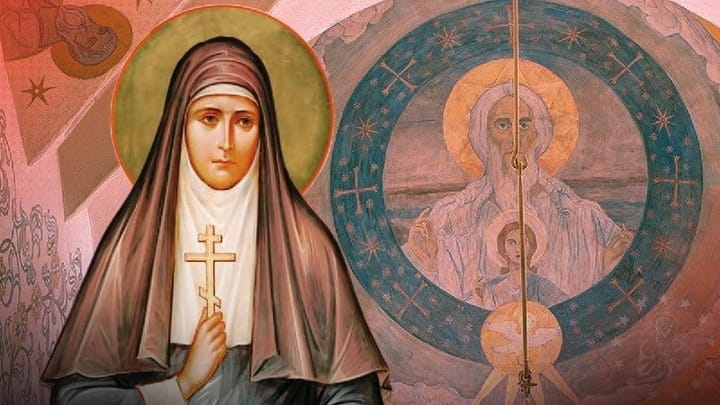
St. Elizabeth the New Martyr, the Divine Liturgy, and the soul’s ascent toward God
I recently celebrated my name day of St. Elizabeth Fyodorovna. My husband, son, and I attended a Saturday Divine Liturgy to celebrate my patron and blessed example of how one draws near to Christ.
It is known that St. Elizabeth Fyodorovna loved the Divine Liturgical services. Similarly, I myself have loved the Divine Liturgy since I was a child. Having memorized it quite young, it resulted in me thoroughly immersing myself in learning as many forms of chant as I could find later on in my adult life.
A particularly fond memory is Fr. Symeon helping to guide me through Presanctified Liturgy services that our OCF held on Friday nights on SIUC campus during Great Lent in 2010. Those were grueling grad school days and the service at the end of the week was a welcome and edifying change of pace from the week’s studies. During this particular service, I found myself reflecting on some of my patron saint’s remarks on the Divine Liturgy. While many had assumed her conversion to Holy Orthodoxy was due to political or familial influence because of her marriage to Grand Duke Sergei, St. Elizabeth was quick to credit another source. “…I feel it brings me nearer to God... You tell me that the outer brilliance of the church charmed me... in that you are mistaken—Nothing in the outer signs attracted me—no—the service, the service, the outer signs are only to remind us of the inner things”.
“We who mystically represent the Cherubim and who sing the thrice holy hymn.”
The Divine Liturgy is in its very nature an elevation and offering of what we have been given by God and giving it back to God. This is true of the bread and wine which is offered and transformed into the body and blood of Our Lord Jesus Christ. But this is also true of ourselves. God has given us life and the breath of the Holy Spirit. We offer ourselves, our very breath, to participate with the angelic hosts in the Divine Liturgy.
“Let us lay aside all earthly cares.”
I came across St. Elizabeth’s biography a couple decades ago and was struck by her life story – a Cinderella in reverse if you will. She was born into royalty but forsook her riches and pursued a life of charity and poverty. She was martyred by being thrown down a mineshaft followed by grenades. Witnesses claim they heard singing of hymns from the mineshaft. When her body and others were discovered, she was partially blown up, one hand severed, but appeared to have been dressing the wounds of the other victims with her veil. One might ponder the likelihood that the singing heard from the witnesses above was none other than St. Elizabeth singing the liturgical hymns.
“We offer unto Thee on behalf of all and for all.”
We are typically encouraged to pursue success in this life and are enticed by fairy tale notions of rags to riches but her life was a living paradox of this concept but with the resultant crown of heavenly glory – by discarding her earthly royalty she received her divine royalty. This emulates and magnifies Jesus Christ humbling Himself to become man, suffer, and die but to rise again and bring hope of eternal life to all.
“That with boldness and without condemnation, we may dare to call upon thee as Heavenly Father and to say…”
We may ask ourselves why do we find the Divine Liturgy so uplifting? One recent reflection on the Divine Liturgy is how much of the service is directly quoted from Scripture, roughly 75-80% depending on the particular service. Of that percentage, the majority are direct quotes of Jesus Christ with the remainder as solemn hymns such as The Triumphal Hymn which is from Isaiah 6:3 in which the prophet Isaiah receives a vision of the angelic hosts worshipping God. In Matthew Chapter 6, the apostles ask Jesus how they should pray. Jesus replies,
“This then, is how you should pray: Our Father, Who art in heaven, hallowed be Thy name. Thy kingdom come. Thy will be done on earth as it is in heaven. Give us this day our daily bread and forgive us our trespasses as we forgive those who trespass against us. And lead us not into temptation but deliver us from the evil one.”
Jesus Christ is The Word of God and when we participate in the Divine Liturgy, we are not just quoting Scripture, we are quite literally reciting The Word and Son of God.
This may be, above all, why St. Elizabeth, myself, and countless others find in the Divine Liturgy the ability to, “in the fear of God, and with faith and love, draw near.”
Read also