News
Metr. Saba Reflects on the Legacy of St. Raphael of Brooklyn
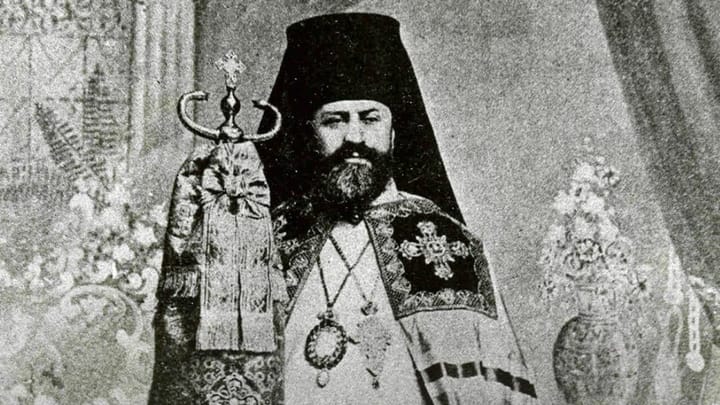
St. Raphael of Brooklyn showed that Orthodox Christians could fully embrace America without compromising their faith.
ENGLEWOOD, NJ — As the United States marks the 250th anniversary of its founding, His Eminence Metr. Saba is calling Orthodox Christians to reflect on the legacy of St. Raphael of Brooklyn, whose missionary vision helped establish Orthodox Christianity in the United States.
In an essay published as part of the "America at 250: Orthodoxy in a New Homeland" initiative, Metr. Saba described St. Raphael as uniquely equipped to serve the diverse Orthodox immigrant communities arriving in North America at the turn of the twentieth century. Born in Damascus and educated across the Orthodox world, St. Raphael brought linguistic ability, cultural adaptability, and missionary zeal to his ministry among immigrants from Greater Syria and beyond.
Metr. Saba recounted being deeply moved by a historic photograph taken during the 1920 consecration of St. Nicholas Cathedral in Brooklyn. Rather than displaying a mixture of ethnic flags, the cathedral was adorned exclusively with American flags, reflecting the desire of early Orthodox immigrants to embrace their adopted homeland while preserving their ancient faith. Metr. Saba suggested that this balance of fidelity and adaptation characterized St. Raphael's ministry as well.
"St. Raphael’s ability to move between cultures and to draw on the best of Orthodox customs makes him a model for our own time," the Antiochian hierarch writes. "He could speak to people in their own language and understood their traditions because of his life experiences, while also encouraging them to adapt to their new homeland. He upheld the teachings of the Church with vigor and protected his flock from ravenous wolves, while adapting to the realities and norms of the American experience without compromising the faith."
St. Raphael traveled extensively throughout the United States, Canada, and Mexico, ministering to isolated Orthodox communities and encouraging the establishment of new parishes. Recognizing the rapid growth of these communities, St. Tikhon of Moscow, with the blessing of the Patriarchates of Moscow and Antioch, oversaw St. Raphael's consecration as bishop in Brooklyn on March 13, 1904, making him the first Orthodox bishop consecrated on American soil.
Metr. Saba argued that St. Raphael's example remains relevant today because he successfully preserved Orthodox doctrine and tradition while embracing the realities of American life. He concluded that contemporary Orthodox Christians should honor the sacrifices of the Church's early missionary pioneers and continue cultivating the faith they planted, welcoming new generations of believers into the life of the Church.
"What, then, can we learn from St. Raphael’s life as we celebrate 250 years of the American democratic experiment? We should be deeply grateful for figures like St. Raphael who cultivated the seeds of Orthodoxy in America," His Eminence writes. "Just as American citizens look to the founding fathers of our nation and to the sacrifices they made to build a stronger and better country, so too should we should look to our own 'founding fathers,' of Orthodoxy in America, learn from their witness, and make it our own. We must continue to nurture what has grown from their early labors, even as we welcome those who now embrace the Holy Orthodox Faith by choice."
Previously, the UOJ reported that Metr. Saba returned to Ontario and visited a future monastery site.
Read also