History and Culture
The Extraordinary Life of Bp. Basil Rodzianko
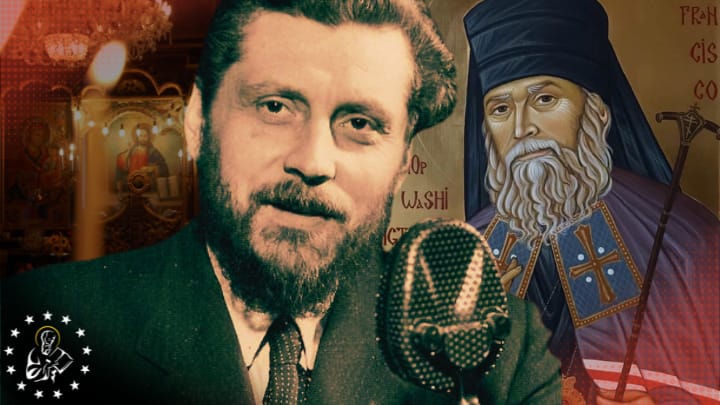
Unless you’ve read the book Everyday Saints by Metr. Tikhon of Pskov, you probably haven’t heard of Bp. Basil Rodzianko. And that’s a shame. Rodzianko is one of the most compelling and admirable figures in the history of the Orthodox Church under
Unless you’ve read the book Everyday Saints by Metr. Tikhon of Pskov, you probably haven’t heard of Bp. Basil Rodzianko. And that’s a shame. Rodzianko is one of the most compelling and admirable figures in the history of the Orthodox Church under Soviet rule. He formed a bridge between the “catacombs Church” and the Moscow Patriarchate. He also spent time in the United States, leaving an indelible mark on American Orthodoxy.
Bp. Basil was born Vladimir Mikhailovich Rodzianko on May 22, 1915, at his family’s estate of Otrada in Ekaterinoslav. The Rodziankos were an aristocratic family: his grandfather, Mikhail Rodzianko, served as President of the Imperial Duma under Tsar Nicholas II.
The Bolshevik Revolution forced the family to emigrate in 1919–1920. They settled in Yugoslavia, a hub for Russian émigrés. Vladimir attended the First Classical Russian-Serbian High School in Belgrade, where he encountered key Orthodox figures, including Metropolitan Anthony (Khrapovitsky) and the future St. John (Maximovich) of Shanghai and San Francisco; the latter became his spiritual father. He earned a theological degree from the University of Belgrade and pursued postgraduate studies in London.
In 1937, he married Maria Kolubayev; the couple had a son. In 1941, Vladimir was ordained to the diaconate and priesthood in the Serbian Orthodox Church, and served parishes in northern Yugoslavia. In 1949, communist authorities arrested him for “illegal religious propaganda.” He endured imprisonment before release and eventual relocation.
Fr. Vladimir became widely known through religious radio broadcasts. For over forty years, his programs aired via the BBC, Radio Vatican, the Slavic Gospel Association, and the Paris-based Voice of Orthodoxy, reaching listeners across the Soviet Union. These broadcasts offered spiritual nourishment, Scripture, and encouragement during decades of state atheism, making him a significant voice for Orthodox Christianity in the late 20th century. He also lectured extensively on Russian spirituality and Orthodoxy.
The family faced personal tragedies, including the loss of a child. Then, in 1978, Vladimir lost his wife. In 1979, at age 64, he was tonsured a monk in England by Metr. Anthony (Bloom), who had became his spiritual father following the death of St. John. Metr. Anthony gave him the name Basil, in honor of St. Basil the Great. Immediately thereafter, he was received into the Orthodox Church in America (OCA) from the Moscow Patriarchate.
On January 12, 1980, Fr. Basil was consecrated Bishop of Washington, DC, as auxiliary to Metr. Theodosius. Later that year, he became Bishop of San Francisco and the West, serving until his retirement in April 1984. His episcopacy faced challenges. In an age when some voices in the OCA called for various “reforms”—including the relaxation of moral teachings and more lay participation in church governance—Basil was viewed as a bishop of the old school, confident in his own authority and committed to preserving Holy Orthodoxy pure and undefiled.
In retirement, Bp. Basil remained active in the capital. He served at St. Nicholas Cathedral, supported Russian immigrants, and continued his broadcasting work through the Holy Archangels Orthodox Christian Broadcasting Center (later the Holy Archangels Foundation). He visited Russia in 1981, where he was warmly received by those who had long admired his radio ministry.
One of Bp. Basil’s greatest contributions to the modern Church, however, was his work promoting the Romanov cause.
As we said, Basil’s grandfather had served as Duma president under Tsar Nicholas II. In fact, it was Mikhail who convinced Nicholas II to abdicate his throne—not realizing the Tsar would abdicate on behalf of his son and heir, Alexey, as well. Mikhail bitterly regretted his counsel for the rest of his life and died blaming himself for the fall of Russia’s ancient monarchy. Following his episcopal consecration, Basil publicly repented for the involuntary sin of his ancestor; he invoked his authority as a bishop to absolve Mikhail of that sin.
When Basil traveled to Moscow, he was identified by a group of “royalist” clergy—including Metr. Tikhon—as a worthy proponent of the Romanovs’ cause. Basil was technically an American citizen, meaning the KGB would have less power over him than they would a Russian bishop. He was also a courageous pastor who was (clearly!) willing to suffer for his convictions. When they approached Bp. Basil about their scheme, he accepted joyfully.
Basil then spent some time traveling in Russia, offering services in honor of the Royal Martyrs. He did so in Old Church Slavonic, ensuring that his KGB minders wouldn’t understand. In this way, an “American” bishop helped lay the foundation for the Romanov cult in Russia!
Bp. Basil reposed in the Lord on September 17, 1999, at age 84, in his Washington apartment chapel, just before he was to receive American citizenship. May God remember him forever in His kingdom!
Read also