History and Culture
Fairy Tales Are Orthodox
“How monotonously alike all the great tyrants and conquerors have been; how gloriously different are the saints.” — C. S. Lewis
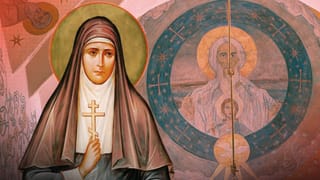
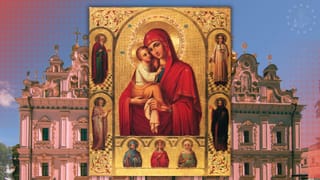
Metr. Anthony Bloom (of blessed memory) made an interesting observation. He said that the closest thing the West had to iconography was the political cartoon. Like an icon, the political cartoon has no sense of “realism.” A work of “realist” art focuses more on those things we have in common. Michelangelo was more interested in the human body, for instance, than in King David’s human body. With a political cartoon—as with an icon—the opposite is true. The details common to all human beings are represented symbolically; the focus is on what makes each figure unique. It might be Donald Trump’s signature quaff or his too-long ties. It might be St. Mary of Egypt’s collar bone or St. Seraphim’s white robe.
This speaks to the deep personalism of Orthodox Christianity. I know the word “personalism” has many meanings, but I use it here simply to mean that it emphasizes the individual person, the unique hypostasis. We say that as a man grows in holiness, he becomes more Christlike. That doesn’t mean that he loses all those qualities that make him unique. He’s not called to imitate Christ in a superficial way, by growing a beard and wearing sandals! On the contrary. God knits each of us in our mother’s womb (cf. Psalm 139:13). He gives us a unique identity—a unique set of traits and talents—as original as our fingerprints. To grow in holiness simply means to become the men and women that God made us to be.
To put it another way, they show that theosis (deification) does not mean being collapsed into a single monad. This would be a sort of modalist idea of theosis. The retention of the individual hypostases—and the glorification that it achieves in the unbreakable union of God’s love—is modeled in the Holy Trinity. Indeed, personalism is closely related to trinitarianism.
As with individuals, so too with nations.
We often hear Protestant and Catholic friends say, “I’m just too Western for Orthodoxy.” Sometimes, this stems from a misplaced conservatism. Often, though, it comes from a very natural—we might even say a Trinitarian—desire to ensure that the particular is not annihilated. We (rightly!) feel that what makes our people unique will not be absorbed and erased but instead transfigured, perfected.
This is nothing new. It’s as old as Christianity itself. Take, for instance, the strange mixture of themes in Beowulf. It’s a pagan story that was written down and “canonized” during the Dark Ages, when the Church was taking her first, furtive steps into the Northland. But it does not depict a paganized Christianity, or even a Christianized paganism. Rather, it’s a sort of metanarrative about the conversion of the Northmen.
In this sense, Beowulf is like a chapter of the Anglo-Saxons’ conversion story. Their understanding of Christianity is far from perfect, but they’re absolutely moving in the right direction. And we know that the glories of British Christianity flowers from these first seeds that pierced the frozen earth.
As Orthodox Christians, it’s important that we keep these stories. They serve for us a purpose not unlike the Confessions. Blessed Augustine’s sins were forgiven. He died with Christ in Holy Baptism and rose again to eternal life. But when the Old Man dies, he isn’t replaced by a Different and Better Man. No: the Old Man is re-newed. The Lord didn’t say, “Behold, I make all new things.” He said, “Behold, I make all things new” (Rev. 21:5). The continuity of the Old and New Man—the transfiguration of the hypostasis by uniting it, by love, to God—gives glory to the All-Holy, Consubstantial, and Life-Creating Trinity.
Again, as with individuals, so with nations.
Russia died in A.D. 998, in the waters of the Dniper, and rose again on the far bank. In the centuries following the conversion of St. Vladimir, Russian fairy tales underwent a “Christianization” of their own. Most of the changes don’t change the plot: characters are seen going to Church, making the Sign of the Cross, etc. Others, however, are rather profound. For example, Baba Yaga is changed from a morally neutral figure—a guardian of the deep woods—to an evil witch. This is how Russians internalized Scripture’s warning, “The gods of the nations are demons” (Psalm 95:5). As Christians, they had to rethink their relationship with Baba Yaga; yet they couldn’t simply forget her without ceasing to be Russian. For better or worse, she was—is—their “grandmother.”
Likewise, the heroes of Slavic folklore all become Christian heroes (“And Ilyusha rode the shoulders of his godfather Mikula as he showed him the wonders of his glorious Rus. There he pointed out the gables and crosses of Kyiv, there, the towers and domes of Novgorod the beautiful…”). The moral of the tales also come to echo the Gospel (“Which princess is the bride for me? The one who used me to buy pretty things, or the one who used pretty things to buy me?”).
Because they speak to the “personality” of the Russian people, these fairy tales tell us a great deal about the unique form of Orthodox Christianity that grew up in the Slavic lands. In fact, we may go further: it’s impossible to understand Russian Orthodoxy without understanding Russian fairy tales. Take, for instance, the enduring—and uniquely Russian—figure of Mother Earth. As George Fedotov wrote in The Russian Religious Mind,
In Mother Earth, who remains the core of Russian religion, converge the most secret and deep religious feelings of the folk. Beneath the beautiful veil of grass and flowers, the people venerate with awe the black moist depths, the source of all fertilizing powers, the nourishing breast of nature, and their own last resting place. The very epithet of the earth in the folk songs, “Mother Earth, the Humid,” known also in the Iranian mythology, alludes to the womb rather than to the face of the Earth. It means that not beauty but fertility is the supreme virtue of the earth, although the Russian is by no means insensible to the loveliness of its surface. Earth is the Russian “eternal womanhood,” not the celestial image of it: mother, not virgin; fertile, not pure; and black, for the best Russian soil is black.
As Fr. Andrew Louth notes, Dostoyevsky had a devotion to the Humid. This is evident when Elder Zosima cries: “Love to throw yourself down on the earth and kiss it. Kiss the earth and love it, tirelessly, insatiably, love all men, love all things, seek this rapture and ecstasy. Water the earth with the tears of your joy, and love those tears.”
Again, both in “high” Russian theology and in the popular religious imagination, the Black Mother looms large. We couldn’t understand her without understanding Slavic folklore, because she’s more than a thousand years old—much like Russia itself.
Ivan Ilyin put this wonderfully when he spoke about “the spiritual meaning of the fairy tale”:
It’s like a refined and sweet-smelling honey. If you drip it on your tongue, you’ll taste all the ineffable essence of Russia’s nature—the smell of the earth, the heat of the sun, the fragrance of flowers, and something else that is subtle and rich, something eternally youthful and yet eternally ancient. All this, in its ineffable taste and smell.
This fragrance has accumulated over hundreds of years inside the soul of people, inside Russian souls that have invisibly flowered and wilted on the plains of that wide land. The Russian fairy tale conceals within itself hundreds and thousands of years of its people’s spiritual experiences. The history of the Russian people is only one thousand years old; however, the age of a nation isn’t limited to the memory of its history. After all, one thousand years ago, Russia only awoke to itself and began to think of itself as a nation, and only after it was baptized.
Dear reader, let me be clear: I am not trying to convince you that you should want to read fairy tales. You know as well as I do, the desire is already there. You want so badly to throw yourselves into these strange and wonderful stories. You’re already fascinated and delighted by what little you’ve seen. Just from glancing at a drawing by Ivan Bilbin, you know that what Professor Ilyin says about the spiritual experiences of hundreds and thousands of years—it’s all true. The only thing holding you back are the voices of certain puritans who say that Orthodox Christians shouldn’t read such stories.
Don’t listen to them.
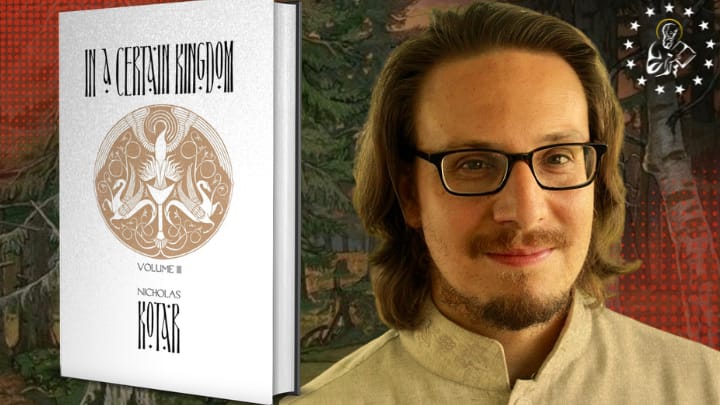
All of the above quotations (except those of Fedotov and Louth) are taken from the work of my friend Nicholas Kotar, America’s leading champion of Slavic folklore. If you’re not familiar with Dcn. Nicholas, I highly suggest you watch his conversation with Matt Fradd on Pints With Aquinas and read the interview he gave to the UOJ. All of his works—including his magnificent compilations of Russian fairy tales—are available on Amazon and through his publishing house, Waystone Press. Buy two copies of everything; keep one and give the other to someone you love very much. Read them to your children, to your grandchildren. Read them to your husband, your wife, your mother, your father, your next-door neighbor.
Let me make one final point. Fairy tales, as we’ve seen, belong to the humanity’s childhood. They are primordial stories. And while the tree itself continue to grow new leaves and branches, the tree itself is unfathomably ancient, and its roots stretch deep down into black earth.
C. S. Lewis dedicated The Lion, the Witch, and the Wardrobe to his goddaughter. “I wrote this story for you,” he said, “but when I began it I had not realized that girls grow quicker than books. As a result you are already too old for fairy tales, and by the time it is printed and bound you will be older still. But some day you will be old enough to start reading fairy tales again.”
There is something to this. Fairy tales are for the very young and the very old—for the new and those who have been made new. Maybe this is what the Lord meant when He said that, unless we become as little children, we won’t enter the Kingdom of Heaven (cf. Matt. 18:3).